

by Kevin McLaughlin
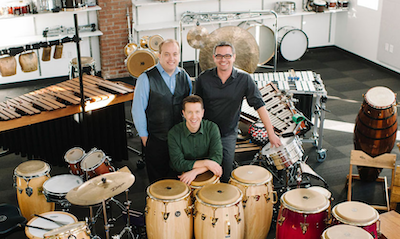 On Monday evening, January 26 at West Shore Unitarian Universalist Church, the Rocky River Chamber Music Society offered listeners a kind of gentle shock: a stage transformed into what looked like a percussionist’s greenhouse — a whole garden of instruments, some recognizable, many not, brightly colored and often hard to name.
Africa → West Percussion Trio (Jamie Ryan, Ryan Korb, and Josh Ryan) made an evening out of that abundance, blending West African and Afro-Caribbean traditions with their Western classical and jazz training. The playing was expert, but the trio’s real gift was making the unfamiliar feel accessible — and joyful.
Josh Ryan, faculty percussionist at Baldwin Wallace University, served as guide and translator. His explanations of traditions, instruments, and the music were genial and patient, never stiff in the way lecture-concerts can be. Beforehand, an audience member described to him the effect of the percussion array: “joy.” Ryan seemed momentarily taken aback — reminded of what all the logistics and performance are about.
Africa → West, an ensemble-in-residence at Baldwin Wallace, has lived with this repertoire for years — not as a museum project, but as a means of communication. And while the trio’s stated mission is fusion — Ghana to Cuba to the United States and back again — the most convincing moments came when those threads sounded less like “influences” than a shared musical logic.
Jamie Ryan, who sat center stage behind congas, sang in call-and-response style for the opening Eshu La Roye (2008), described by his brother as music associated with the Lucumí deity Eleguá. The trio’s rhythmic architecture turned on threes — a nod to Eleguá’s symbolism — and moved through steady accompaniment patterns and crisp unison breaks before slipping, as the program notes put it, into a songo-rumba undercurrent, a subtle salute to the songo innovator Batacumbele. Fortunately, you didn’t need to track every reference to feel the shape: song became groove, groove became a small ritual.
A pair of movements from the group’s Lobi Variations (2007–08) offered a different kind of pleasure — less overtly festive, more compositional. “Darkpey/Shambelle Variations for Kakraba Lobi” fused a Dagara funeral style with a quotation from Police guitarist Andy Summers’s “Shambelle.” Josh Ryan played the gyil, a large mallet-keyboard instrument from northern Ghana positioned at the front of the stage. The alternation between fast, polyrhythmic intensity and the somber “Shambelle” texture gave the music its expressive bite.
Turning up the heat before intermission was Tribute to Caravan (2002), Africa → West’s homage to the Duke Ellington/Juan Tizol vehicle — and more specifically, to the drummers who made Caravan a traveling laboratory: Art Blakey, Max Roach, Sam Woodyard, Jeff Hamilton. The program described it as a study in how percussion can “speak” in dialects — jazz ride patterns, Afro-Cuban languages, West African timbres. The performance made the metaphor stick: you heard intonation, vowels, and speech rhythms. And the nod to Blakey came through clearly in sudden, attention-grabbing outbursts on deep-voiced drums.
After intermission, Makuta (2007) deepened the idea of shared ancestry. The trio’s concept, reuniting Cuban/Congolese material with “long-lost cousins” from West Africa and U.S. popular drumming, invites skepticism. These are the kinds of pairings that can feel like collage. But in performance they were meshed and inevitable, especially in the way the gyil, drum set, batá, and congas all spoke through the music’s organizing rhythmic pattern. The piece’s cross-references to Steve Gadd, the legendary studio drummer, and folkloric vocabularies, felt less like citations than family resemblance.
The latter half revealed the trio’s faith in classical form as much as groove. In Afro-Cuban music, clave is a short repeating pattern, a two-bar rhythmic “key” that keeps everything oriented. Ochún (2003) began with a fugue composed “in clave,” bringing Bach into conversation with Afro-Cuban organizing principles. The fugal subject began as rhythm, passed from instrument to instrument, then gradually opened into freer episodes. It was an unusually successful hybrid. Neither classical form imposed on folkloric material, nor a drum piece dressed up in counterpoint, it was a single musical argument.
The program concluded with Yambúsawa (1999), a group mission statement in miniature, moving from slow Cuban yambú (a relaxed rumba) into Ghanaian material (a proverb stated in rhythm and then chanted) before launching into a fast Gahu, (an Ewe-style dance section) with a highlife-inflected drum set solo. The shifts were abrupt by design — changes of orchestration, changes of rhythmic feel — though the thread never broke. If anything, the ending acted as a final release: dance music, where moving the body is the point.
Part of the trio’s achievement was technical: so many instruments, so many traditions, handled with the calm of musicians who have done the work. But the larger achievement was communication. In their speaking from the stage and in their playing, the trio presented African and Afro-Caribbean traditions as living languages — and trusted the audience to hear them.
Published on ClevelandClassical.com February 4, 2026
Click here for a printable copy of this article
