



by Hannah Schoepe
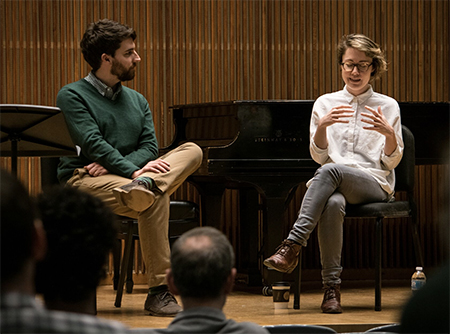 How are your compositions formed? How do you balance judgement with unhinged creativity? What is the most profound advice you can offer students today? Those were a few of the questions posed to the Pulitzer prize-winning composer and Roomful of Teeth member Caroline Shaw during an insightful Q & A session Thursday afternoon, February 16 in Oberlin’s Kulas Recital Hall.
During the session Shaw addressed her compositional process, as well as her creative sources of inspiration. She began by playing an excerpt from her recently composed string quartet Valencia. With its simple lines and ethereal harmonics, the piece grabbed the audience’s attention immediately. When asked about the work, Shaw affirmed her love for simple layers in her music. She said, “I like to create a ‘room,’ a musical space where people can walk around but don’t get lost.” Continuing on a humorous note, she said most listeners assume there is a connection between the quartet and Valencia Spain, when in fact the genesis of the work was derived from the beauty of a valencia orange.
Shaw delved into her experiences with Baroque and Renaissance music and how she loved the vast repertoire of those periods as well as the sense of freedom brought through ornamentation. She recalled singing the music for the first time, and the wonderfulness of that experience, both musically and physically.
How much detail does she include in her scores? While she appreciates the artistry of an intricately annotated score, she likes to leave interpretational room for the performer. “What makes me feel most alive as a performer is the freedom to shape. Baroque music literally only has a few markings along the lines of strong and soft. What happens in between those is entirely up to the performer.”
A student asked, “Do you experience fear of being judged, and if you do, how do you keep that from impeding your artistic process?” Shaw said “The important thing is inviting people in. It’s cripplingly frightening if people are not 100% on board, but very encouraging and exhilarating when they are. Sometimes the idea of judgement is also all in your head.”
Regarding her sources of inspiration, Shaw said, “Sometimes it’s a game of sorts that bounces around in my head. Sometimes it’s like writing a short story, although it doesn’t have to be a narrative.”
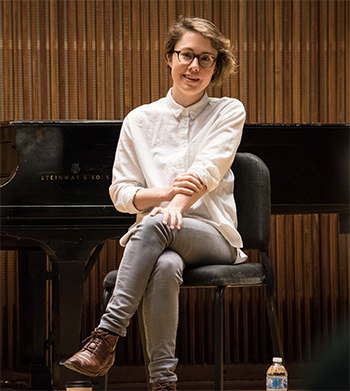 When asked why she does what she does, Shaw pondered for a moment. “Because I think music and performing is important,” she said. “My music is not political, but I’d like to start experimenting more with text as a method for approaching more difficult subjects.” She continued by saying that “trust is a big thing when working with people. Appreciate all the people that participate in making something happen. Appreciate the person who puts the chair on the stage.”
What advice she offer to college students? “Make music with your peers. Establish that common language, find that empathy for fellow musicians. These relationships will be more influential for your future then you might realize.”
Approaching the end of the session, Shaw was asked what it means to her to be a member of Roomful of Teeth She answered with a smile, “Being in Roomful of Teeth is so great. Creating music with people who continually put energy into the ensemble is a lot of fun. I hope to see more junior members in the future.”
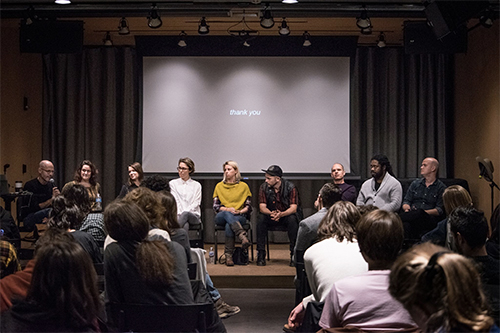 Later that evening at the Birnbaum Performance Space, astounding vocal techniques, amazing sound effects, and a diverse range of folk styles defined Roomful of Teeth’s composition forum. The ensemble touched on their experiences of studying Tuvan throat singing, Inuit throat singing, Broadway belting, Persian classical singing, and Korean p’ansori, among other vocal techniques. As the evening unfolded, the forum evolved into an engaging combination of lecture and demonstration.
The session began with a demonstration of “Allemande,” from Caroline Shaw’s Pulitzer prize-winning Partita for 8 Voices. It begins with an unconventionally spoken text which is passed between each singer. This is followed by a jubilant melody as the piece finally breaks into its harmonic content. Showcasing perfect intonation, “Allemande” provided a beautiful mixture of contemporary ideas and accessible tonality. The performance created a haunting ambience, making the audience marvel at the variety of human vocal sounds.
Gregory Ristow, director of vocal ensembles at the Oberlin Conservatory, and Brad Wells, Roomful of Teeth’s artistic director, began the discussion with an introduction to the Grammy-award winning ensemble. The conversation quickly turned to yodeling, the first vocal technique the group ever studied together.
Moving to Mongolia, the conversation turned to Tuvan throat singing. The grumbly depths of this technique create impressive sound effects. To combine this concept with yodeling, the group performed snippets of Judd Greenstein’s The Road to Montmartre, which creatively combines both elements.
After a discussion of classical Persian singing, Indian Hindustani and Korean p’ansori were introduced. The aggressiveness of p’ansori was particularly noteworthy. The vigor of the technique combined with the long durations of p’andori works prompted Teeth member Thann Scoggin to talk about injury prevention. The ensemble performed “Sarabande,” from Partita, which was inspired by the “scooping sensation” p’andori utilizes for transitions between chords.
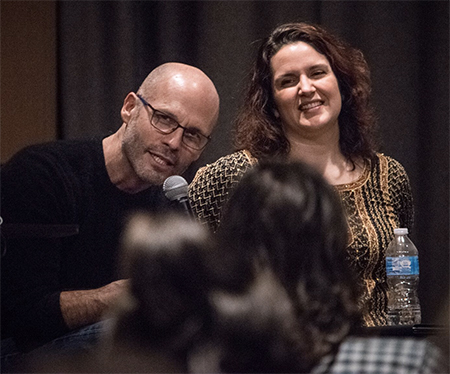 The evening then moved to the Arctic for Inuit throat singing, which produces a wheezy, slightly grumbly effect. In its most archaic form, it involves a type of game where two women sit across from each other and breathe in rapid succession. One breathes out, while the other breathes in and the first person to miscalculate a rhythm or a vocal effect loses that round of the game. “Courante” from Partita proved to be an exhilarating example of this technique.
The lecture moved from the cold winds of the north to the heat of Sardinia with a brief explanation of Cantu. This style finds one person singing nonsense syllables while the other sings a text. The final stop on the world tour stop was Bulgaria with an explanation of Bulgarian Belting or Bulgarian women’s chorus style.
Bringing the evening to a close, an audience member asked what other types of singing the group would like to pursue in the future. Brad Wells laughed, hinting that the audience should keep their ears open for various forms of Southeast Asian singing, as well as a type of Malawi folk singing that he is battling to learn before it reaches a point of extinction.
Photos by Julie Gulenko.
Published on ClevelandClassical.com February 23, 2018.
Click here for a printable copy of this article