

by Kevin McLaughlin
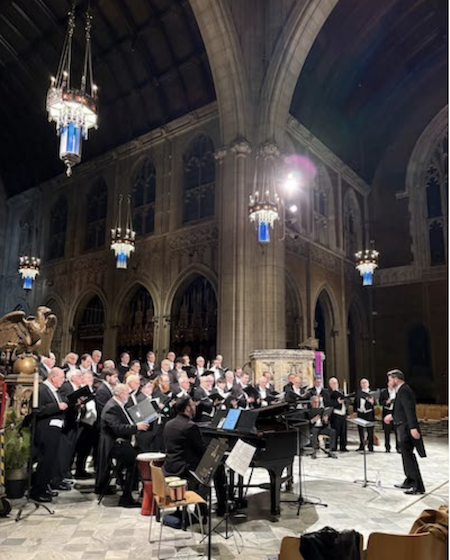 The Singers’ Club of Cleveland brought the joy of the season to Trinity Cathedral on Tuesday evening with a program titled To Dwell in Harmony, a holiday offering both polished and good-humored. The venerable all-male chorus — whose lineage stretches back to 1891 and includes collaborations with conductors from Beryl Rubinstein to Robert Shaw — now finds itself under new leadership.
Christopher Clark, appointed in August as Artistic Director (while serving concurrently as Director of Choirs at Case Western Reserve University), led his first Singers’ Club concert with easy command. The chorus appeared to trust him from the first downbeat, and the audience received him just as warmly.
Trinity Cathedral, whose acoustics can flatter or expose a chorus in equal measure, proved an asset. The evening opened with one of its most effective moments: Veni, Veni Emmanuel in John Englert’s arrangement. Clark placed the choir on three sides of the audience, creating a surround-sound of chant that was silky and assured — a confident beginning.
Lighter fare followed. Patrick Quigley’s Wassail! spotlighted three exceptional soloists — Ryan Smith, Noah Whitaker, and Kevin Psolka-Green — and warmed the room with its convivial air. Dan Forrest’s Angels We Have Heard on High offered a spotlight for pianist Ben Malkevitch, who dispatched some brilliant filigree, answered in kind by the chorus in Forrest’s extended “Gloria” refrain.
Behold How Good, by Michael John, bore the evening’s most personal dedication, to the recently deceased father of Executive Director Tricia Bohanon. Michael Gross and Rob Alston, both light tenors, sang their parts with clarity and restraint.
The intermission came quickly — after less than half the program — and stretched on longer than expected, leaving the room in a mild, puzzled hush.
But the center held and the choir began the second half as it had the first — beautifully, and by invoking tradition. Arcadelt’s Ave Maria showed the group at its best: clean, well-shaped lines, sensitively tuned, and a steadiness suited to music that requires unanimity more than display. Assistant Conductor Will Davis then led a vigorous reading of Masters in this Hall, with solo contributions from Alston, Psolka-Green, and Hans Holznagel (a Männerchor name if ever there was one).
Dan Forrest returned to the program as composer of See, Amid the Winter’s Snow, producing one of the most blended, settled sonorities of the night. Chuck Bridwell’s Various Themes on “Fa-La-La” let the chorus lean into seasonal playfulness. Snatches of William Tell, Beethoven’s Fifth, The Blue Danube, and the 1812 Overture slipped into the fa-la-la refrains, and one young singer in a Santa hat bobbed his head for a touch of show-choir mischief.
Not everything stayed perfectly in hand. Diction grew tangled in Wilhousky’s Carol of the Bells as the tempo pressed and the texture thickened. But the group recovered its footing with Lefevbre’s Good King Wenceslas, which Clark introduced, without exaggeration, as a “banger.”
The closing set, Jay Althouse’s A Swingin’ Christmas, moved with a warm, easy gait, folding together Walking in a Winter Wonderland, I’ll Be Home for Christmas, and Santa Claus Is Comin’ to Town. The finale, Timothy Takach’s We Wish You a Merry Christmas, added some light percussion — triangle, bongos, and Malkevitch on djembe — and the two clean obligato tenor lines from Will Davis and Chris Tipton were icing on the Christmas cake.
The evening suggested a chorus mindful of its past yet ready for a new chapter. Clark’s debut showed a steady hand and a commitment to lifting the group’s work, and Davis’s brief turn at the podium confirmed the Club’s deep bench.
As holiday programs go, it was a sincere, generous offering — a short pause in which to dwell in harmony and cheerful company.
Published on ClevelandClassical.com December 11, 2025
Click here for a printable copy of this article
