



by Stephanie Manning
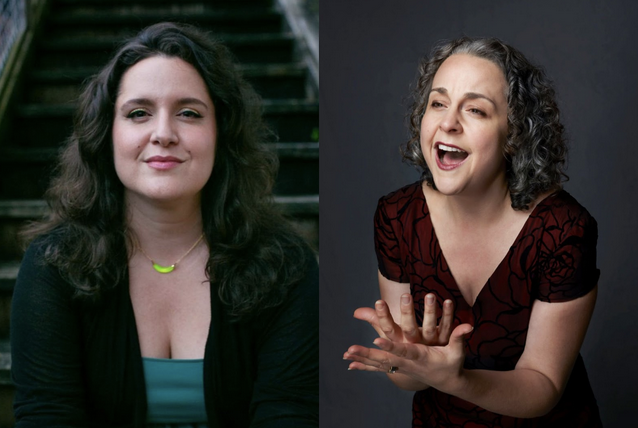 The Venn diagram of performers who love early music and those who love new music is closer to a circle than one might think. Take soprano Estelí Gomez, who is as likely to appear on a Baroque program as she is on a contemporary one.
“One of the reasons people love doing both is that the composer has a lot of excitement for and trust in the performer,” Gomez said in a recent interview.
From the composer’s perspective, that idea of artistic freedom is “wonderfully liberating,” Gilda Lyons said in that same Zoom call. While research is important, “I’m never going to know as much as the performers do about their specific instrument. So I’m going to leave space for them to be the artists that they are.”
The composer and soprano are putting that type of collaboration into practice with Lyons’ Soy La Diosa, which will be premiered by Les Délices on February 28 and March 1. The commission, which marks the second of three installments in Les Délices’ Mythology Project, is programmed together with 17th & 18th century music from Latin America. Click here to find information about tickets and a free preview event on February 26.
Gomez, a founding member of the Grammy-winning vocal band Roomful of Teeth, is no stranger to performing new music. But when Les Délices artistic director Debra Nagy approached her about being part of the Mythology Project, she saw an opportunity to become much more involved with the commissioning process than usual.
“To be in on the ground floor with the concept was really extraordinary,” she said. Among her priorities: honoring her Nicaraguan roots, celebrating the divine feminine, and welcoming a female composer to the table. The composer position eventually went to Lyons, who was aligned with the project’s values and also shares Gomez’s Nicaraguan heritage.
The resulting work for soprano and early music ensemble, Soy La Diosa (“I Am the Goddess”), centers Latin American folk stories about women and embraces spirituality and sensuality. Some of the women featured in the four movements include the Mayan goddess of fertility Ix Chel and the Guardian of Mombacho. But Lyons said this work is about more than specific stories or people.
The first movement emphasizes that “La Diosa is all around us at all times,” she said. “If we bring that awareness to our surroundings, then we see the creator and the destroyer, we see the eternal and the ephemeral, and we see it all as part of what we live in.”
Lyons’ libretto switches smoothly between Spanish and English, with a roughly 2:1 ratio between the two. “If you only speak one of the two languages, you’re still receiving a complete story,” she said. “Each gives context to the other in a way that carries us forward.”
Performing in both languages resonates strongly with Gomez, whose father is a translator and whose cousin is a professor of translation studies. “Having the languages juxtaposed is really beautiful and thoughtful,” she said. “And I think having that immediacy for the audience is really special.”
She also noted the classical music world has only recently recognized Spanish as a language available to perform in. “A racist tenet of classical music is that we can only perform in certain ‘high art’ languages,” she said. “As a teacher, I really respond negatively to that, especially considering how many of my students love and speak Spanish, regardless of their background.”
Once the composer and soprano arrive in Cleveland and meet in person for the first time, Lyons looks forward to seeing the rehearsal process unfold. “I know I did my job, and now I’m going to come with an open mind and be there to support and lift up my collaborators,” she said. “We’re coming together to make something bigger than any one of us alone.”
Published on ClevelandClassical.com February 18, 2026
Click here for a printable copy of this article
