

by Mike Telin
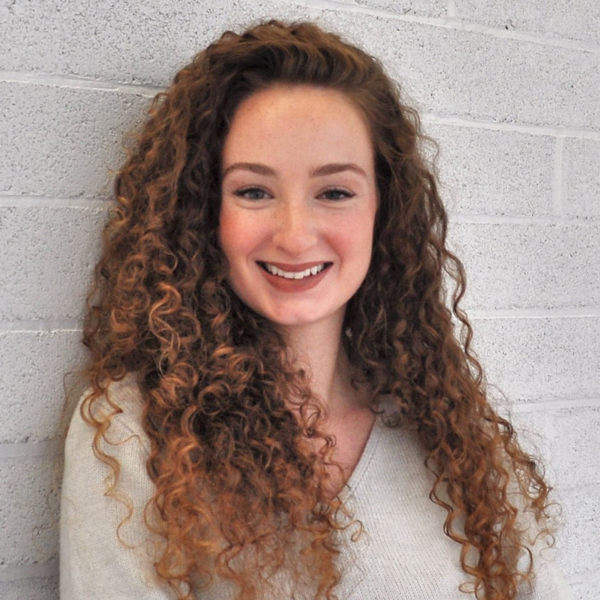 When Allison Hillier was starting her graduate studies at the Cleveland Institute of Music, she needed to find a place that was within walking distance of the school. While apartment hunting in nearby neighborhoods, Hillier found herself walking through Little Italy. “I heard opera coming from restaurants, and I thought this is a really vibrant community. There’s a lot going on,” she recalled during a recent Zoom conversation.
After finding an apartment that she loved, she asked if it was alright for her to bring her piano. “They told me: ‘This is a quiet house, so maybe not. Although we have a commercial space available at the Murray Hill Galleries. Would you like to put your piano there?’ I said, ‘Absolutely.’”
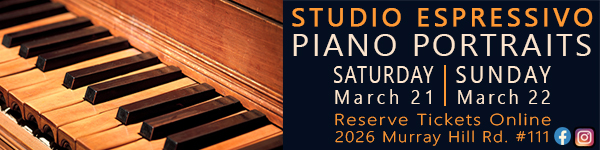
On Saturday, March 21 at 3:00 pm, Studio Espressivo (2026 Murray Hill Road) will present “Piano Portraits,” featuring favorites from Baroque to Modern and hidden Italian gems. The program will be repeated on Saturday at 8:00 pm and Sunday at 3:00 pm. Reserve pay-what-you-wish tickets here.
Hillier opened Studio Espressivo in 2019, first as a teaching space and recital space. “I currently have about 20 students. The youngest is seven years old and I have people well into adulthood who have decided to either start fresh with the piano or to come back to it after learning in childhood.” She added that the recitals provide a way for people “to come together and celebrate their hard work.”
Hillier said the idea of starting a concert series was sparked during a dinner conversation she had with composer and Studio Espressivo teacher, Chris Neiner. “That was something I always wanted to do, but it wasn’t until Chris and I met that it really took off. He asked ‘Do you want to start a concert series?’And I said, ‘Yes, let’s do it.’”
Hillier and Neiner began a series of Sunday Concerts in 2023. “We had around 50 people at the last concert of the first season,” Neiner said during the same Zoom conversation. “So we thought, let’s do a Saturday and a Sunday show. By the time we got to the end of the second season, we were presenting two Saturday shows and a Sunday show. We’ve grown more than we expected, which is great.”
The series programs often spotlight well-known Italian pieces as well as overlooked repertoire. “When I was a student I remember discovering that an Italian had invented the piano and being so surprised about that,” Hillier said. “And that’s where the inspiration for this program came from.”
Piano Portraits traces the history of the piano from its invention by Bartolomeo Cristofori of Padua around the year 1700 to the present beginning with the first movement of J.S.Bach’s Italian Concerto.
“This piece should be familiar to students, or anybody who has studied music,” Hillier said. “Bach was such an important composer not only for classical music, but for pianists. He was certainly aware of the German imitations of the first Italian piano, and that’s how we got the Well-Tempered Clavier. which is such a foundational part of piano history.”
 Neiner noted that on the program, the Italian Concerto will be played in an arrangement for two pianos.“What the Russian arranger Alexander Siloti did is to have a solo piano and orchestra piano that is four hands.” Maggie Johns will play the solo part while Neiner and Hillier will play the orchestra part.
The program also includes Mozart’s popular C major sonata in a version for which Greig provided an accompanying part. “It’s an interesting contrast of styles,” Hillier said. “When Maggie and I were rehearsing I asked her, ‘Do we want to play this more like Mozart, or more like Grieg?’ We went back and forth so I guess we’ll find out at the concerts.”
Hillier and Johns will also play the 18th variation from Rachminoff’s Rhapsody on a Theme of Paganini.
Neiner said that he has always loved Respighi’s Notturno. “The piece is painstakingly beautiful. The way he uses the hands and creates harmonies with a Ravel-like kind of floating-ness. It’s a piece that should be played more often.”
Adding some variety, cellist Brendon Phelps will present two works, the second movement from Boccherini’s Sonata No. 6 in A and Saint-Saëns “The Swan” from The Carnival of the Animals.
Neiner and Hillier will team up for Cécile Chaminade’s Valse carnavalesque. “I’ve slowly become a big fan of her music,” Neiner said “She wrote a lot of music for pianists at every level. Music by women composers is something that I would like to incorporate more of.”
“If you talk about contemporary Italian music, I would say that Ludovico Einaudi is one of the foremost composers at the moment,” Hillier said. “He’s very popular with my teenage students because they hear his compositions on TikTok. I was skeptical at first, especially when my students brought it to me and said, ‘Hey, listen to this TikTok song.’ But there’s something about it that draws people in. I think putting Experience on the program will resonate with people. They’ll recognize it from something they’ve heard online.”
Piano Portraits will conclude with Gaetano Corticelli’s Gran Sonata brillante, Op. 12 for two pianos, eight hands. “It’s an obscure Italian sonata that’s adorable,” Neiner said, adding that you would never know about it unless you went to IMSLP and searched for two pianos, eight hands.
“I’m not even sure a recording of the piece exists,” Hillier said. “So it’s new for us and it has been so much fun to put together.”
Making classical music fun, relevant, and welcoming is what Hillier and Neiner strive for with the series. “So much of the time classical music is you show up, they play for you, you clap, they leave, you leave, and you never have a conversation,” Neiner said. “So we have a little bit of speaking before each piece that tells people why we have chosen a piece, what the significance of it is, and what it means to us.”
Hillier said that the audience reception has been great. “Oftentimes people will come up afterwards and say how helpful it was to hear about a piece and why it’s on the program. It’s a learning experience — people walk away from the concerts knowing more than when they came in.”
Published on ClevelandClassical.com March 18, 2026
Click here for a printable copy of this article
