



by Peter Feher
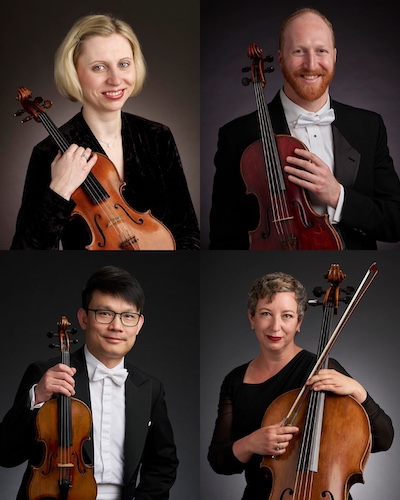 The Taplin Quartet, Cleveland’s newest chamber ensemble, gave its first local performance this month — and at the same time traveled to Europe, Asia, and Oceania. In fact, the group’s world tour brought along the entire audience at Dunham Tavern in Midtown on Sunday afternoon, February 8.
“From East to West,” the Quartet’s debut program — presented as part of Heights Arts’ Close Encounters concert series — took listeners on a musical trek across three continents while never straying too far from home.
It helped to be embarking with four familiar guides. Violinists Katherine Bormann and Zhan Shu, violist Gareth Zehngut, and cellist Martha Baldwin are all Cleveland Orchestra members, and together as the Taplin, they have the advantage of a shared starting point.
The skills essential for great orchestral playing — rhythmic precision, interpretive clarity, and a quick ability to adapt — were also what kept the Quartet confidently on course during Sunday’s performance.
The program’s chief destination was Paris by way of Claude Debussy’s String Quartet, Op. 10. In the City of Light, Debussy is as unmistakable as the Eiffel Tower, though this early work is altogether less traversed and well worth exploring. The score’s sensuous attention to detail is innately French, yet, like many of the painters and poets of his day, Debussy’s inspirations ranged from Western Europe to the Far East.
Wherever it led, pleasure was the principal pursuit — and as usual, Debussy offers plenty of it. His String Quartet assigns every player a prominent role, which makes for a wholly satisfying ensemble experience.
From the opening down-bow, Bormann’s bravado on first violin was matched by her colleagues, who came increasingly to the fore in each subsequent movement. Zehngut introduced the slinking theme of the scherzo, Shu set a hushed tone for the Andantino, and Baldwin perfectly paced the shifting tempos throughout the finale.
The rest of the concert followed a more rugged route, beginning with an arrangement of the Australian tune “Waltzing Matilda” that went from simple fiddling to full-on hoedown in just a few minutes. Here was a selection to confound any stable concept of East or West and to prove that the spirit of a nation has little to do with its position on the map.
But how do you explain finding the same folk stylings thousands of miles away on the Mongolian steppe? This was the conundrum posed by Lei Liang’s 2006 composition Gobi Gloria, inspired by the oral traditions of a landlocked culture. In brilliant flashes of extended techniques, Shu, on first violin, led the ensemble in uncovering the common ground that music occupies across space and time.
Between these two pieces, a delicate arrangement of Debussy’s “Clair de Lune” sounded slightly out of place — not least because it left the strings to navigate the intonation-unfriendly key of D-flat.
The conclusion of the program sought a similar effect but with greater success, capturing the sweetness and sentiment of the traditional Chinese song “Jasmine” and preserving the moment as a souvenir.
Published on ClevelandClassical.com February 19, 2026
Click here for a printable copy of this article