


By Mike Telin
 When the Osa Festival in Voss, Norway commissioned Norwegian composer and accordionist Frode Haltli to write a full concert-length work, he knew he wanted to compose a piece that would combine the improvised qualities of traditional Scandinavian folk music with classical, notated music. “From Edvard Grieg on, a lot of Norwegian composers have been interested in traditional music, and used it as a source of inspiration,” Haltli said during a telephone conversation from Norway.
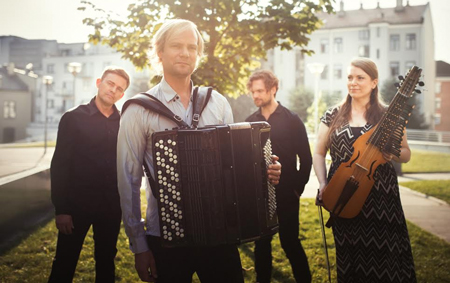
On Wednesday, March 29 at 7:30 pm in Gartner Auditorium, the Cleveland Museum of Art will present Frode Haltli’s The Border Woods (Grenseskogen). The performance will feature Frode Haltli (accordion), Emilia Amper (nyckelharpa), and Eirik Raude (percussion).
“I love the sound of the nyckelharpa,” Haltli said, “and Emilia is one of the great folk musicians in Scandinavia. I adore her playing and her approach to traditional music, so I wanted to write something that she could play as freely as she plays folk music. I didn’t want to score every detail, I wanted her to add her own touch to it.”
Emilia Amper holds Haltli in equally high regard. “Frode is so amazing. The first time that we played together we clicked right away,” Amper said via Skype from her home in Sweden. “He’s creatively used so many musical inspirations in the piece, because he is such a virtuoso player of contemporary classical music, experimental, and folk music.”
The first time Haltli combined contemporary classical and improvised folk music was in his 2007 recording, Tossing Images, but he said that The Border Woods takes what he did on that recording even further. “The sound world of the piece is more from contemporary music, especially with the two percussionists who play cymbals, musical glasses, marimba, and vibraphone. It does not sound traditional, but you clearly hear the connection to Scandinavian music.” (View a short video excerpt from The Border Woods here.)
The work also traces the connections between Nordic folk music and Arabic scales. How did Haltli discover those connections? “I have a friend and fellow musician, Trygve Seim, who has a background in jazz. At one point, he was into Arabic classical music, and he asked me if I could take one of my smaller accordions to Egypt to have it tuned in an Arabic scale. So I did.”
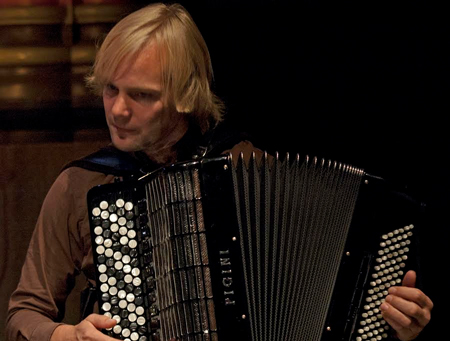 Haltli pointed out that the accordion is quite common in the Middle East, and in Egypt, imported Italian instruments are often re-tuned to fit into the most common Arabic scales. “They have a standardized system called maqam. We don’t have a tuning system like that but there are a lot of non-tempered scales in Scandinavian music — it’s very common for fiddlers and singers to go outside the well-tempered scale that is used in Western music.”
He later discovered that Amper’s nyckelharpa could play quarter-tones, the kind that are common in Scandinavian folk music. Haltli also realized that his re-tuned accordion and her instrument could play the same scales. “At the end of The Border Woods we play together and create something new out of something old. I’m not trying to write Arabic music, that’s not the idea of the piece. It’s more to use these elements and create some atmospheres that hopefully are interesting and beautiful. Some of it may sound a bit familiar, but you won’t exactly know where you heard it before.”
Emilia Amper has performed with Nordic folk music groups, and Persian classical, jazz, and rock musicians, as well as with the Norwegian Chamber Orchestra. She earned a Bachelor in Musicology from the University in Trondheim, a Bachelor in Swedish Folk Music from the Royal University College of Music in Stockholm, and a Masters in Nordic Folk Music.
The roots of the nyckelharpa go back to Medieval times, however it is difficult to know exactly where the first instruments were made. “The idea of putting keys on a bowed instrument popped up in different places in Northern Europe around the same time,” Emilia Amper said, noting that there is evidence that the instrument existed in Finland, Norway, and Denmark, as well as in Northern Germany and Poland. “But it disappeared everywhere except in Uppland, Sweden, a tiny region just north of Stockholm, and it’s a mystery as to why it survived there.”
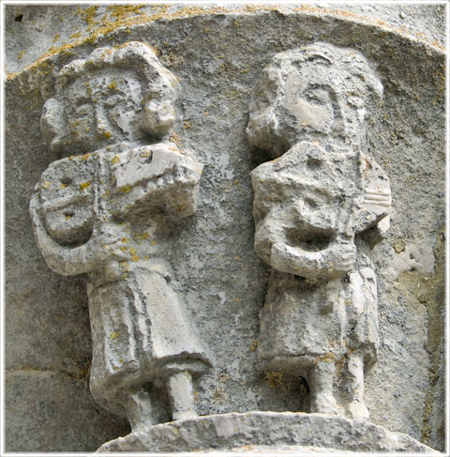 The first known picture of the instrument dates from 1350, and is carved into a stone wall of a church in Gotland, Sweden, an island in the Baltic sea (photo below). “All nyckelharpa players go there and take selfies in front of it,” Amper said laughing.
Although the early instruments were much smaller than they are today, and were only equipped with three strings and twelve keys, over time the body became larger as more strings were added. During the seventeenth century the instrument acquired sympathetic strings.
“By the middle of the twentieth century the tradition of playing nyckelharpa was almost lost,” Amper said. “Because it was a drone instrument that could only play in certain musical keys, it was incapable of playing modern music. But there was a frustrated nyckelharpa player, August Bohlin, who wanted to play new music, so he created the chromatic nyckelharpa.”
The instrument was further developed by Eric Sahlström, a composer, player, and maker of nyckelharpas, but still the instrument’s popularity continued to decline until the Roots Revival of the ‘60s and ‘70s. “That was kind of a hippie time in Sweden — people were interested in handicraft and old traditions, one of which was building nyckelharpas. It became popular for people to attend workshops on how to make the instruments based on Sahlström’s drawings. Even today people still tell me that their grandmothers went to a workshop in the ‘70s and built a nyckelharpa that they still have in their wardrobe.”
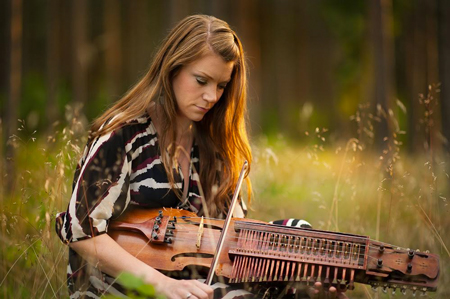 Amper, who grew up in the Småland region of southern Sweden, said that the nyckelharpa was still an uncommon instrument when she began playing it at age ten. Since that time its popularity has spread across Sweden and throughout the world. “In the United States, Canada, and Japan, people usually start playing it because they’re interested in Scandinavian culture. But in places like France and Germany, people take it up simply because they are interested in the instrument. A friend told me that he met a guy from Africa who played it, and I’ve taught people from China and Argentina. Everywhere I go I meet someone who plays nyckelharpa.”
Today the instrument is used to perform all styles of music from folk to Bach to rock. Amper has even performed Persian classical music and Flamenco on the nyckelharpa. Part of what makes it such a versatile instrument is that can be tuned in different temperaments. “Since I play so many styles of music with piano, guitar, and accordion, equal temperament is the best way for me to go.” To read an article by Emilia Amper about tuning the instrument, click here.
Although Amper did not come from a folk music family, she always loved music. How did she find her way to the nyckelharpa? “When I was ten, the music school teachers came around and showed us all the different instruments we could choose from. It just so happened that the fiddle teacher also taught nyckelharpa. She played it and I was taken with it right away,” Amper recalled. “I went home and told my parents that I was going to play the nyckelharpa, and they said, Great — what is that?”
Amper, who quickly took to the instrument, said that she was lucky because her grandfather bought her a nyckelharpa which was far better than the borrowed school instrument. “I was so in love with it, I didn’t let anybody carry it — I even slept with it beside me in my bed.”
Emilia Amper said that she could not be happier that the instrument has survived. “Now it’s like we’re taking over the world. If you meet someone who plays it, you are immediate friends. We call ourselves the international nyckelharpa mafia.”
Published on ClevelandClassical.com March 24, 2017.
Click here for a printable copy of this article
