



by Robert Rollin
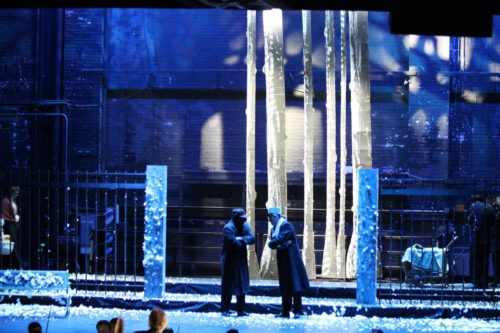 On Sunday evening, June 10, The Cleveland Opera presented an outstanding production of Puccini’s La bohème at the Ohio Theater in Playhouse Square. An exceptional cast and an exemplary orchestra made for a marvelous evening. Though tragic operas can often be overly melodramatic, Puccini’s sensitively beautiful music elevates the simple story of artists struggling to survive in a Paris to a higher plane.
Jorge Pita Carreras sparkled as the poet Rodolfo. His fine, dark tenor projected well all evening, and his strong stage presence supported the drama. At the outset Rodolfo burns the manuscript of his play to provide warmth in the cold garret apartment he shares with Marcello, the painter, sung expressively by the gifted baritone Jianan Huang. James Binion as Schaunard the musician sang with an attractively robust baritone timbre. His expansive movements helped to portray his character’s warmth and generosity.
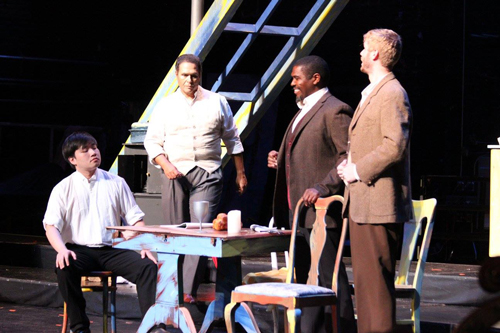 Bass Bryant Bush’s resonant depiction of Colline, the philosopher, concentrated on his pensive seriousness. Bass Jason Budd, known for his comedic roles, effectively portrayed Benoit the landlord as a gullible and licentious drinker easily tricked out of his rent check.
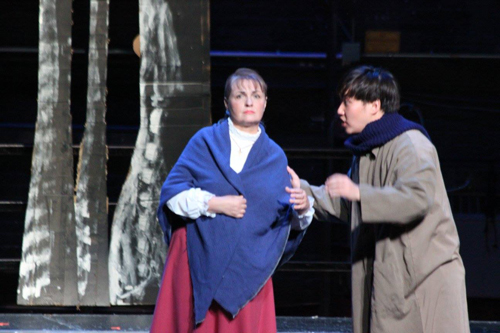
Soprano Dorota Sobieska sang the role of Mimì the flower embroiderer, whose relationship with Rodolfo and declining health is the focal point of the opera. Her tone color shone, especially in the high register.
Once the friends depart, Rodolfo’s and Mimì’s duet helps outline their growing affection for one another. Sobieska doubled as Stage Director and the fine blocking kept things moving.
 Puccini’s skillful music and orchestrations opened each act quickly, pulling the audience into the action. The few initial balance problems soon evaporated.
The orchestra, led by Grzegorz Nowak, was consistently excellent, and harpist Melody Rapier kept her crystal clear playing in perfect sync with the percussion.
Act 2, set in the bustling Latin Quarter, introduces a lively chorus of men, women, and children, as the friends purchase items from street vendors, and Musetta, Marcello’s estranged lover, appears with her elderly admirer, a rich government minister.
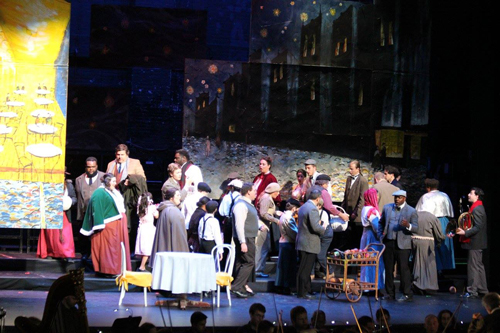 Soprano Angela Mitchell scintillated as Musetta. She succeeds in making Marcello jealous, coquettishly singing the famous “Musetta’s Waltz.” Her vocal color was lovely, though sometimes she was covered by the enthusiastic orchestra. As Parpignol, the toy seller, tenor Kyle Kelvington added to the excitement with a vivacious performance.
After Act 3’s alternation of women’s and men’s chorus sections at the tollgate, Mimì and Rodolfo’s wonderfully expressive duet underlines their strong love for one another. Sobieska and Carreras sang it passionately. In the end, despite all her friend’s efforts, Mimì’s health deteriorated amid duets of touching sincerity. When her heart finally stops, Puccini’s gorgeous music was overwhelming in its sadness. The Opera ended with a standing ovation.
Photos by Ryan Teti.
Published on ClevelandClassical.com June 16, 2017.
Click here for a printable copy of this article