



by Kevin McLaughlin
 This article was originally published on Cleveland.com
CUYAHOGA FALLS, Ohio – The Cleveland Orchestra sounded far younger Saturday than their 107 years, energized by guest conductor Stephanie Childress, lifted by cellist Sheku Kanneh-Mason, and buoyed by a program of youthful works by Britten, Saint-Saëns, and Mendelssohn.
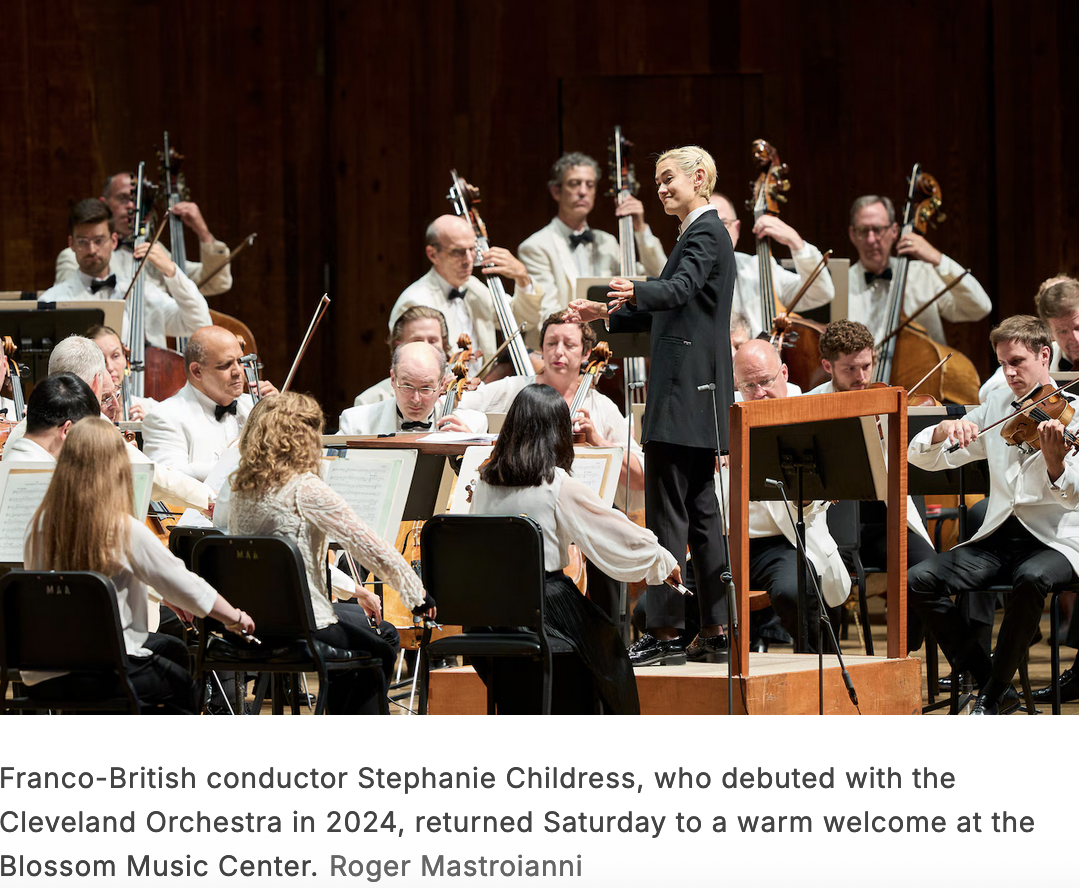
Franco-British conductor Stephanie Childress, who debuted with the Orchestra in 2024, returned Saturday to a warm welcome at the Blossom Music Center. From her slight frame and controlled gestures came a striking reserve of power. Whether with baton or without, her long, expressive fingers eloquently shaped phrases with precision and grace throughout the evening.
Benjamin Britten’s Simple Symphony is truth in advertising. The teenage composer took tunes he had written as a child — mostly for piano — and dressed them in orchestral clothes. The music is both playful and sly, and Childress, born and raised in London, seemed delighted to share it with a North American audience.
Its alliterative movement titles wink at you — “Boisterous Bourrée,” “Playful Pizzicato,” “Frolicsome Finale” — and the orchestra snapped, plucked, and scampered as if the players were children running across the Blossom lawn. Childress shaped it all with a light hand, letting the humor peek through without overstatement.
In the third movement, “Sentimental Saraband,” the longest and most serious of the four, she let the shifts between major and minor unfold at leisure, giving the music a tone both grave and tender.
 Camille Saint-Saëns’ Cello Concerto No. 1, written at 37, brims with youthful energy. It begins not with a polite clearing of the throat but with the soloist bursting headlong into the argument, the orchestra at his heels.
For 20 tightly packed minutes (the three sections proceed without pause), the score demands strength and agility. British cellist Sheku Kanneh-Mason, a hit in his Cleveland debut in 2021, received a warm welcome, and again, he showed more than technique. In the lyrical passages, especially in the lower register, he drew out a tone of extraordinary beauty.
Childress kept the interplay taut and charged, matching the soloist’s rhythmic bite with crisp, spring-loaded responses from the orchestra. Kanneh-Mason was the picture of focused listening — concentration so intense his ears seemed to squint.
Mendelssohn’s Scottish Symphony is music with a passport. At 20, the composer sketched a moody theme while staring at the ruins of Edinburgh’s Holyrood Palace. Ten years later he expanded those notes into a symphony, but the feeling of discovery remains: you hear mist and craggy hills, but also the sparkle of reels and dances.
Childress captured both its Scottishness and drama. The brooding opening lingered, the dance rhythms sparkled, and the finale strode across the moors with a warrior’s vigor. Mendelssohn had a gift for turning landscape into melody, and by the end you felt you’d been on the excursion with him without ever packing a bag.
The finale’s jubilant coda — praised by some, questioned by others — has long posed a quandary for conductors.
Likened to a male-voice chorus, it crowns the symphony with radiant affirmation. Otto Klemperer famously rejected it in favor of his own sterner conclusion. Childress embraced Mendelssohn’s vision unreservedly, delivering it with a youthful exuberance that sent the Blossom audience home smiling.
Published on ClevelandClassical.com August 28, 2025
Click here for a printable copy of this article
