


By Mike Telin
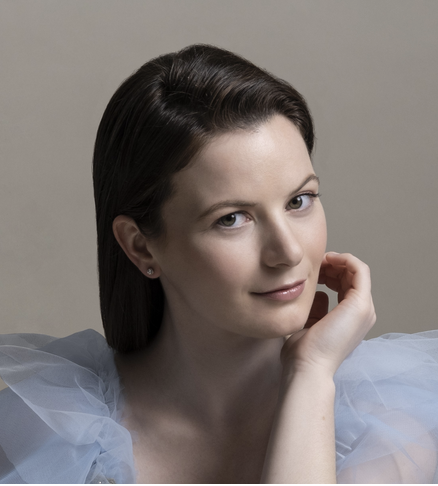 “One of my favorite things to do is to sing with the Cleveland Orchestra,” soprano Liv Redpath said during a telephone conversation. “There’s really no better orchestra — it’s kind of freakish how great they are.”
On Thursday, December 4 at 7:30 at Severance Music Center, Redpath will join her solo quartet colleagues — countertenor Tim Mead, tenor Andrew Haji, and bass-baritone Philippe Sly — when Bernard Labadie leads The Cleveland Orchestra and Chorus in Handel’s Messiah. The program will be repeated on Friday and Saturday at 7:30 pm. Tickets are available online.
Redpath looks forward to once again working with Labadie, who she said brings a great balance to classical and Baroque music. “Bernard has a huge heart and passion for this music and making it alive. But behind that is a deep knowledge of the structure that makes the music tick like a really beautiful Swiss clock. I’m excited to once again sing with The Cleveland Orchestra, but I have not performed with them together with Bernard, so that’s going to be a treat.”
The soprano is also excited to join her quartet colleagues. “I don’t know Philip, but I remember Tim from when I was singing Echo in Ariadne auf Naxos in St. Louis one summer, and he was singing Riccardo Primo. I remember going to that Handel opera and being completely floored by his music making and technical prowess. I made my Glyndebourne debut with Tim in A Midsummer Night’s Dream. We were Oberon and Titania a couple summers ago. And Andrew is just an amazing singer and the sweetest Canadian guy you’ll ever meet. I actually sang Messiah with Andrew last year in Montreal, with Bernard, so I know he sings this piece like nobody else.”
Does Redpath have a favorite aria? “It’s funny because the soprano — poor me — has to wait so long before I get to sing. Everybody else sings, and then I finally stand up. So it’s interesting because you want to bring a prowess to the figuratura in “Rejoice Greatly,” which I’ve sung for so long that it’s an old friend to me.”
As she has developed as a singer, a musician, and a person, Redpath has come to enjoy “I Know that my Redeemer liveth,” that opens the third part. And while “If God Be For Us” can be sung by the mezzo, she has never had to give it up. “I’m so glad,” Redpath said, “because I really love being able to finish on that kind of declamatory note. And while I love ‘Rejoice Greatly,’ I do find that by the end, I’m glad that I get to sing something that is more faith-based.”
Given that the soprano does spend a fair amount of time sitting, is there a part or aria that she looks forward to hearing? “I really like the tenor aria ‘Thou Shalt Break Them,’ and I love the way Andrew sings it. But I think ‘He Was Despised,’ is one of the best arias. It’s a gift to every countertenor on Earth. And even though the aria is quite long, with a great musician you’re on the edge of your seat because the way Handel writes for the mezzo is hypnotic.”
Redpath grew up in Minneapolis, and at the age of thirteen was cast in her first opera, Hansel and Gretel, with Minnesota Opera. Was that a life changing experience for her? Yes it was.
“I was a shy kid and a bit of a perfectionist, so having to stand up in front of people and act and remember music at that time was very complicated to me. I remember wondering how I would ever do it. But like magic the words came out of my mouth at the right time in a language that I was not really fluent in.
“So I think when I finished, because it took so much concentration, I became kind of addicted to that. I enjoy things that are high pressure like tests. So singing was like a test where you also get to connect with people, and express things. When I was thirteen it was the ultimate thrill.”
Although she was certain that she wanted to pursue a career in opera, she didn’t feel the need to follow a traditional conservatory path, opting instead to attend Harvard College, where she earned her Bachelor of Arts in English. In an article in Harvard Magazine Redpath said that while you have to figure out how to sing — “that’s the requirement of the job — what you can say with that is what I’m most interested in.”
Handel was not a native English speaker and had only turned to writing English oratorio in the 1730’s. Given that Messiah was only his sixth work in the genre, what grade would Redpath give to the German composer for his setting of English text to music?
“That’s a good question. I’m going to say a lot higher grade than I would give to Stravinsky. I’d give him a B+ or A minus — without inflation.
“Part of it is that Handel is in his own world in the art of how to sing. You have this guy who sets things in a very instrumental way. And now, as I get older, I enjoy the repetition of the same four or five sentences in an aria. It’s really a gift to see how one sentence is repeated in different ways before moving on to the next idea.”
Winding down our conversation Redpath reflected on how her love of singing was realized in the choral culture of the upper Midwest.
“My mom is very passionate about music, and she sings, so she wanted to make sure that both of her kids had that experience. So I have sung since I was six or seven in a kids’choir, which is very common in that part of the country. But when I was a kid, I really didn’t think ‘Wow, I’m so talented,’ or ‘Wow, I have a special voice.’ I just thought, if I do well or if I get the solo, it’s because I prepared well. I was responsible about it.
“Now, I’m so excited when it’s just caring about what you do, caring about the expression and the experience that you have with other people. And that part of choral singing and community has really informed the best parts of the way I get to make music.”
Published on ClevelandClassical.com December 3, 2025
Click here for a printable copy of this article
