

by Kevin McLaughlin
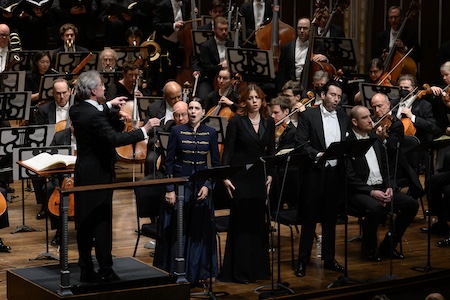
Photo by Yehven Gulenko
This article was originally published on Cleveland.com
CLEVELAND, Ohio — Verdi’s Requiem surprised in its beauty on Thursday evening Jan. 15 at Severance Music Center in a performance by Franz Welser-Möst and The Cleveland Orchestra and Chorus.
Welser-Möst understands that the Requiem lives on a fault line between opera house and church, but, as he explains in the program, a performance ought never lose sight of Verdi’s reverence for the mass text. On Thursday the balance felt wisely judged. The “Dies irae” was terrifying precisely because it was controlled. The choir’s entrance struck with sudden force.
Tempos were brisk and firmly maintained but elastic when accompanying the soloists. The climaxes arrived naturally, not forced into being.
The solo quartet — soprano Asmik Grigorian, mezzo-soprano Deniz Uzun, tenor Joshua Guerrero, and bass Tareq Nazmi — was exceptional.
Grigorian’s soprano was agile, colorful, and appropriately shaded by melancholy rather than brilliance. She was superb throughout, but her Libera me was sublime. She showed stamina and an ability to maintain the beauty of her voice across a two-octave range, conveying shifting states of serenity, fury, and reverence. Her spoken lines projected easily, a detail not always achieved in a large hall.
Deniz Uzun brought warmth and poise to the Liber scriptus, shaping her lines with calm authority. Her a cappella duets in octaves with Grigorian were lovely, matching pitch and timbre without fault. Joshua Guerrero sang with focus and ease, his tenor warm and steady. And Tareq Nazmi provided bass weight without bluster — a true voice of judgment — particularly effective in the darker movements, “Mors stupebit” and “Confutatis maledictis.”
Just as important was The Cleveland Orchestra Chorus, singing with unanimity and precision and capable of whispering terror as effectively as proclaiming it. Prepared by Lisa Wong, they were treated as the conscience of the piece, not merely as a massed effect.
A sense of patience carried through from the opening to the Dies irae. When that movement arrived, the impact was strong and clearly articulated, the bass drum strokes measured and worrying. Operatically placed in the first balcony, the offstage trumpets answered from a distance, their calls traveling cleanly across the hall.
Even in the loudest passages rhythms remained clear. The Orchestra held its textural balance, and the music always moved forward.
The most affecting moments came in the quieter sections. The “Agnus Dei” unfolded simply, its unison lines exposed and fragile. In the “Lux aeterna,” low winds and percussion held a deep hush, with high strings and piccolo casting a pale glow above them. Discipline over dynamics invited close listening and sustained attention.
The arrival of the final “Libera me” was well-prepared and delivered. The return of the Dies irae carried accumulated weight, and the closing fugue steadily moved forward, resolute rather than consoling. In the end, Verdi withholds harmonic warmth, choral affirmation, and emotional release, but the audience did not seem to mind.
Published on ClevelandClassical.com January 22, 2026
Click here for a printable copy of this article
