

By Peter Feher
 There’s something sacred about the female voice. And while the title of “La Divina” has already been claimed, today’s sopranos might still aspire to a similar status — “La Diosa,” perhaps.
That’s the self-assertion made early on in Soy La Diosa (“I Am the Goddess”), a prophetic new piece by composer Gilda Lyons. The work’s soloist delivers this phrase after detailing, in alternate Spanish and English lyrics, the various guises her spirit can take: “messenger,” “creator,” “warrior,” “protector,” “shadow,” and “song.” Naturally, such shape-shifting calls for a comparable array of vocal techniques, everything from whoops to whispers to full-throated high notes.
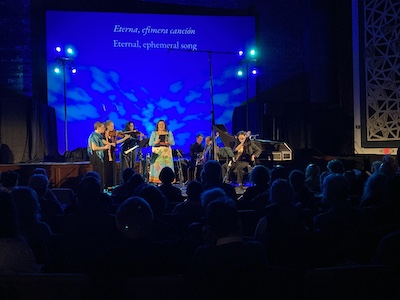
Only a confident performer could embody these powerfully clashing roles, and soprano Estelí Gomez was in her element singing the world premiere of Lyons’ score on Saturday, February 28, at the Heights Theater. If the afternoon felt vaguely out of time and place — with the period instrumentalists of Les Délices not just accompanying but commissioning this contemporary endeavor — then ethereal aims accomplished.
Soy La Diosa is the second installment in the ensemble’s Mythology Project, which combines a timeless interest in ancient tales with the 17th- and 18th-century genre of the cantata. The basic format is one singer, one composer, and Les Délices’ chamber musicians, together bringing to life legends from outside the European tradition.
Lyons miraculously gets the concept to cohere by focusing on a key figure from Latin American mythology. Following the initial invocation of the muse (in all her many forms), the piece’s second movement centers on Ix Chel — an amorphous deity whose competing depictions, as both an old and young woman, suggest a magical threshold where early and new music converge.
You can imagine the vocal flexibility required, and Gomez sang with an astonishing, instrument-like level of control. As the old Ix Chel weaving at her loom, she dispatched strings of notes with the same sinuous ease as oboist Debra Nagy and guest guitarist Héctor Alfonso Torres. In the very next breath, the soprano brightened her tone to better suit the young maiden.
Later movements had Gomez modulating her approach still further, descending into a rumbling, quasi-spoken register for “The Guardian of Mombacho” (a volcano in Nicaragua) before soaring in the finale’s exuberant song of praise to Ix Chebel Yax (heavenly patroness of the arts).
The afternoon was hardly short on inspiration, with Les Délices programming half a dozen historical selections that complemented the commission in creative ways. To start, Gomez starred in a church cantata by the Spanish Baroque composer José de Torres y Martínez Bravo.
A sequence of secular tunes — some drawn from a colonial-era codex compiled by the bishop of Trujillo, Peru — soon established the scene in Latin America. Percussion accented the continuo accompaniment of harpsichord, viola da gamba, and guitar. A vast ocean separates the symphony from samba, but once upon a time, the component parts of future genres did commingle.
This fusion was absolutely irresistible in Pastoreta Ychepe Flauta, an anonymous instrumental work from Bolivia that blends the bravado of a classical concerto with the rhythms rippling across an entire hemisphere. Nagy, who also serves as Les Délices’ artistic director, stepped into the spotlight on recorder and gave a virtuosic performance that would delight flutists of any culture, past or present.
Published on ClevelandClassical.com March 5, 2026
Click here for a printable copy of this article