


by Daniel Hathaway
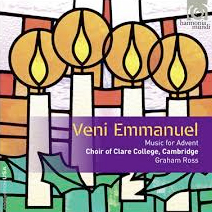 If the commercial frenzy of Christmas and its wall-to-wall musical onslaught already has your ears ringing with fatigue, there’s a wonderful antidote close at hand: the Choir of Clare College, Cambridge and its new CD, Veni Emmanuel: Music for Advent (Harmonia Mundi). The ensemble stops at Fairmount Presbyterian Church this Saturday evening to sing the last concert of its seven-city U.S. tour, a program taken from the CD, and there will certainly be copies for sale that night.
Don’t miss the opportunity to pick one up and play it frequently between now and December 24 and beyond — it’s a superb collection of music brilliantly conceived and wonderfully performed by the 30-voice ensemble of women and men, formed in 1971 under John Rutter and now directed by Graham Ross (Rutter still has a hand in the choir’s activities, having served as sessions producer, recording engineer and editor for the album, which was recorded at All Hallows Church, Gospel Oak in North London and at St. Alban’s Abbey in March and April of 2012.)
The album begins and ends with its title piece, first in a simple plainchant version, last in an opulent setting for choir and organ by Ross. Between those two versions of that famous 15th century Advent hymn come thirteen choral selections, themselves interspersed between chant settings of the eight “Great O” Antiphons that form the basis for the verses of Veni Emmanuel — forming an intricate web of textual connection.
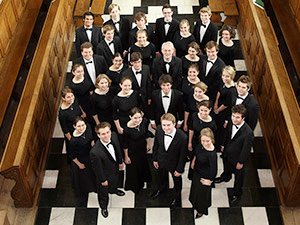 Though Clare College Choir continues the great Anglican choral tradition, it does that without aping the sound of a boys’ and men’s choir. Sopranos and altos sound like women, though they sing with minimal or no vibrato, and men’s voices ring out with characteristic timbre. The choir produces a supple, versatile choral sound that can run the gamut between light and floating and full-throated and colorful. Their polyphony is clear and lively in Byrd’s Vigilate, their singing in Herbert Howells’s The fear of the Lord and the Magnificat from the Gloucester Service is rich and vibrant. They handle the complex textures and harmonies of Rutter’s Hymn to the Creator of Light (written for the dedication of the Howells window at Gloucester Cathedral) and Ross’s I sing of a maiden with transparency and excellent tuning.
Other lovely tracks include Jan Sandström’s take on Praetorius’s Es ist ein Ros entsprungen, John Sheppard’s high voice, old-style, votive antiphon Audivi vocem de caelo, Peter Warlock’s Bethlehem Down and a brief movement from Rachmaninof’s All-Night Vigil. There’s also a loveable old warhorse, Mendelssohn’s Say, where is he born and There shall a star from Jacob come forth, and a timely tribute to John Tavener, who died last month, in his Eastern Orthodox-inspired God is with us. Organ parts are expertly handled by Clare’s senior organ scholar Nicolas Haigh, and Cleveland native Gabriella Haigh (no relation) sings a beautiful, stratospheric solo in Roderick Williams’s haunting O Adonai, et Dux domus Israel.
Published on ClevelandClassical.com December 10, 2013
Click here for a printable version of this article.
