


by Daniel Hathaway
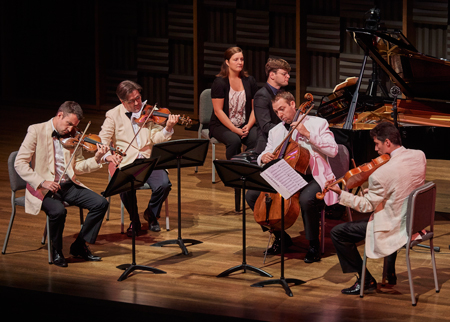 In a new twist this time around, the Cleveland International Piano Competition is requiring each of its finalists to play a chamber music round with the Escher String Quartet. Aside from the welcome change in musical timbre after many hours of solo piano music, this new round is designed to show how well pianists play with others — a direct look at their musicianship in collaboration with a world-class ensemble before moving on to play concertos with The Cleveland Orchestra.
Why is this important? Pianists, especially those who make the rounds of competitions, spend long hours in communion with only themselves and 88 black and white keys. Performing a piano quintet with four string players requires that they enter into an artistic give-and-take that demands compromise and collegiality.
While it may seem that bringing a keyboard player together with an established string quartet for a limited amount of rehearsal to prepare for a public performance puts the pianist at an unfair disadvantage, that’s in fact a real-life situation. There are pianists who regularly perform in piano trios, but few if any touring piano quintets include a permanent pianist.
So it was that on Tuesday, August 2 in Gartner Auditorium at the Cleveland Museum of Art, Georgy Tchaidze and Nikita Mndoyants played piano quintets with the Escher in the first of two chamber music rounds — performances that would count for 25% of the pianists’ total score for the competition. (That’s the same percentage as the combined first and second rounds, the semifinal round, and the concerto phase of the final round.)

Appearing in the same order as the original draw, Georgy Tchaidze was up first, joining the Escher (violinists Aaron Boyd and Pierre Lapointe, violist Adam Barnett-Hart, and cellist Brook Speltz) in Antonín Dvořák’s wonderful Piano Quintet No 2 in A, Op. 81. Bedecked with cheerful melodies and incorporating the traditional Czech musical forms of the Dumka and the Furiant, the Quintet bestows a solo passage or two on every member of the ensemble, as well as requiring some virtuosity from all concerned.
Tchaidze, whose bio notes that he tours regularly with Canada’s Cecilia Quartet and also plays duo piano with his wife, gave every indication of being comfortable as a cog in a chamber music machine. He paid close attention to his colleagues, and together, their performance brimmed with mutual understanding and nuance.
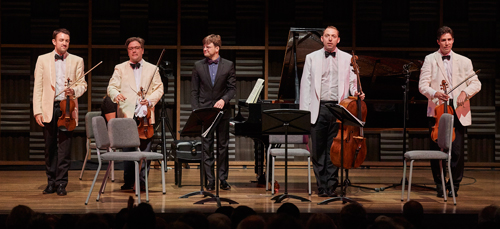
That said, Tchaidze’s playing often seemed to hover in the background of the ensemble. On many occasions, the string sound was markedly more prominent than the piano — though when he got to play solo passages, Tchaidze’s tone was radiant, his sense of musical line shapely.
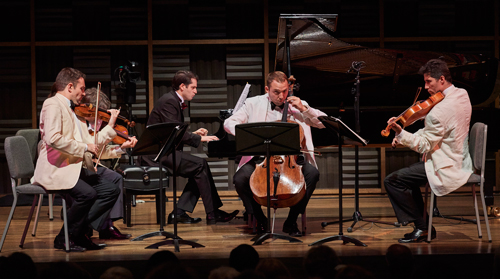 After an intermission, Nikita Mndoyants took on an assertive role in Johannes Brahms’s Piano Quintet in f, Op. 34, playing with a robust tone and presence that matched the timbre and volume of the strings.
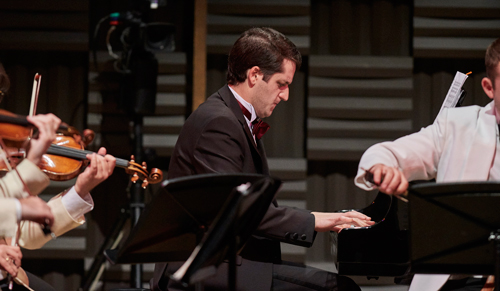
This performance wore its passion on its sleeve. The ensemble chose drama over blend and transparency, producing some oversized climaxes that, while riveting, sounded more noisy than loud. Did Brahms ever imagine a performance that would crest in such powerful outbursts of tone?
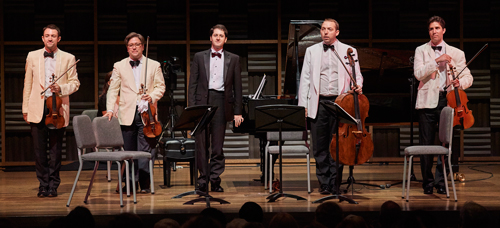 Mndoyants played masterfully, highly focused n his own role but well in touch with the Escher players. His contributions to the collective performance reflected his experience both as a composer and as collaborator with some important string quartets.
This is a fascinating process to watch. On Wednesday, Leonardo Colafelice and Dinara Klinton will join the Escher for quintets by Schumann and Brahms (another performance of Op. 34).
Photos by Roger Mastroianni.
Published on ClevelandClassical.com August 3, 2016.
Click here for a printable copy of this article
