

by Daniel Hathaway
 Beethoven’s music comes in all flavors. On Thursday, January 7 at Severance Hall, Franz Welser-Möst and The Cleveland Orchestra — back after a month’s worth of holiday music — delighted a capacity audience with the string orchestra version of one of the composer’s late quartets, the middle child of his five piano concertos, and an occasional piece specially composed to include all the performers involved in the composer’s marathon concert at the Theater-am-Wien on December 22 of 1808. The triptych of pieces, two of them featuring the commanding work of pianist Yefim Bronfman, added up to a thoroughly gratifying evening.
Beethoven’s next-to-last string quartet — the one with the famous “Heiliger Dankgesang” movement — opened the program. Felix Weingartner, Gustav Mahler, Arturo Toscanini, and more recently Terje Tonnesen have made orchestral arrangements or transcriptions of late Beethoven quartets. Presumably the Cleveland musicians were simply playing from the quartet parts — except for the basses, who were doubling the cello line at various times.
The Op. 132 quartet, remarkable for its philosophical depth and its tangled web of emotions, is well-known. It’s also remarkable for having first been heard in public at the Viennese inn “Zum wilden Mann” on September 9 and 11 of 1825, an early example along with Zimmermann’s Coffee House in Leipzig of “classical” music being performed in what we now call “unconventional spaces.”
Welser-Möst, in a rare talk to the audience at the beginning of the concert, spoke feelingly about Beethoven the philosopher, framing his remarks in a tribute to Pierre Boulez, who died two days before. He then asked the audience to stand while he read a few lines from the first poem of T.S. Eliot’s Four Quartets, “Burnt Norton,” a work that some scholars believe was inspired by Beethoven’s late string quartets.
The Cleveland Orchestra strings played Op. 132 with astonishing dexterity, nuance, and sense of ensemble. With a full string section it almost becomes a new piece. Some passages like the Lydian Mode chorale in the third movement take on a new depth and sheen with multiple players on a part, but elsewhere the intense energy a string quartet can bring to the material becomes dissipated.
Yefim Bronfman reined in his considerable power to match the scale of the C minor concerto, Op. 37. Playing with a strong, full tone, Bronfman shaped perfect runs and spun out masterful trills, ending the first movement with a hushed version of Beethoven’s suspenseful coda. The pianist’s beautifully understated playing in the slow movement was magical — a spell unbroken even by the double intrusion of a single cell phone. The concluding rondo was delightful, the ovation strong and protracted.
After the Cleveland Orchestra Chorus had filed on (an admirably brisk 2½ minute entrance), Bronfman returned to the stage, launching the opening cadenza of the Choral Fantasy even before the applause had faded. A curious but infectious piece, Op. 80 has seemed to many to be a living sketchbook for the later finale of the ninth symphony. It presents many of the elements of the “Ode to Joy” in embryonic form: a simple, repetitive theme that gets decorated and worked over many times; a military march; an exuberant finale; and words, here added after Beethoven had already penned the theme, about the transformative power of music.
Bronfman played the cadenza like a masterful improvisation, then engaged in a series of charming conversations with the orchestra: with solo flute, with oboes, with clarinetists and solo bassoon, with string quartet. Finally, the chorus entered with their tongue-twisting opening words, Schmeichelnd hold und lieblich klingen, beginning a long crescendo to the final extravagant outbursts of a finale that suddenly reminds you of the last moments of Fidelio. The chorus and semichorus (in place of soloists) sang stunningly and with excellent diction, bringing the evening to an uproarious conclusion.
Almost. Welser-Möst and Bronfman quieted the enthusiastic applause by returning to the front of the stage for — an encore? No, “a little surprise,” the conductor said, turning to the orchestra for the opening bars of Tchaikovsky’s first piano concerto, which suddenly morphed into “Happy Birthday.” The second tribute of the evening was in honor of Mrs. Norma Lerner, honorary chair of the Musical Arts Association and co-sponsor of the Thursday evening performance. She must have been thrilled with the whole evening, not the least by Bronfman’s festive arpeggios in the birthday song.
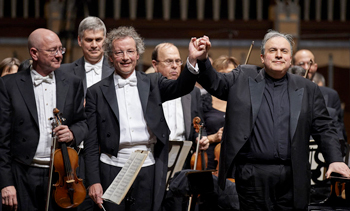
Photo by Roger Mastroianni from a performance in February, 2015.
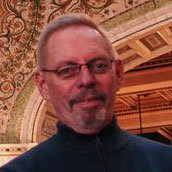 Daniel Hathaway founded ClevelandClassical.com in September, 2008, after a thirty-one year tenure as music director of Cleveland’s Trinity Cathedral, where he founded the Wednesday Noon Brownbag Concert Series and Trinity Chamber Orchestra. A graduate of Harvard College and the Episcopal Divinity School, he also studied historical musicology at Princeton and Harvard Universities. Before coming to Cleveland in 1977, he served as head of humanities at the Sunset Hill School in Kansas City and as head of arts at Groton School in Massachusetts. Other Cleveland activities have included serving on the music staff of Cleveland Opera, Great Lakes Theater Festival, and the faculty of Laurel School. As an organist, Hathaway has played recitals in the U.S., England, France, Germany, and Austria. He currently team-teaches Introduction to Music Criticism at Oberlin College and Conservatory.
Published on ClevelandClassical.com January 11, 2016.
Click here for a printable copy of this article
