

by Daniel Hathaway
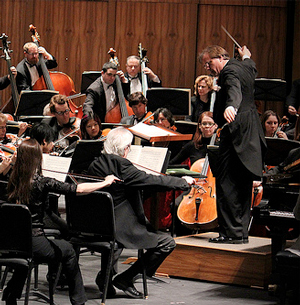 The Akron Symphony opened its new season on Sunday evening at E.J. Thomas Hall under the expressive baton of music director Christopher Wilkins with assured performances of a Ron Nelson overture, a Mozart piano concerto with assistant conductor Levi Hammer at the “Three Graces” Steinway, and a Brahms Symphony. The High Holy Days bumped the performance a day later than the ASO’s normal Saturday evening slot and probably accounted for an opening night crowd a bit smaller than usual but no less effusive in its support for their local ensemble.
Brahms was famously nervous about producing his first symphony. The project languished for years as the composer’s original ideas were repurposed into a piano concerto and parts of his Requiem. What finally emerged in 1876 has become one of the standards of the repertoire, and the ASO did the piece proud. A rich, full, blended tone filled the hall in the tuttis and solo winds (notably oboist Terry Orcutt and clarinetist Kristina Belisle Jones) were splendidly lyrical. The whole wind section, supported by Mark DeMio’s expert contrabassoon playing, shone as a sub-ensemble, and horns and brass crowned the finale with noble, sostenuto chords. Conducting without score, Wilkins moved what can sometimes be a turgid work steadily forward, creating at the same time warmth of sound and transparency of ensemble.
The evening ended with the Brahms but began — after a mellifluous arrangement of the National Anthem — with a brassy, high-energy overture written by Ron Nelson the year he graduated from the Eastman School of Music in 1952. That seems to have set the composer off on a string of festive orchestral curtain-raisers. It’s a format he seems to have been very good at, judging from Savannah River Holiday. Fast-Slow-Fast and fun throughout, the piece gave every section a good workout. Orcutt and the horns contributed luscious moments to the slow section and the violins spun dizzing swirls of notes before and after.
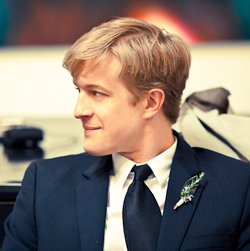 Wilkins kept the string sections large for Mozart’s Piano Concerto No. 25 in C, K. 503, which emphasized the symphonic nature of the piece as well as giving Levi Hammer a cushion of sound to play against. His first entrance (he seemed to be doing a bit of his own conducting during the orchestral introduction) set the tone for the whole work: clear, nuanced voicing, fleet passagework and a keen sense of form and integration with the orchestra characterized his approach to all three movements. With such a large string section and winds far away from the piano, the orchestra lagged behind a nanosecond or two in parts of the opening movement but otherwise proved to be malleable and supportive colleagues. Hammer’s own nicely-wrought cadenza sported witty references to other works (including the “Jupiter” symphony).
The slow movement flowed along agreeably. The finale needed just a bit more pizzaz each time the rondo theme came around again to keep the music buoyant and lively in the dry acoustic of the room. A standing ovation at the end rewarded the audience with more music. “Brahms,” Levi Hammer noted, before playing a lovely encore that made a nice transition into the symphony that would follow intermission. Though the baton is alluring, Hammer should keep a hand or two on the piano as his career advances. He’s good at it.
Published on ClevelandClassical.com September 17, 2013
Click here for a printable version of this article.
