

 by Daniel Hathaway
IN THIS EDITION:
. Opportunities to hear multiple performances of the same program around the region.
. Mäkelä conducts & coaches cellists, Tuesday Musical extends scholarship deadline
. Almanac remembers Mendelsssohn, Dallapiccola, Alain & Leinsdorf
HAPPENING THIS WEEKEND:
Apollo’s Fire visits early Baroque instrumental & vocal works by Franz Biber and his contemporaries, featuring violinist Alan Choo (Friday & Saturday in Cleveland Hts., Sunday in Rocky River).
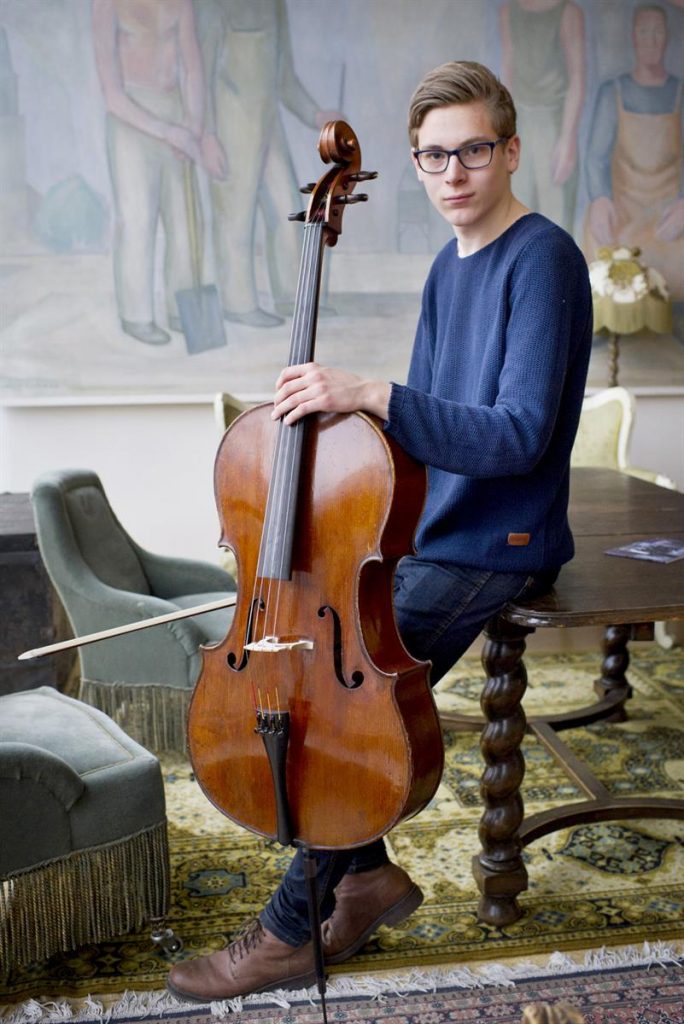
The Cleveland Orchestra welcomes Finnish conductor Klaus Mäkelä back for music by Norman, Debussy & Ravel (Fri, Sat & Sun), and Mäkelä appears in his alter ego as a cellist (pictured) to teach a Cleveland Cello Society master class on Saturday morning. [RESCHEDULED FOR TUESDAY, FEBRUARY 7 AT 7:00 PM]
New music ensemble No Exit joins forces with its Twin Cities cousins Zeitgeist on Friday (Spaces Gallery), and Saturday (Heights Arts).
Oberlin faculty recitals feature Mathilda Edge, soprano, Sibbi Bernhardsson, violin, Dmitry Kouzov, cello & Tatiana Lokhina, piano (Saturday, all-Brahms), and Salvatore Champagne, tenor & David Breitman, fortepiano (Sunday, Schubert’s Winterrise).
And in a one-off performance on Saturday, four young violinists will divvy up Vivaldi’s The Four Seasons with Carl Topilow and the Firelands Symphony at Sawmill Creek in Huron.
See our Concert Listings for details.
NEWS & ANNOUNCEMENTS:
Reminder to cellists and followers: reservations are required for Klaus Mäkelä’s Master Class on Saturday, February 4 (11am to 1pm in Reinberger Chamber Music Hall at Severance Music Center. Click here to make your reservation. NOTE: rescheduled for Tuesday, February 7 at 7pm due to illness.
Tuesday Musical has extended the application deadline for its scholarship competition to Sunday, February 5. Click here for details.
WEEKEND ALMANAC:
by Jarrett Hoffman
Felix Mendelssohn was born on February 3, 1809. He got started early as a composer, having written the overture of the incidental music to A Midsummer Night’s Dream as a teenager. Among his standout works is the Sixth String Quartet, which he dedicated to his sister Fanny after her passing at age 42 of complications following a stroke. (Felix would die of the same cause six months later.)
One takeaway from the piece is the frantic and distressed feeling that can be heard through much of it. Here’s one memorable performance of it to watch again, from the hands of violinists Alexi Kenney and Nathan Meltzer, violist Hsin-Yun Huang, and cellist Nicholas Canellakis on a program by ChamberFest Cleveland in June of 2019.
Two other important composers who were born on February 3 in history did not gravitate towards the string quartet — very inconveniently for my attempt at a neat summary of this day in history. Luigi Dallapiccola, the first Italian composer to adopt twelve-tone technique, brought his emotionally expressive approach to that style largely to the realm of vocal music. His best-known work is probably the one-act opera Il prigioniero (“The Prisoner”), a chilling piece of music written in response to Fascism. Watch here from the Teatro Colón.
And Jehan Alain is most famous for his organ music. Listen to his Trois Danses played by recent Cleveland Museum of Art recitalist Vincent Dubois and to a selection of his unjustly neglected choral music (here performed by the Camerata Saint-Louis and the Ensemble Vocal Sequenza 9.3).
by Daniel Hathaway
On February 4, 1912, conductor Erich Leinsdorf was born in Vienna. The vicissitudes of history took him to New York’s Metropolitan Opera in November, 1937, a few months before Hitler’s Anschluss made a return to Austria impossible. Freshman U.S. Representative Lyndon B Johnson took Leinsdorf under his wing and he eventually became a naturalized U.S. Citizen in 1942. (Read the oral history transcript of an interview where Leinsdorf recalls his experiences with Johnson and the federal government.)
He became the third conductor of the Cleveland Orchestra in 1943 by vote of the board of directors (who chose him over another candidate, Georg Szell). But Leinsdorf received and decided not to challenge a draft notice in October of that year, and joined the U.S. Army for barely a year. By the time he was discharged in September, 1944, sentiments in Cleveland had changed, and Szell had made an impressive debut with the Orchestra. Leinsdorf, still under contract, submitted his resignation. After Szell died, Leinsdorf began appearing frequently as guest conductor in the 1980s. He died
Here are three live Cleveland Orchestra performances led by Erich Leinsdorf: Beethoven’s Seventh Symphony, Schumann’s Third Symphony, and the conductor’s own suite from Debussy’s opera, Pelleas et Melisande.
I can’t resist telling a Leinsdorf story. When I was in college in the 60s, the Harvard Glee Club and Radcliffe Choral Society frequently sang with the Boston Symphony under his direction. One memorable performance was Schumann’s Scenes from Goethe’s ‘Faust’ in 1966 with the New England Conservatory Chorus and a starry cast of soloists: Hermann Prey, Beverly Sills, Charles Bressler, Thomas Paul, Veronica Tyler, Tatiana Troyanos, Florence Kopleff, and Batyah Godfrey.
The first chorus/piano rehearsal on the Symphony Hall stage did not go well. Leinsdorf had the flu and we were singing from scores that only printed our individual voice lines with cues like instrumental parts. Leinsdorf grew more and more impatient and finally said, “I am going to leave you in the hands of your chorus masters and if you can’t learn the music, we’ll replace it with … the Brahms Academic Festival Overture.” And he strode offstage through the central door between the two halves of the chorus — after which we terrified singers spent another hour and a half drilling cues.
I learned only years later that Leinsdorf had never used that door before — which only led to a room where they stored timpani and the organ console. Having made a dramatic exit, he could hardly have crept back onstage again, so he paced for 90 minutes until the stage was clear. (The performances went beautifully, by the way. Listen to one of them here.)
