

by Daniel Hathaway
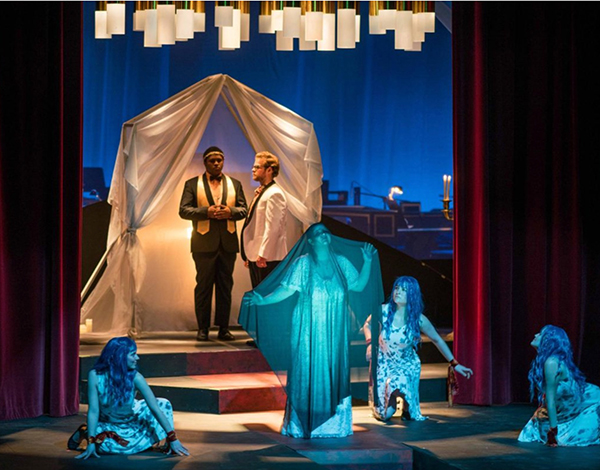 The ancient Greek legend of Orpheus and Eurydice has interchangeable endings.
At the end of Claudio Monteverdi’s musical fable L’Orfeo, first performed at the ducal palace in Mantua on February 24, 1607 and staged by Oberlin Opera Theater in four Hall Auditorium performances last weekend, the god of music lives on to continue to enchant everything that hears him sing, having been snatched from the clutches of Pluto in a classic deus ex machina intervention.
Those who prefer happy-ever-after endings can rejoice that Monteverdi didn’t set the alternate conclusion of Alessandro Striggio the Younger’s libretto, in which Dionysius’ Maenads, having grown tired of his incessant mourning for Eurydice, dramatically tear Orpheus limb from limb.
Oberlin’s production, directed by Stephanie Havey and conducted by Christian Capocaccia, offered the rare opportunity to hear Striggio’s poetic verse and Monteverdi’s inventive score performed by college age voices and period instruments.
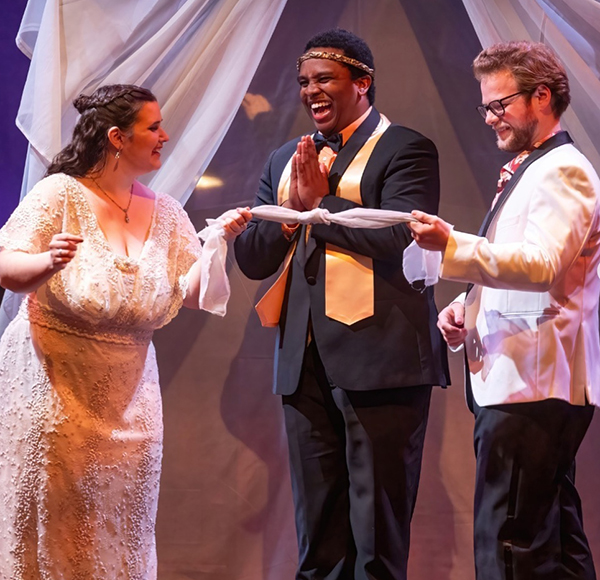 It also proposed some modernizations that Havey introduced into the plot: Eurydice died of a gunshot wound on her wedding day instead of a snake bite, and later, Orpheus radically changed his instrument of persuasion, trading his lyre for a handgun.
The singing by Isabel Merat (Orfeo), Travis Guillory (Apollo/Eco), Mae Harrell (La Musica/Euridice) Delaney Fox (Ninfa/Proserpina), Athena Woodfin (La Messaggiera/Speranza), William Sulkow (Pluto), Matthew Garvey (Caronte) and a half dozen soloists was uniformly impressive on Sunday afternoon. It seemed perfectly in accord with what the Roman aficionado Vincenzo Giustiniani described as the prevailing Mantuan style in Monteverdi’s time:
They moderated or increased their voices, loud or soft, heavy or light, according to the demands of the piece they were singing; now slow, breaking off with sometimes a gentle sigh, now singing long passages legato or detached, now groups, now leaps, now with long trills, now with short, and again with sweet running passages sung softly, to which sometimes one heard an echo answer unexpectedly. (Kelly, First Nights).
Equally impressive was the 16-voice vocal ensemble who acted as wedding guests and sang choruses throughout the show. Monteverdi had already produced five books of madrigals by the time he took up the subject of Orpheus and Eurydice, and his settings of pastoral poetry in the opera demonstrate his mastery of the form.
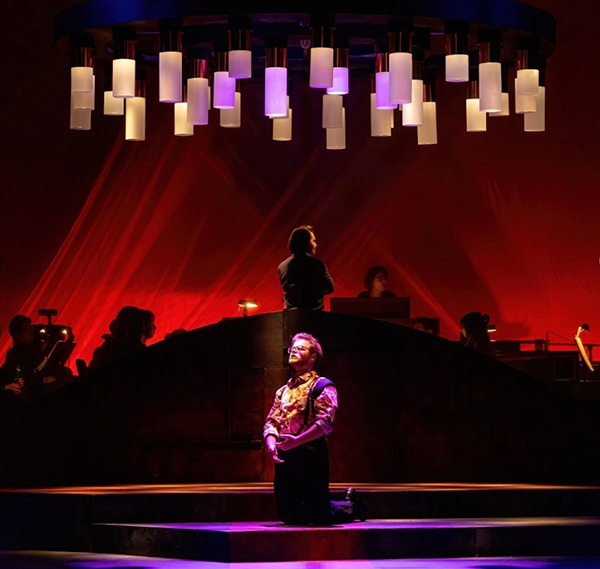
 The fine 25-piece instrumental ensemble of ten Baroque strings, pairs of theorbos, recorders, and cornetti, five sackbuts, harp, harpsichord, chamber organ, and regal (mostly students with a few guests), lined up precisely with the composer’s intentions: Monteverdi not only drew up a roster of instrumentalists for the first performance, but also indicated in the score who was to play what and where at any given moment.
(Details of the first performance of L’Orfeo are lavishly presented in Thomas Forrest Kelly’s book First Nights, in which the former Oberlin professor also chronicles the premieres of Handel’s Messiah, Beethoven’s Ninth Symphony, Berlioz’ Symphonie Fantastique, and Stravinsky’s Le sacre du printemps).
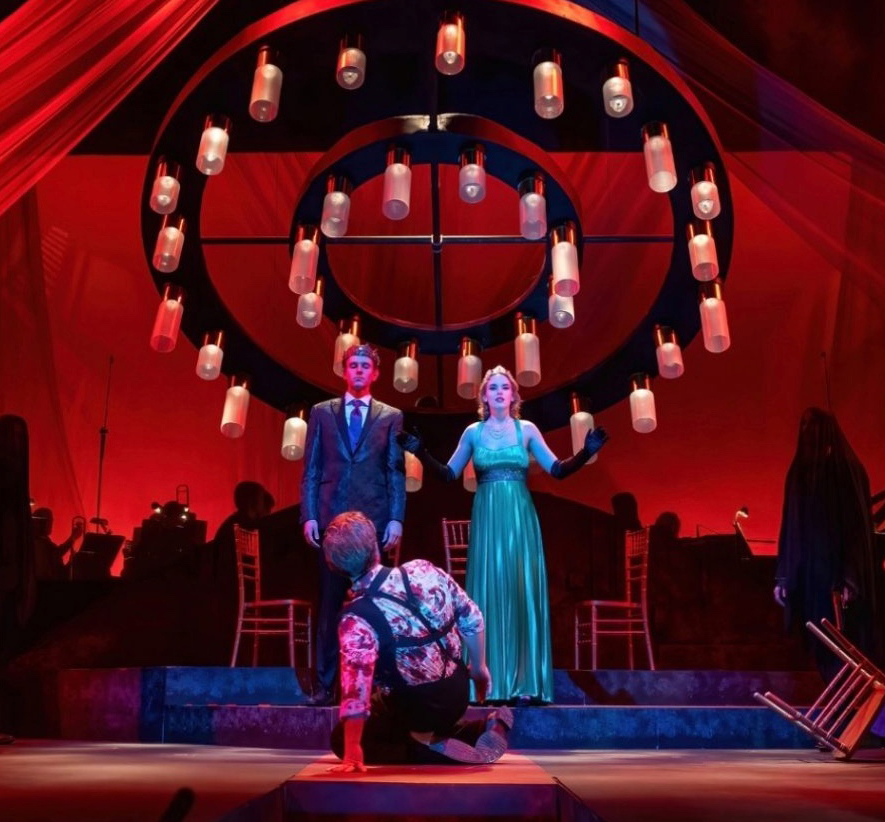
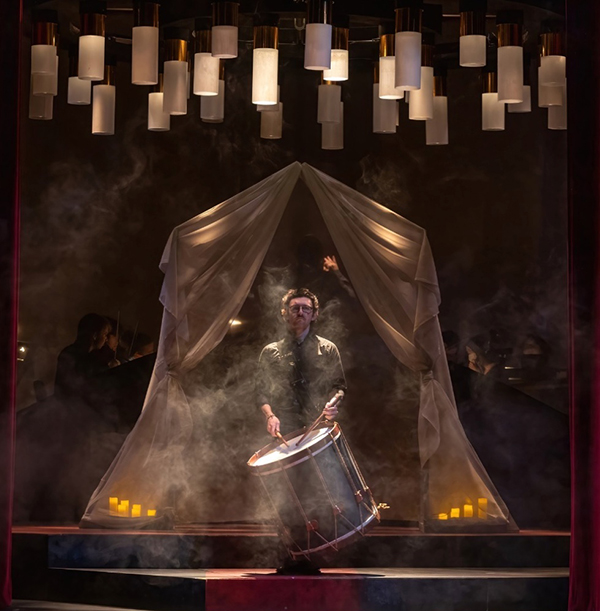 The result on Sunday was a delightful afternoon of early Baroque opera performed in period musical style but staged in modern dress (costuming by Chris Flaharty) on a minimal set (design by Laura Carlson-Tarantowski) dominated by a huge circular chandelier that changed its tilt for the Underworld.
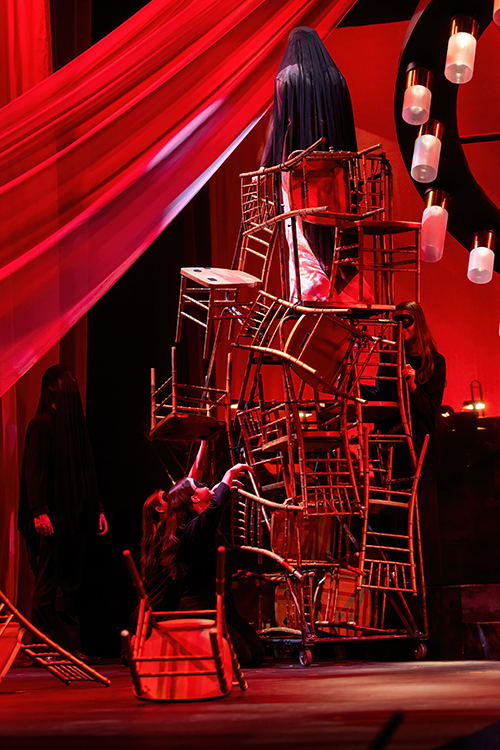 A collection of chairs accommodated wedding guests at the beginning and later, overturned, became symbolic of disorder. The chairs returned in Hades to form a bizarre, towering chariot for Eurydice.
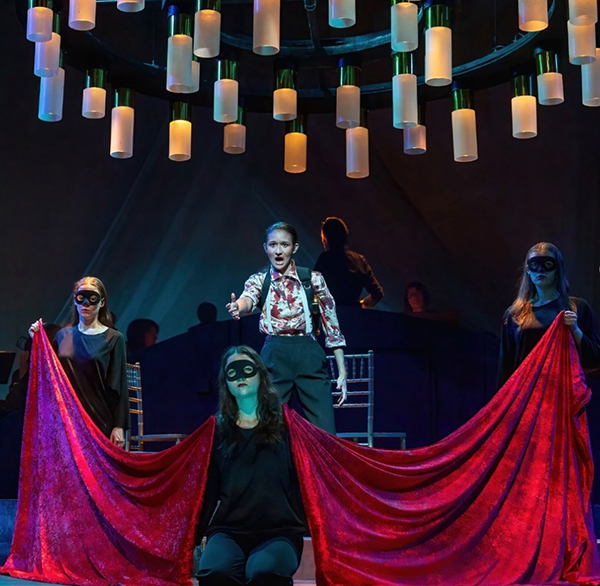
One particularly riveting scene with Orfeo and Caronte imaginatively suggested the River Styx ferry with swaths of scarlet cloth and underscored the singing with the otherworldly buzzing of the regal.
 Other striking instrumental effects included wonderfully mellow chorales played by the five sackbuts, and festive flourishes from the cornetti, whose calls to attention were designed to settle the audience in their seats at the beginning.
Photos: Scott Shaw
Published on ClevelandClassical.com March 20, 2024.
Click here for a printable copy of this article
