



by Daniel Hathaway
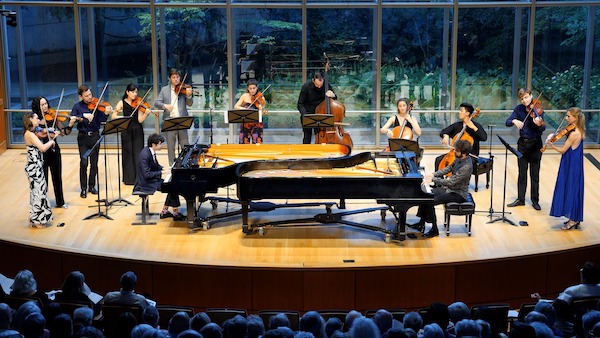 The thirteenth season of ChamberFest Cleveland began on an auspicious note with “Lost and Found,” a sold-out opening concert on Wednesday, June 11 at the Cleveland Institute of Music’s Mixon Hall.
The Festival put a special mark on the occasion by fielding two of its largest ensembles for the opening and closing works, and by presenting the Cleveland premiere of a riveting work by one of CFC’s four composer-performers in between.
Pianists Michael Stephen Brown and Roman Rabinovich shared thousands of notes as soloists in Johann Sebastian Bach’s Concerto in C for two claviers, a product of the composer’s concerts in Zimmermann’s Leipzig Coffee House, when he increasingly turned his attention away from church duties and produced concerts with University musicians. The C-major concerto is apparently unique for not having been arranged from an earlier work.
Brown and Rabinovich gave the concerto an elegant performance, maintaining a relaxed tempo while shaping long, smooth lines. Unusually, the strings dropped out for the slow movement, leaving Brown all alone on the beautiful, shapely lines and lovely articulation soon to be perfectly matched by Rabinovich. A sensible tempo and crisp articulation both from soloists and ensemble gave the concluding fugue room to breathe.
A complex stage reset took place for Michael Stephen Brown’s The Lotos-Eaters, an exotic sound sculpture inspired by evocative lines from the eponymous poem by Alfred Lord Tennyson that was a favorite in English Victorian literary circles.
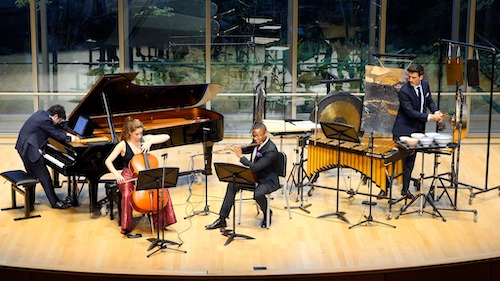 Most of the heavy lifting — both figuratively and literally — was entrusted to percussionist Tanner Tanyeri, who manned a thunder sheet, struck rice bowls with chopsticks, and added atmospheric effects on the vibraphone. Brown doubled on the angklung (bamboo rattle), playing inside the piano.
Conducting from the keyboard, Brown joined Tanyeri, flutist Brandon Patrick George and cellist Annie Jacobs-Perkins to launch the piece with a stormy opening movement that grabbed and held your attention amid harmonic cello slides.
Brown and Tanyeri collaborated in episodes of piano plus rice bowls and in stunning doublings between piano and vibraphone. George’s larger than life flute solos and Jacobs-Perkins’ huge cello sound wonderfully moved the air in Mixon.
The composer’s writing made for a magical transition into the return of the opening material and the final full ensemble movement suggested by Tennyson’s line, “O, rest ye, brother mariners, we will not wander more.”
Fresh and inventive, Michael Stephen Brown’s new piece steered clear of the musical clichés that its instrumentation might have suggested to less creative minds, and revivals of Tennyson’s poetry are always welcome.
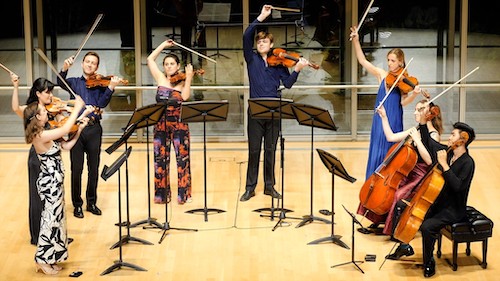 CFC’s opening concert concluded with Mendelssohn’s always thrilling Octet in E-flat with a lot of talent assembled on the Mixon stage.
The opening movement featured a healthy sound and a relaxed tempo. Leading the ensemble, violinist Maria Ioudentich handled the fast, technical solo passages with ease.
The “Andante” was graced by singing lines and a beautiful solo by cellist Annie Jacobs-Perkins. The players seamlessly passed the musical line from one to another, perfectly matching tone color and dynamics.
The famous Scherzo was spirited, but in this performance almost played too softly to make its mark. The transition into the coda of the finale was stunning.
Published on ClevelandClassical.com June 19, 2025
Click here for a printable copy of this article
