


by Mike Telin
 Daniel Reith was appointed assistant conductor of The Cleveland Orchestra by Music Director Franz Welser-Möst at the beginning of the 2022–23 season. In June of 2024, following a one-year contract extension, he was promoted to the position of associate conductor through the end of the 2024–25 season.
On Saturday, August 16 at 7:00 pm, Reith will conclude his tenure when he leads The Cleveland Orchestra at Blossom Music Center in a program of music by Edward Elgar, Gabriella Smith, and Max Bruch (tickets are available online.)
He made his Cleveland Orchestra subscription debut in February 2023 when he replaced Finnish conductor Klaus Mäkelä on very short notice. He also stepped in for Welser-Möst to lead the Orchestra as part of the first annual Mandel Opera & Humanities festival concert in May 2023.
Reith has also led the Orchestra in many performances, including Education Concerts in Cleveland and Miami, the Family Concert series, the annual Martin Luther King, Jr. Celebration Concert, and the Orchestra’s inaugural Sensory-Friendly Concerts.
“It is a bittersweet moment,” Reith said during a recent Zoom conversation, “Some of my fondest, dearest memories were made during the last three years. But the music world is very well connected, so I’m sure it isn’t a farewell in the final sense.”
When asked about Saturday’s program, Reith noted that Gabriela Smith’s Rewilding, a Cleveland Orchestra co-commission, marks the 50th anniversary of Cuyahoga Valley National Park — where Blossom Music Center is located.
“Many of Gabriela’s compositions draw their inspiration from nature. The music moves organically from one section into the next without your really noticing it. Nothing is repeated in exactly the same way, but everything is tightly related. It’s like taking a walk in a part of nature that is untouched by human beings. I think it’s a beautiful way of composing and the audience can look forward to hearing a very colorful piece.”
Reith said the 23-minute work for full orchestra travels through many different soundscapes including frog and bird sounds. “She uses a pair of bicycles as well as twigs, so there are a lot of unconventional playing techniques, especially in the percussion section. She also works with microtones. The score is quite complex, but the piece is very approachable and has a color pallette that is very personal — it’s her own brand.”
Reith said that during his time with the Orchestra he has developed a fascination with the music of Edward Elgar, whose Variations on an Original Theme is also on the program.
“It was wonderful to have played a couple of his lesser-known works like Sea Pictures and his first Symphony. But the “Enigma” Variations are quite well-known, and I find the background story to be so beautiful.”
Reith imagines Elgar improvising at the piano when his wife reacted to something he played, which became the original theme.
“In each of the variations Elgar describes one of his friends. I was lucky to get to know so many wonderful people over the last three years that there couldn’t be a more beautiful piece for a farewell concert than the Enigma Variations. So this is also a big thank you for the beautiful time I had here in Cleveland.”
Reith also looks forward to working with his good friend and assistant concertmaster Stephen Tavani. “I’m very glad he’s playing Bruch’s second Concerto. It’s a wonderful piece that he wrote for violin virtuoso Pablo de Sarasate. Sarasate loved the concerto and it’s a shame that it didn’t establish itself on the international stage like Bruch’s first concerto.”
Daniel Reith reflects on his tenure with The Cleveland Orchestra
Mike Telin: It’s hard to believe how much you have accomplished in three years.
 Daniel Reith: I’ve been told that I had the most step-ins of any assistant conductor. With all of those I was lucky to be able to conduct repertoire that you don’t often get as a young conductor. For example Varèse’s Amériques was one of my dearest memories. And recently I filled in for the all-Tchaikovsky program — working with Yuja Wang and then playing such an iconic piece as his Fifth Symphony with the incredible sound of the Cleveland Orchestra.
Those experiences give you opportunities to grow. Preparing one, or sometimes two programs every week over three years provides you with a huge amount of repertoire knowledge. And then, when it comes to the actual situation, it’s always amazing to feel the spontaneity, because nobody knows how it will turn out — neither the conductor nor the orchestra.
It’s also beautiful to experience what can happen when you don’t have the time to even think about it. Like this past March when I had to conclude the concert with the Leonora No. 3 Overture. I literally found out two minutes before I went on the stage.
MT: And this past fall when everything changed with the Beethoven Piano Festival.
DR: That was also a very special occasion. When would a young conductor get to lead all of Beethoven’s piano concertos plus the triple concerto with such amazing pianists and an orchestra like The Cleveland Orchestra. After conducting all six concertos it felt exactly as I described Gabriella’s piece — like having traveled around the world.
MT: You were also the music director of The Cleveland Orchestra Youth Orchestra (COYO). Congratulations on all the great work you did with them.
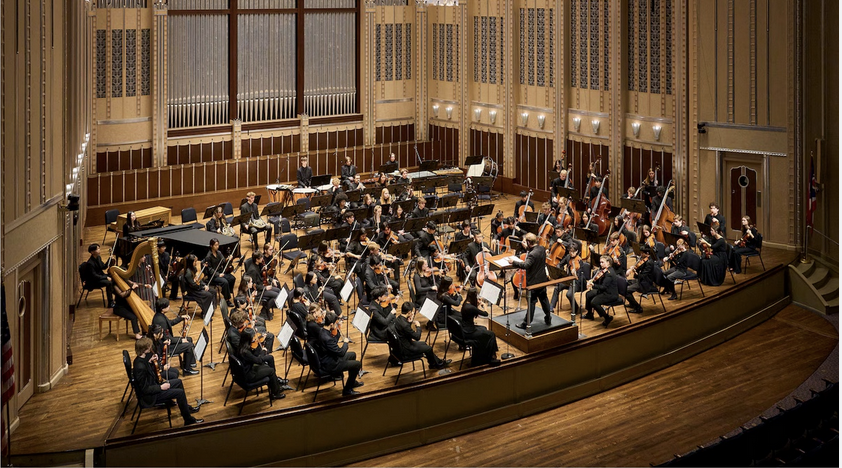 DR: Thank you very much. On the one hand it was a lot of work, but on the other hand, just a joy and really a privilege to see that growth.
A special aspect of a youth orchestra is that they are experiencing almost everything for the very first time. It was their first time playing a Beethoven 5, Tchaikovsky 4, and Rachmaninoff’s 2nd symphony. I took great inspiration from the joy they had experiencing something for the first time.
The other thing I appreciated about working with COYO is that it provided a wonderful frame for the students to learn about themselves and their role in the greater community. So from week to week I was able to watch everybody grow as musicians and as people.
Because I grew up in a family without any other musicians, I was very thankful for my teachers and the opportunities to be in touch with music and other musicians.
We want to provide the best possibilities for growth through the wonderful coaching by TCO members and rehearsing in Mandel Hall. It was inspiring to be a spoke in such a huge wheel.
After the final concert the players gave me a book where everybody had written comments about their experiences. It was really beautiful to see how different these moments were for them. Everybody focused on a different moment, but it was very beautiful to see what a strong impact COYO had for them and how they will carry these moments with them into the future.
MT: We’ve touched on so many special moments already. But is there anything else you’d like to share?
DR: Some of my favorite moments happened during tours. It enabled me to have close contact with the orchestra in a way I wasn’t able to at home. For example it was interesting to have deeper conversations with the musicians and hear about their perspectives and their experiences with certain conductors. Learning from that, what can I take over into my own work? What should I do? What should I not do? A lot of things like that.
Then of course experiencing Franz in his core repertoire. Watching him rehearse Strauss, Mahler, Schubert, and Bruckner was always an incredible learning moment.
So was watching composers like John Williams, John Adams, Esa-Pekka Salonen, and Thomas Adès. It is always a special moment to see composers performing their own pieces. That is really is one of the most valuable privileges of being an assistant conductor, because nowhere else can you experience these things and get to know them alive and in this moment.
MT: Final topic. What are your plans for the future?
DR: At the end of the month I will move back to Germany. I’ll conduct more there and in Scandinavia, where I was living before I moved to Cleveland. Most of my plans are not public yet, so I cannot say any more. But there are many exciting things coming up.
(Photos © Roger Mastroianni and Scott Esterly)
Published on ClevelandClassical.com August 12, 2025.
Click here for a printable copy of this article
