


by Daniel Hathaway
WEEKEND HIGHLIGHTS:
 On Friday at 7:30, Robert Walters steps out in front of The Cleveland Orchestra to play the U.S. premiere of Geoffrey Gordon’s Mad Song for English horn and orchestra. (Read our preview interview here.) Also on the program: Gustav Mahler’s Sixth Symphony. Tugan Sokhiev conducts at Severance Music Center. Repeated Saturday at 7:30. Tickets available online.
Also on Friday, Cleveland State University presents Boulez 100: Celebrating the Pierre Boulez Centenary, with Andrew Rindfleisch, director, Shuai Wang, piano, and the Boulez 100 Ensemble. Pierre Boulez’s Incises for solo piano, Dérive 1 for six players, and Dérive 2 for eleven players. 7:30 in Gartner Auditorium at the Cleveland Museum of Art. Tickets available online.
On Saturday, Cleveland Classical Guitar Society hosts Duo Noire, Thomas Flippin and Christopher Mallett, guitars, in world premieres of works by Bryan Senti, Casimir Liberski, and Layale Chaker, plus arrangements of music by J.S. Bach, Nathaniel Dett, and more. 7:30 at the Maltz Performing Arts Center. Tickets available online.
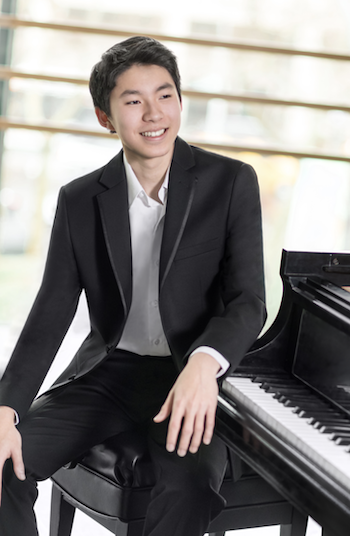
And on Sunday, the Tri-C Classical Piano Series presents Elliot Wuu (pictured), performing Claude Debussy’s Suite Bergamasque, Ludwig van Beethoven’s Sonata Op. 31 No. 3, “The Hunt,” and Sergei Rachmaninoff’s Daisies, Op. 38 No. 3, Preludes Op. 23 No. 4 & 8, and Sonata No. 2. 2:30 at the Tri-C Metropolitan Campus Auditorium. Free, but tickets required — register online.
For details of these and other classical events, visit the ClevelandClassical.com Concert Listings.
WEEKEND ALMANAC:
Paul Hindemith — that celebrated composer of the first half of the 20th century who was also a violist, conductor, and important music theorist and compositional pedagogue — was born on this November 14, 1895 in Hanau, Germany. His greatest works include the opera Mathis der Maler and the Symphonic Metamorphosis of Themes by Carl Maria von Weber, but going just slightly off the beaten path, wind players owe him a debt of gratitude for several major works of chamber music.
Oberlin Conservatory faculty members surveyed five of his sonatas on the 2018 album Convergent Winds: Music of Paul Hindemith (read Jeremy Reynolds’ review here).
And for a different and compelling take on standard repertoire — in this case Hindemith’s wind quintet — one can turn as usual to the Carion Quintet, that Danish-Latvian ensemble known for performing with choreography, and without chairs and stands. In this video of the first movement, they add even more theatricality: their performance is paralleled by a silent film that presents the music as a metaphor for disagreement — and maybe reconciliation — among the players.
