



by Daniel Hathaway
 There’s a long history in Western sacred music of extending and enriching liturgical forms and texts by adding new material. That’s how we got mass movements titled Kyrie cunctipotens genitor: medieval monks added words to decorate long chains of untexted notes called melismas. J.S. Bach tucked five extra pieces in between movements of his first version of the Magnificat to more clearly place them in the context of Christmas celebrations in Leipzig.
More recently, in 1962 Benjamin Britten added devastating verse by World I “war poet” Wilfrid Owen to the traditional funeral rite of the western Christian Church in his War Requiem, written for the consecration of the new Coventry Cathedral, built next door to the bombed-out shell of the previous church.
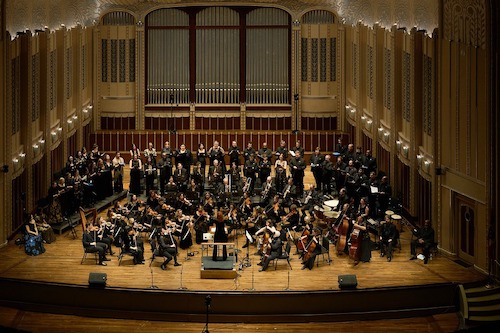
Jeannette Sorrell has now added to that tradition with her Mozart’s Requiem: A Tapestry, which cleverly expands and comments on the composer’s work, left unfinished at his death in 1791, with works by Black composers. I heard the premiere of her Tapestry in an often brilliant performance by Apollo’s Fire at Severance Music Center on November 8.
For more than 230 years, Mozart’s work has been generally accepted as complete in the version his widow commissioned from his student Franz Xavier Sussmayr, who had the benefit of access to the composer and his sketches in Mozart’s final hours. More recently, conductors have found the work of Sussmayr and his assistants to be less than edifying, and there are to date some 18 different pairs of hands who have sought to do better both with the musical material and its orchestration.
Sorrell’s scholarly re-imagining of the Mozart Requiem is more radical than creating plausible replacements that second-guess Mozart, and she has chosen wonderful excerpts from works by Eric Gould (from his Apollo’s Fire commissioned work, 1791: Requiem for the Ancestors), Damien Geter (from An African American Requiem), and Jesse Montgomery (from Five Freedom Songs), as well as her own Voices of 1791 to weave into the warp and woof of her Tapestry.
 Apollo’s Singers and Orchestra sounded wonderful all evening, beginning with Mozart’s Introitus expanded into the narrative of a typical slave ship that embarked from the west coast of Africa in 1791 as told by bass baritone Kevin Deas and soprano Sonya Headlam underscored by strings and harp with a repeated bass line. Mozart’s Kyrie eleison of the mass elicited gripping playing from the orchestra.
The torso of a Requiem mass from the late middle ages onward has been the Sequence, Dies irae, a long, fear-inspiring poem about the Last Judgment that began with Headlam’s beautiful singing of Eric Gould’s A Mother’s Pain, and concluded with Deas’ heartfelt Sometime I feel like a motherless child.
Tuba Miram was regally sung by Kevin Deas and accompanied by a smooth trombone solo by Greg Ingles..
Apollo’s Singers sounded fearsome in the over-dotted rhythms of Rex Tremendum majestatis, Elora Kares sang sweetly of freedom in Gould’s Phillis’ Song, and tenor Jacob Perry led Geter’s Sanctus Kum ba yah, spiced up with tambourine (Katy LaFavre) and congas (Luke Rinderknecht) to end the first half of the program.
After intermission, the Sequence resumed with Geter’s Lacrimosa, Mozart’s Confutatis, and the first eight bars — all that Mozart wrote — of his own Lacrymosa, the conclusion of the lengthy Dies irae.
 Presumably taking the place of a sermon, Headlam’s arresting performance of Jesse Montgomery’s arrangement of the traditional Black Spiritual, My father, how long will my people suffer here, ended what might be called the literary half of the Requiem, before bread and wine are offered as sacrifice and consecrated as the body and blood of Christ.
That action was accompanied by Mozart’s Offertorium, Domine Jesu Christe, his hostias et preces tibi, and the repetition of the former. In the middle, Charles Wesley Evans soloed dramatically in the traditional Nobody knows the trouble I’ve seen. A Sanctus went missing.
Only Mozart’s own Agnus Dei and the customary repetition of the Lux Aeterna from the beginning of the Requiem were left, but Sorrrell added two more movements: Geter’s Agnus Dei, and Jesse Montgomery’s arrangement of The Day of Judgment sung by Deas, Headlam, and company as a grand finale.
 Still to some extent a work in progress, a bit of tweaking with the Tapestry might turn a very good idea into a brilliant one. Taking an intermission only served to stop the progress of a Requiem mass in its tracks, and performing only the eight bars of Mozart’s Lacrymosa robbed. the Sequence of a suitable ending. Performing Montgomery’s Day of Judgment after the fragment of Mozart’s Lacrymosa vanishes might make for more drama.
And it’s not quite clear what the Tapestry wants to be, but the audience clearly enjoyed it and decided it wanted to begin applauding early in the piece. At the conclusion the capacity crowd rewarded Sorrell and her colleagues with a long ovation.
Published on ClevelandClassical.com November 16, 2025
Click here for a printable copy of this article
