


by Daniel Hathaway
HAPPENING TODAY:
 Tonight at 7 pm Matthew Jaroszewicz leads the Canton Youth Symphony Advanced Orchestra in Charles Ives Variations on “America,” Faye-Ellen Silverman’s Yellow Lilies (world premiere), John Williams’ “Adventures on Earth” from E.T., and George Gershwin’s Concerto in F with pianist Baron Fenwick.
Visit our Concert Listings for details of these and other performances.
INTERESTING READ:
In a frenetic digital era, he’s helping Angelenos rediscover the classic cassette player – LA Times via Yahoo
TODAY’S ALMANAC:
There are two major British composers to celebrate today, one adopted, the other very much a native of “England’s green and pleasant land.”
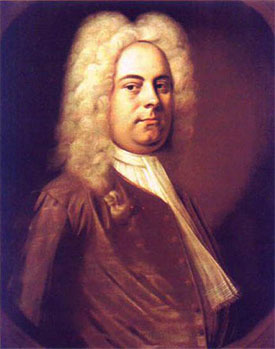
George Frideric Handel (pictured above) was born in Halle, Saxony on February 23, 1685. Details of his life are so well known — except perhaps his recently documented financial involvement with the slave trade — that a few random references may be welcome.
Like the British monarch at the time, Handel’s native tongue was German, which didn’t prevent him from becoming an English musical icon — but still gave him a bit of trouble when composing. In his book Handel, Christopher Hogwood relates this story told by John Taylor in 1832:
I heard [Morell] say that one fine morning he was roused out of bed at five o’clock by Handel, who came in his carriage a short distance from London. The doctor went to the window and spoke to Handel, who would not leave his carriage. Handel was at the time composing an oratorio. When the doctor asked him what he wanted, he said, ‘What de devil means de word billow?’ which was in the [libretto of the] oratorio the doctor had written for him. The doctor, after laughing at so ludicrous a reason for disturbing him, told him that billow meant wave, a wave of the sea. ‘Oh, de vave,’ said Handel, and bade his coachman return, without addressing another word to the doctor.
In 1723, Handel moved into rooms at 25 Brook Street in Mayfair, where he remained until his death in 1759. Some 230 years later, Jimi Hendrix moved into No. 23, and now you can visit a joint museum featuring the two musicians. Imagine if those two had been occupying adjacent digs at the same time.
When tastes changed away from Handel’s main source of income, Italian opera, he applied his dramatic gifts to oratorio. One of the most dramatic of those — and one that has in fact been performed as opera — is Belshazzar, performed here by René Jacobs and the Akademie für Alte Musik Berlin.
The oratorio Samson allowed the composer to address a personal malady: his failing eyesight due to cataracts. He began it immediately after completing Messiah, and Samson’s “Total eclipse” aria is poignant. Listen to the entire piece conducted by Harry Bickett here (the aria comes at 0:25:11). Tragically, the same incompetent surgeon who unsuccessfully operated on Handel later botched a job on the eyes of Johann Sebastian Bach.
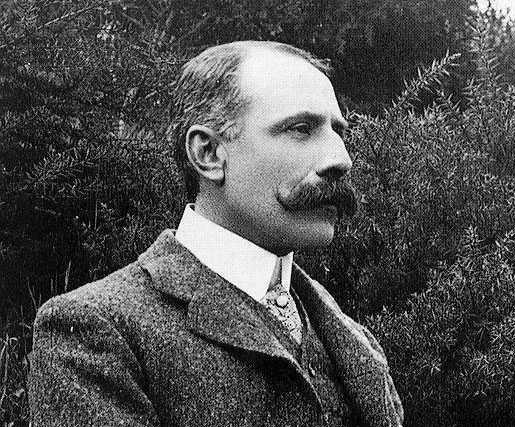 That native English composer is Edward Elgar, who died on this date in 1934 in Worcester. Best known to concert audiences for his Variations on an Original Theme (aka the “Enigma” Variations), Elgar scored an unlikely music coup with his oratorio The Dream of Gerontius, composed for the Birmingham Festival in 1900. His setting of a Roman Catholic poem by Cardinal John Henry Newman became much beloved in a Protestant country and frequently performed by choral societies.
(Watch a live performance from the BBC Proms in 2005 by the Halle Orchestra and Choir and the London Philharmonic Choir led by Mark Elder with Paul Groves as Gerontius here.)
A similarly unlikely meeting of cultures occurred when the Oberlin Musical Union performed Gerontius in 1907 and 1908. Oberlin musicology professor Steven Plank explores those events in his monograph, Elgar in Oberlin: A Meeting of Worlds.
Finally, I vaguely recall that The Cleveland Orchestra was scheduled to perform the work a few decades back when the featured soloist had to withdraw due to illness. But through sheer luck, the only other tenor active on the concert scene who knew the role of Gerontius was just leaving town and was able to be tracked down at the Cleveland airport. Anyone remember the dates and details?
