


by Daniel Hathaway
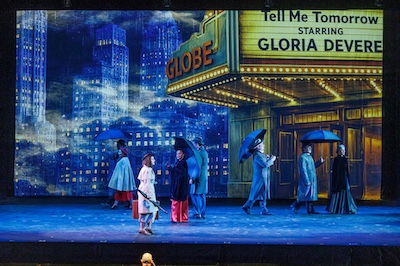 Oberlin Opera Theater’s spring productions brought two recent titles by composer John Musto and librettist Mark Campbell to the Hall Auditorium stage from March 5-7.
The excellent productions were masterfully directed by Scott Skiba, and the first-class Oberlin Contemporary Music Ensemble was conducted by Timothy Weiss, who synchronized stage and pit with a deft hand. And the singing and comedic acting — clearly informed by a residency with John Musto — were terrific.
Later the Same Evening (2007) was inspired by five paintings by Edward Hopper, the famous 20th-century chronicler of urban isolation. Bastianello (2008) expands on an outrageous Italian folk tale. Both have been filtered to some extent through Freudian psychoanalysis, which makes them relatable on the same program for those who wish to dig deeper.
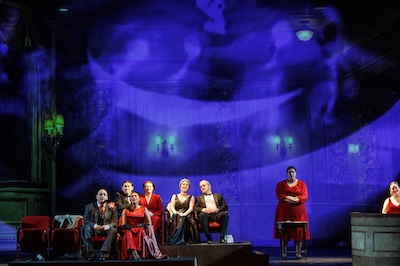 The earlier title, set in 1932 with a runtime of 70 minutes, animates some of Hopper’s characters as attendees of Tell Me Tomorrow, a fictitious Broadway musical. They’re a colorful collection of personalities with a variety of personal stories, who come together again in different combinations ‘later the same evening.’
The top-notch cast showed their excellent vocal and acting skills in bringing authenticity to their characters. Ella Vaughn and Finian Malarkey were sympathetic as Elaine and Gus O’Neil, a young married couple struggling to find their place in the world..
You had to feel for Estelle Oglethorp (Mackenzie Strum), a widowed woman waiting in a hotel lobby for her date for the evening, the charming Ronaldo Cabral (Brandon Jeung Phillips).
Isabelle Balderra brought a touch of regret to the role of Ruth Baldwin, a failed ballet dancer who writes a letter to her boyfriend Joe Harland (William Sulkow) telling him she is leaving to return home. Joe later encounters Thelma Yablonski (Rebekah Grande), a theater usher sitting alone in an automat. He’s already forgotten about Ruth.
Madeleine Métraux and Ilan Balzac were completely believable as the older couple Rose and Sheldon Segal, who continuously bickered as they settled into their seats at the theater.
Rounding out the stellar cast was Ethan Burck as Jimmy O’Keefe, a young out-of-towner who buys a theater ticket from Elaine, and Molly Chun as Valentina Scarcella, a singer who makes a cameo appearance during the opera.
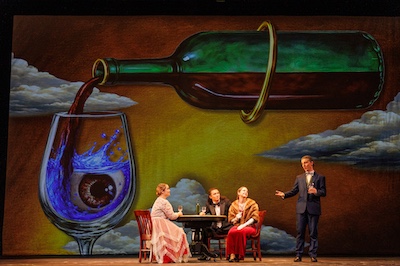 In contrast to Later the Same Evening, Bastianello is an exaltation of sheer silliness. Running only 40 minutes, it centers around the young husband Luciano (Matthew Garvey) who is on a quest to find three fools greater than his wife Amadora (Kailey Pritchard), from whom he has become estranged after she spills an entire barrel of wine.
He has little trouble locating Frediano, a man who is famously incapable of putting on his own trousers (Will Sulkow), Eustacia, a bride on horseback who repeatedly hits her head on an archway (Maya Brown), and even his wife, who falls into a lake mistaking the reflection of the moon for her face.
Proposed solutions to their thorny problems — including decapitation — are hysterically funny. Some come from her horse Lambent (Venus Minaya), and Luciano finds even himself branded as a fool in the final episode.
Scenic design by Laura Carlson-Tarantowski and projections by Brittany Powell Blaschke added vivid and sometimes controversial context to both shows, raising the question of how much artificial intelligence should figure in the creative process. No matter your opinion about that, the colorful Hooper and Dali-like images were fun and engaging.
Likewise, John Musto’s musical score uses a combination of styles — contemporary classical, blues, and jazz — to great effect, always serving the libretto.
Photos by Scott Shaw
Published on ClevelandClassical.com March 25, 2026
Click here for a printable copy of this article
