

by Mike Telin
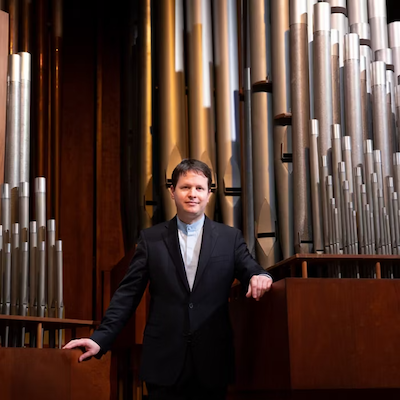 For over a decade, organ virtuoso Paul Jacobs has been a frequent guest soloist on Cleveland Orchestra programs. Jacobs made his debut in February of 2015 when he had the Severance Hall stage all to himself when he opened for the Orchestra, playing music by Johannes Brahms and Johann Sebastian Bach on the 94-rank Norton Memorial Organ.
Jacobs returned in September of 2016 with Aaron Copland’s Organ Symphony and in November of 2017 with Stephen Paulus’s Grand Concerto for Organ and Orchestra. In March of 2019 he gave the U.S. premiere of Bernd Richard Deutsch’s Okeanos for organ and orchestra. And in 2021 he was featured in Francis Poulenc’s Concerto for Organ, Strings, and Timpani.
On Thursday, April 2 at 7:30 pm Paul Jacobs will return to the Mandel Concert Hall stage to revisit Poulenc’s concerto with The Cleveland Orchestra. Under the direction of Daniele Rustioni, the concert also includes Gabriel Fauré’s Suite from Pelléas et Mélisande, Alfredo Casella’s Italia, and Claude Debussy’s La Mer. The program will be repeated on Friday and Saturday at 7:30 pm. Tickets are available online.
I caught up with the organist by phone and began our conversation by noting that he had previously performed Poulenc’s Concerto with Franz Welser-Möst and the Orchestra in 2021 under the constraints of COVID.
Paul Jacobs: It’s great that we get to revisit it, however this time the console will be in its usual concerto position on the platform in front of the conductor so I’ll have a very clear sense of the balance, and the audience will be able to see and hear everything.
Mike Telin: The concerto has a very interesting background.
PJ: It was written for the Princess Edmond de Polignac, the American-born heiress to the Singer sewing machine fortune. It was not uncommon in those days for affluent individuals to have pipe organs in their salons for musical soirees.
Initially, Poulenc was considering the organ part to be on a more modest scale and not very difficult so that she could play it herself in her own home and maybe for an intimate audience.
And then he continued to reflect on the piece. He was coming to discover (or rediscover) his Catholic faith. So this concerto takes on a more serious spirit than his Double Piano Concerto or the Harpsichord Concerto — though you do get splashes that are very joyful and very earthy in the Organ Concerto. But it definitely has moments that seem more ominous and even terrifying.
The end of the work reminds me of mortality with the ticking of the clock in the pizzicato strings. Then in the last few measures, we get this unison fortissimo chord and it ends with a bang. It’s a very enigmatic conclusion. It’s amazing how he’s able to mix so many moods and textures in a strangely convincing way. It’s a life’s journey wrapped up in a little over 20 minutes of music.
MT: You play a lot with orchestras — probably more than any other organist that I’m aware of. What makes you want to do that?
PJ: As a student and a young musician, I always craved opportunities to collaborate, whether they be with other instrumentalists or singers. Then increasingly, I started to work with conductors and orchestras, and it just snowballed from there. Of course I have wide repertory interests. I cover the gamut, everything from Handel through premieres of new works, including that magnificent concerto Okeanos by Bernd Richard Deutsch that I played with Cleveland a few years ago.
MT: I couldn’t help but notice Daniele Rustioni is on the conductor list of your website. I’m taking it that you have worked with him before.
PJ: Last season actually — he conducted the Philadelphia Orchestra in a pretty flamboyant organ concerto by Alfredo Casella, Concerto Romano.
MT: As you know, the Severance organ is an E.M. Skinner. They’re all so different. How long does it take to acquaint yourself and, or in this case, to reacquaint yourself with an instrument?
PJ: I am intimately familiar with Skinner organs and love them. Ernest Skinner, one of the most prestigious organ builders of the first part of the 20th century, took organ building to an even greater level of refinement. Skinner, for instance, invented the French horn organ stop, as well as the Erzähler. And he made some other tonal refinements to the pipe organ. So the palette of the Skinner organ is rich and warm and brilliant when called for.
There is a wide range of beautiful string stops and well-voiced reeds, all under a higher wind pressure than organs of previous times. He was very inspired by the sound of the orchestra and wanted his organ to imitate more closely the beautiful tones that come from an orchestra. The Skinner seems like a perfect fit with the Cleveland Orchestra. One of the finest orchestras in the world, obviously.
MT: What drew you to the organ in the first place? I know you had your first church gig by the time you were 15. But what happened in those first 15 years?
PJ: I had aspirations of being a pianist and then a conductor. As a boy I listened to old LPs at my grandparents of classical masterpieces. I would seclude myself in a room, put on a record and conduct with sticks. Eventually a family member bought a real baton for me.
Then I became acquainted with the organ in church. I would work myself into the gallery as the organist played the postlude.
Not growing up in a particularly musical family in the small town of Washington, Pennsylvania, I was very fortunate to have wonderful mentors who encouraged me. But it was in church that I became fixated on the sounds of the pipe organ and the complexity of the instrument. I’d find myself even sneaking up on ladders into the pipe chamber and looking around. I probably shouldn’t have been there. It might even have been dangerous. But I couldn’t help myself.
MT: Everyone needs good mentors. You’ve been teaching at Juilliard for a number of years.
PJ: This is my twenty-third year.
MT: Congratulations.
PJ: Well, thank you. I’ve had some major talents entrusted to me over this time. And I remain very encouraged working with some extraordinary young people from all over the world.
MT: You also head the Organ Institute at the Oregon Bach Festival.
PJ: That’s right, which has become a very special part of my life.
MT: I was looking through some of your social media. You seem to be a student of history who admires those who came before you. I’m sitting there looking at photos of you and your teacher, photos of you and Gary Graffman, and the tombstone of Horatio Parker.
PJ: I love Parker’s concerto. That is a piece that Cleveland needs to hear on the Skinner organ.
MT: Do you consider yourself to be a historian?
PJ: I certainly am interested in history — music history and the history of architecture. Organists have the great pleasure of playing in beautiful spaces, many of them churches, not just concert halls. But yes, history is important to me. Showing the timelessness of great art and great music, and how it can transform our lives today. This is a mission that is important and thankfully never tires me.
Published on ClevelandClassical.com March 30, 2026
Click here for a printable copy of this article
