



by Daniel Hathaway
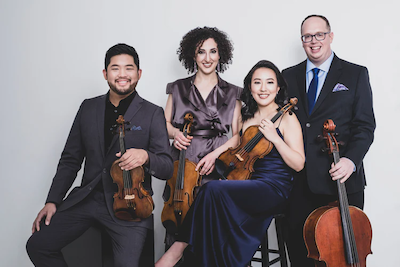 Most often, ensembles hosted by the Cleveland Chamber Music Society are on tour and get picked up and dropped off at Cleveland Hopkins Airport. But for their April 28 performance at the Cleveland Museum of Art, the Verona Quartet were able to avoid all the vagaries of modern air travel — TSA searches, lost luggage, hassles over transporting cellos, and the inevitable flight delays.
Based at Oberlin Conservatory, where the Verona are the resident quartet, they were only 45 minutes away by car from the concert venue, where they joined pianist Yaron Kohlberg in a fascinating program of works by Alessandro Scarlatti, Phillip Glass, Leoš Janaček, and Antonín Dvořák — not your usual three-course string quartet menu.
The quartet — violinists Jonathan Ong and Dorothy Ro, violist Abigail Rojansky, and cellist Jonathan Dormond began the evening’s adventure with Neapolitan composer Alessandro Scarlatti’s Sonata a Quattro No. 4 in d. Although not so prolific as his Spanish-based son Domenico, who produced 600 keyboard sonatas, Alessandro brought a similarly individual voice to his operas and vocal works.
Tonight’s Sonata comprised a fugue that the Verona played with richly hued, well-blended lines, beautifully spun, a suspenseful, second movement larded with harmonic surprises, two fast and virtuosic episodes, and a quick, jovial dance.
The program took a literary as well as a psychological turn with two works based on novellas that plumb the human psyche.
The Verona brought visual life to Phillip Glass’s Quartet No. 2, a collection of fragments based on Samuel Beckett’s Company that jettisons traditional movement titles in favor of metronome markings. Quarter note = 96 has the first violin hovering above the other players. Quarter note = 160 features seismic dynamic shifts, and Quarter note = 96 starts off as a beautiful piece that suddenly stops, while the second Quarter note == 160 conveys visions of mental anguish.
The quartet moved without pause into Janáček’s String Quartet No. 1 (“Kreutzer Sonata”), which takes its subtitle from Leo Tolstoy’s novella of the same name.
Although the work is not intended to be programmatic, the Verona brought Tolstoy’s characters to life in a passionate performance filled with color. The music is intense, emotional, volatile, and dramatic, and was brilliantly played by the Veronas. A highlight was Jonathan Ong’s sidetrip into polka rhythms.
While one Czech composer had filled Gartner Auditorium with such drama, another Czech composer was waiting in the wings to throw the windows open and bring fresh, spring air into the second half of the program.
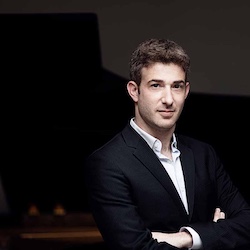 Equal to the latter task was Antonín Dvořák, whose Piano Quintet in A closed the evening, joined by pianist Yaron Kohlberg, who is usually busy behind the scenes as CEO of Piano Cleveland, but is a first-class pianist himself — as much fun to watch as he is to hear.
The opening allegro began with a beautiful cello solo by Dormand which led to lean, fast scale passages and splendid dynamic shifts and full-bodied cresendos. Wonderful phrasing abounded, and no one stepped on another player’s moment to shine.
The many mood shifts in the “Dumka” made for an exciting listening experience. The recap of the opening was like meeting up with a long lost friend, the finale like a celebration.
The scherzo was fast and full of life, always pushing forward but never sounding rushed. The slow section was relaxed and beautiful. The ensemble’s playing of the finale was pure fun. Tight, clear, and electrifying. A first-class collaboration.
Published on ClevelandClassical.com May 14, 2026
Click here for a printable copy of this article
