

by Peter Feher
 CLEVELAND, Ohio — When the sun rises on the sea at the beginning of Claude Debussy’s La Mer, there’s no coastline or human civilization in sight. Dark, rumbling waves in the timpani and low strings have brightened to reveal the full orchestra in sublime, surging phrases. We could be anywhere on the wide-open ocean.
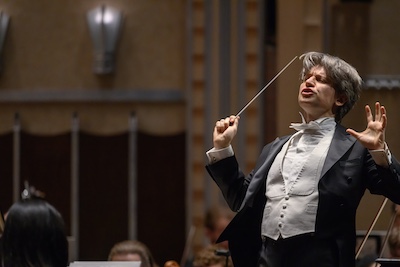
But listeners won’t be left adrift in Debussy’s score this weekend at Severance Music Center. The Cleveland Orchestra is embarking on a luxuriously charted course with Italian guest conductor Daniele Rustioni. Although mostly focused on French repertoire, the program basks in a broader Mediterranean spirit.
An abundance of pleasure — along with the occasional burst of hot-blooded passion — was palpable throughout the Orchestra’s performance on Thursday, April 2, in Mandel Concert Hall.
The emotions that well up in La Mer are a touch more restrained, even as Debussy’s inspirations for the piece ranged far beyond Southern Europe. To capture the sea in all its shifting subtleties, the composer drew not only on personal experience — such as childhood trips to the French Riviera — but also on the work of visual artists he admired.
A woodblock by the Japanese printmaker Hokusai graces the original 1905 cover of Debussy’s score, though you could just as easily imagine a seascape by the English painter J.M.W. Turner in its place.
All of this suggests the many creative directions that La Mer might take. Rustioni’s interpretation sought out the drama in the music’s emotional depths, building to an impressive climax of brass and percussion at the end of the first movement — the moment the sun strikes the water at full noon strength.
The scherzo that followed, titled Play of the Waves, was perhaps too agitated, with the conductor’s churning tempo obscuring some of the surface delights in the woodwinds and strings. But the musicians were primed to whip up a massive storm in the last movement, which thundered to its final note.
And to think the evening had set sail so gracefully. The program began with Gabriel Fauré’s Suite from Pelléas and Mélisande, and the lilting rhythm of the Sicilienne — introduced by flutist Jessica Sindell — soon established the leisurely scene. No one can resist the allure of this Mediterranean dance, not the least Fauré, who somehow wove it into a Symbolist story about French lovers lost in a medieval forest.
After intermission, Rustioni swept everyone back to Sicily with a romp through Alfredo Casella’s Italia. Restraint was left somewhere on the mainland as the Orchestra tore into a 20-minute rhapsody on regional folk songs, seldom heard in American concert halls but instantly recognizable once the strains of Funiculì, Funiculà started up. The whole thing was a lot of fun — and about ten minutes too long.
Between these two excursions came a good measure of Catholic faith courtesy of Francis Poulenc’s Concerto for Organ, Timpani, and Strings — a major work that coincided with the composer’s reconversion. The score is weighted toward solemnity, though Thursday’s performance perked up whenever Rustioni pivoted on the podium to cue a change in character from soloist Paul Jacobs, seated front of stage at the Norton Memorial Organ console.
With the E.M. Skinner keyboards at his hands and feet, Jacobs was adroit, unfazed, and a force to match the Orchestra. He contributed to the magnificent excess of the evening with an encore of J.S. Bach’s Fugue in A Minor, BWV 543.
Photos courtesy of Yevhen Gulenko
Published on ClevelandClassical.com April 8, 2026
Click here for a printable copy of this article