

by Kevin McLaughlin
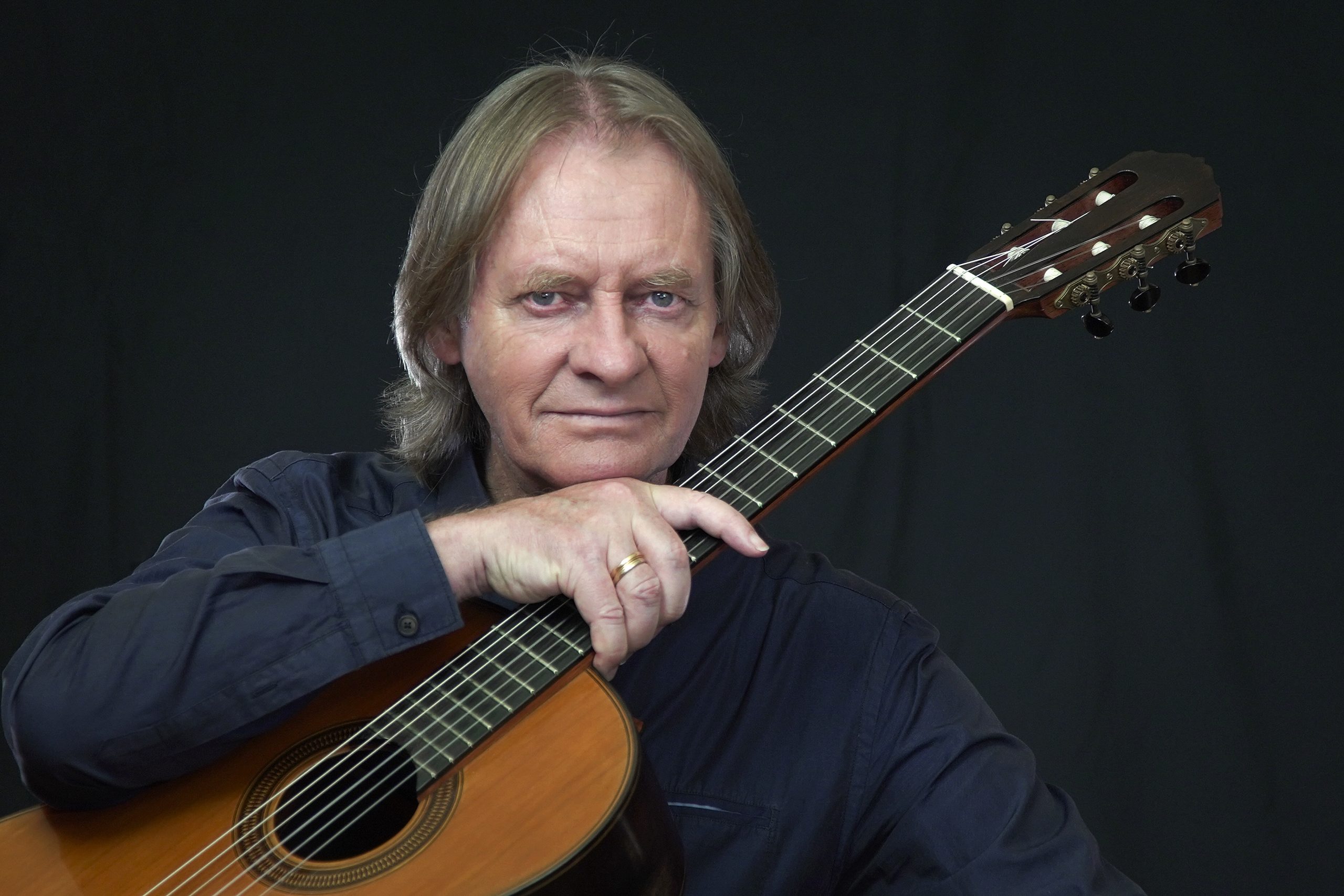 On Saturday evening, April 11, David Russell — the renowned Scotsman who makes his home in Spain — walked onto the stage of the Maltz Performing Arts Center, and with a shy smile and wave, set about performing wonders on his instrument for the Cleveland Classical Guitar Society.
He began with Mauro Giuliani’s Grand Overture, a piece from the era when the guitar was still trying to elbow its way into the drawing rooms of Europe, hoping to be taken as seriously as the piano or the violin. Giuliani, who left Italy for Vienna in 1806, was among those tireless advocates. Though he once played the cello in the first performance of Beethoven’s Seventh Symphony, it was the guitar that preserves his name in amber.
The Giuliani, with its bold chords and quicksilver runs, made a fitting opener. Russell shaped the music wisely, giving each fast passage a clean edge and guiding the piece forward with a sure hand.
After that, Russell turned to the music of Johann Sebastian Bach, offering what he called, with a smile, “simply works he liked to play.” Bach never wrote a note for the modern guitar, but you wouldn’t know it from the way these pieces have found a home on the instrument. Russell picked out a handful — a lute prelude, a keyboard sinfonia, the Arioso from a beloved cantata (BWV 156), and a few dances written for harpsichord — and strung them together into a suite that felt both spontaneous and carefully considered.
What held them together was Russell’s sense of phrase — an awareness of both the long line and the small turn. Just as striking was his ability to separate melody from accompaniment — old hat, perhaps, for guitarists, but handled here with a finely varied palette of color. In the Prelude and Sinfonia, the notes seemed to hang in the air for a moment, then glide forward like a bobsled. The beautiful Arioso came out in one long, unbroken line (a neat trick for a plectral instrument), as if he were singing it to himself. When he played the dances, the rhythms had lift. You might even say, swagger. The guitar, in his hands, sounded like itself — warm, rounded, and intimate — not trying to be a harpsichord or an organ.
The first half concluded with works by Isaac Albéniz, the Spanish pianist whose music is catnip for guitarists. Though written for piano, his evocations of Spain — Andalusian dances, Moorish echoes, street songs — seem to have been waiting for the guitar all along. Again, Russell offered a selection of his own favorites: Cuba, Capricho Catalán, Pavana, Zambra Granadina, and Malagueña.
Here, Russell’s playing shifted gears. The rhythms had a sway, and the melodies were dressed with just enough ornament to catch the ear. Afterward, I heard more than one person say, with a kind of wonder, that they’d “never heard thirds sound so good.” What stuck in the ear was his tone — rich and clear, filling the hall with an easy bloom.
After intermission, Russell returned with a new work written for him by Stephen Goss, a Welshman, a prolific composer for the guitar, and a longtime friend. Don Quixote unfolds as a series of musical snapshots drawn from Cervantes. As he played, the movement titles — “Don Quixote and Sancho Panza,” “Dulcinea,” “Tilting at Windmills” — were projected above the stage, along with illustrations by Gustave Doré and Tony Johannot for context.
The images did more than decorate. They shifted attention away from the player and toward the story, leaving Russell freer to play — not as the main event, but almost as a sideman to the narrative. In the opening movement, the contrast between knight and squire came through clearly; in “Dulcinea,” the line opened into something frank and lyrical. The tone he drew from his instrument was luminous — for a moment, you felt more kindly toward the world.
Elsewhere, moods turned quickly, with a kind of narrative logic, however absurd: the would-be knight charging windmills, mistaking sheep for armies, attacking puppets. The music sketched these scenes with orchestral breadth, enough to make you forget, at times, that it all issued from six strings.
To finish, Russell played a handful of pieces from Gabriel Estarellas’s Homage to Charles Chaplin, a suite that tips its hat to the actor and the silent film era. Estarellas, a native of Mallorca, writes plainly, with a Spanish inflection. The six movements selected — “Sueños” (Dreams), “Bastón” (Cane), “Blanco y Negro” (White and Black), “Añoranza” (Nostalgia), “Botas” (Boots), and “Tramoyista” (Stagehand), trace Chaplin through comedy, tenderness, and solitude. Again, relevant images were projected overhead: the cane and bowler, the worn boots, the small figure with a flower, pausing on the edge of pathos.”
Russell met the music with an inward quiet. The tremolos were particularly effective, not as a party trick, but in the service of color and line. In “Añoranza,” a muted sadness settled over the hall. In the lighter numbers, Russell caught Chaplin’s mix of humor shadowed by loneliness.
By evening’s end, what lingered wasn’t any single display of fingerwork, though there was plenty, but the sense of musical thought directly expressed. Nothing seemed to intervene between intent and realization.
He gave the final word, in the form of an encore, to the Celts: Gurtie’s Frolic, played at a lively clip.
Before Russell came on, five young guitarists from the CCGS Advanced Ensemble, under the direction of Christopher McDonald, played a short set: two spirituals arranged by Thomas Flippin and Adelita by Francisco Tárrega. The group played together well, giving the music a straightforward reading and setting a quiet, attentive mood for what followed.
Published on ClevelandClassical.com April 15, 2026
Click here for a printable copy of this article
