

by Kevin McLaughlin
 Early May is when things begin again — the ground softens, and routines return.
Under the direction of Daniel Meyer, BlueWater Chamber Orchestra’s program on Saturday, May 2, “Rustic Reverie,” traced that process in works by Douglas Moore, Joseph Canteloube, and Joseph Haydn.
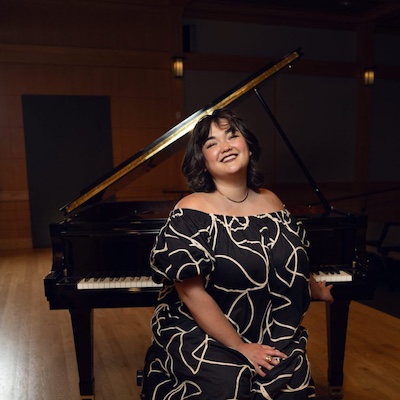
The concert’s high point was American-Canadian soprano Midori Marsh’s return to Cleveland and Covenant Church. A native of Cleveland Heights who attended the church in her youth, Marsh has spent recent months touring as Carlotta in The Phantom of the Opera, including a stop at Playhouse Square.
Marsh offered a poised account of several of Canteloube’s Songs of the Auvergne. A young singer still finding her ease onstage, she brings a springlike quality to her voice — bright highs alongside a honeyed middle, and a quiet inwardness that lends the melodies and texts a settled, almost conspiratorial depth.
In “Lou Coucut” — faithful to the dialect (she sounded the final “t”) — she leaned into the song’s mischief. The text turns on the repeated “coucut,” a simple bit of onomatopoeia that becomes, in performance, something more suggestive. Marsh paused and raised an eyebrow at the slyly placed “Say?” The audience was in on it, and she returned to the song as an encore.
Meyer and the orchestra kept a light frame around her. The strings provided atmosphere, flutist Sean Gabriel added a light sheen, and in “Baïlèro,” oboist Terry Orcutt answered the voice from across the river like a distant shepherd’s pipe.
The program opened with Douglas Moore’s Farm Journal (1948), a suite drawn from his score for the documentary Power and the Land. That film, part of the Rural Electrification Administration’s campaign, documented the arrival of electricity to a working farm in southeastern Ohio. Unlike Virgil Thomson’s comparable The Plow That Broke the Plains (1936), Moore’s music feels less like Depression-era commentary than description — plainspoken, folk-like, American. Meyer and the Orchestra met it on those terms.
“Up Early” had a steady, unforced gait, the strings moving with a workman’s swing. Solos by David Duro (trumpet), Phillip Austin (bassoon), and Amatai Vardi (clarinet) added lift, while Terry Orcutt (oboe) supplied a touch of pastoral color.
“Sunday Clothes,” “overstarched” in Moore’s description, settled into something like a hymn. “Lamplight” drew inward, Orcutt’s oboe line gently nostalgic, evoking the comfort of a family circle on a porch at dusk. In “Harvest Song,” the music broadened, the farm community sketched in open, affectionate strokes. Meyer resisted the urge to press the tempos or over-shape the phrases, and the result felt direct and close to home.
Haydn’s Symphony No. 99 does not pretend to be pastoral, yet it teems with life. Like the other works on the program, it is grounded and energetic, propelled by sturdy rhythms, clear textures, and direct, immediately graspable themes.
Guided by Meyer, the opening Adagio carried weight without heaviness. In the ensuing Allegro, textures were transparent; he gave the wind choir room to answer the strings as momentum gathered.
The slow movement proceeded with restraint, its variations shaped without exaggeration. The oboe and bassoon lines came through with chamber-like clarity. The Menuet had welcome heft — less courtly, more grounded — and the Trio offered a lighter turn. The finale moved with a ready lift, the orchestra providing equal parts clarity and forward motion. The winds — particularly horns and flutes — added color and buoyancy.
If Moore’s suite and Canteloube’s songs place us in a landscape, Haydn brings that same vitality into motion.
Happy spring.
Photo by Daniel Welsh
Published on ClevelandClassical.com May 14, 2026
Click here for a printable copy of this article
