



by Daniel Hathaway
 This article was originally published on Cleveland.com
CLEVELAND, Ohio — In 1897, a year before Richard Strauss wrote his shamelessly autobiographical tone poem, Ein Heldenleben, Antonín Dvořák completed his Heldenlied (Hero’s Song), a more generalized ode to Courage that ended and gave its title to The Cleveland Orchestra’s program at the Mandel Opera and Humanities Festival at Severance Music Center on May 22.
The Dvořák work joined Adolphus Hailstork’s Epitaph for a Man Who Dreamed, Grażyna Bacewicz’s Symphony No. 4, and the world premiere of Jüri Reinvere’s Concerto for Violin, Harp, and Orchestra on a brilliantly played, fascinating playlist of rarely performed works that invited introspection and earned their performers the kind of wild ovations usually reserved for old warhorses.
Hailstork wrote his Epitaph in 1979 in memory of Dr. Martin Luther King Jr., the civil rights hero who was assassinated in Memphis in 1968. It takes its title from Dr. King’s I Have a Dream Speech, delivered during the March on Washington in 1963.
Beginning with a soft, expressive statement in the violas and cellos, the solemn, the piece subtly turned into a hymn or spiritual. Off-stage chimes rang from both sides, as the music grew in volume and intensity, calling on King’s followers to carry on his work. Throughout the ten minute piece, Franz Welser-Möst drew a richly hued sound from the ensemble.
Polish composer Grażyna Bacewicz, an active member of the Resistance during World War II, became a refugee following the Warsaw Uprising in the summer of 1944, and her Fourth Symphony, composed in 1953, is still bleeding from her wounds.
The Symphony is a highly dissonant but attractive four-movement piece full of compelling musical ideas that keeps you waiting on edge to hear what she is going to do next. Happily, Welser-Möst figured out how to make her collection of musical ideas work together.
The Appassionato – Allegro inquieto opens with a passionate, anxiety driven character, driven by strong, angular melodies and the rhythmic intensity characteristic of Bacewicz’s style. The deeply-moving Adagio offers a more lyrical, introspective, and emotional mood with slow, lyrical wind solos. Becoming unsettled, the music leads to a soft, pizzicato ending.
The lively, Scherzo demands — and received — precise, agile playing from the orchestra. Cascades of notes yield in the middle section to a child’s tune, and finally to a march, complete with a concluding stinger. The finale begins with a mournful, solemn introduction before launching into a wildly energetic, almost violent, but thrilling conclusion.
After a re-centering intermission a large orchestra assembled for Estonian composer Jüri Reinvere’s Concerto for Violin, Harp, and Orchestra, which may have strayed from the evening’s theme, but was captivating in its own way.
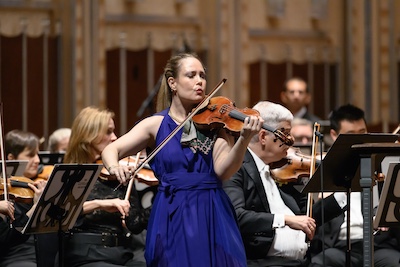
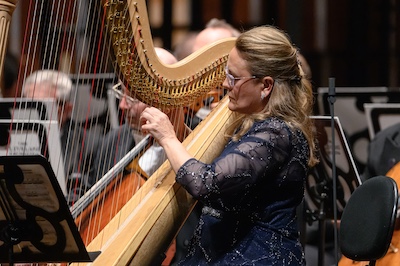 Reinvere’s score is not a battle between soloists, but rather a poem defined by a constantly evolving sonic world in which violinist Leila Josefowicz and harpist Trina Struble at times move the magical music forward and at others blend into the concerto’s robust sound palette.
The composer brilliantly uses a large orchestra that somehow never obscures the solo lines, but rather takes on the role of a third soloist.
Leila Josefowicz, a Cleveland favorite, obviously relished the challenging details of her solo part, which often took her into the violin’s highest register. Trina Struble, the Orchestra’s principal harp, brought grace to the instrument’s idiomatic musical gestures, and Franz Welser-Möst kept everything neatly together, while making space for the work’s many orchestral nuances.
The Concerto was greeted with a strong and immediate ovation from the audience, and a warm embracing of soloists, conductor, and composer ensued.
The evening ended with its title work, Dvořák’s fifth and last tone poem that returns to the idea of triumph over adversity. In that struggle, it was clear who ended up on top. The Cleveland Orchestra played with a true Hero’s Spirit, bringing the concert to a jubilant conclusion
Photos by Yevhen Gulenko
Published on ClevelandClassical.com May 28, 2026
Click here for a printable copy of this article
