

by Kevin McLaughlin
 Scottish folk tunes have a way of traveling. In the eighteenth century, they caught the ears of Italian composers working in Britain, who dressed them in Baroque harmonies and techniques.
On Friday, November 20, CLE Concierto, the early music arm of The Resonance Project, explored this musical exchange in From the Isles: A Scottish Baroque Concert, presented at Forest Hill Presbyterian Church in Cleveland Heights.
Originally based in Seattle, The Resonance Project came to Cleveland in 2024 and has since distinguished itself with imaginative programming across musical periods and traditions.
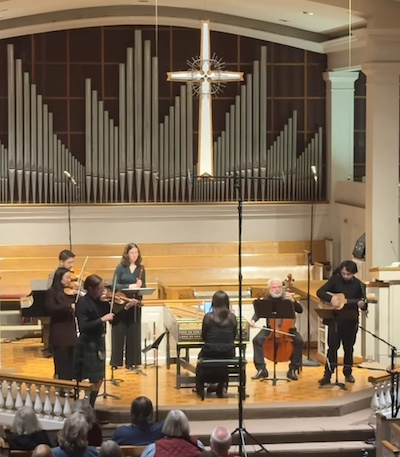
Graciously introduced by artistic directors Irwin Shung and QinYing Tan, the seven-member ensemble brought together Italian Baroque style and Scottish folk music in a program ranging from composed sonatas to traditional songs and dances. Tan led the ensemble from the harpsichord.
James Oswald’s Sonata on Scots Tunes wove five melodies drawn from his Curious Collection of Tunes. The players gave each its own character, moving between lyrical airs and lively dances and not stinting on improvised ornaments.
Francesco Geminiani’s The Last Time I Came Over the Moor offered another example of Scottish melody adapted to Italian taste. Its elaborate instrumental writing invited conversation among the players, with the familiar tune passing through a succession of harmonic and decorative changes. Violinists Salas-Suárez and Yu drew equal measures of Italianate refinement and Scottish earthiness.
The traditional Scottish ballad Elore brought Brian Kay into the foreground. His avuncular singing and lute playing added an appealing informality to the evening, along with a welcome change of texture. John Come Kiss Me Now followed, with Tan inviting the audience to sing along in the first verse. The old English-Scottish tune, long favored by improvisers, gave the players room for ornamentation and rhythmic invention. Cellist René Schiffer took full advantage, spinning out extravagant divisions and even slipping in a quotation from Offenbach. Can he do that? Yes, he can-can.
Francesco Barsanti’s Sonata in E minor, Op. 2, No. 4, returned the program to the Italian Baroque. Its three movements — Vivace, Grave, and Allegro — offered contrasts of energy and expression. Ellen Sauer Tanyeri’s flute sounded supple and smooth, though she was sometimes overpowered by the continuo players, particularly in the slower central movement.
William McGibbon’s Trio Sonata In Imitation of Corelli made its Italian origins explicit. Guillermo Salas-Suárez and Ann Yu were a well-matched pair on Baroque violins, with René Schiffer’s cello and Tan’s harpsichord providing a warm harmonic foundation. The four movements alternated measured expression with lively, closely coordinated passagework.
Scottish fiddler James Balfour MacQueen, emerging from the wings in a kilt, brought the concert back to its traditional roots. With virtuosic playing and his arrangements of seventeenth- and eighteenth-century tunes from the Simon Fraser and Niel Gow collections, he and the ensemble moved through airs, jigs, reels, and a Scotch measure. MacQueen’s fiddle commanded attention, with Brian Kay’s plucked strings and Ellen Sauer Tanyeri’s flute adding rhythmic vitality and tonal color.
The program showed how readily Scottish and Italian musical traditions could accommodate one another. Across two centuries, the tunes retained their identities, even as composers and performers found new things to do with them.
As a bonus, the musicians were joined by dancers for more music at the reception afterward.
Published on ClevelandClassical.com November 23, 2026
Click here for a printable copy of this article
