


by Mike Telin
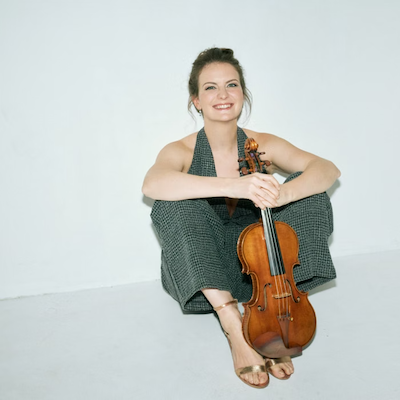 Violinist Veronika Eberle made her Cleveland Orchestra debut at Blossom Music Center in July of 2025. On Friday, November 27 at 7:30 pm she will appear with the Orchestra for the time in Mandel Concert Hall at Severance with Max Bruch’s Concerto No. 1.
Under the direction of Elim Chan, the evening also includes Sofia Gubaidulina’s Fairytale Poem and Pyotr Tchaikovsky’s Suite from Swan Lake. The program will be repeated on Saturday at 7:30 and Sunday at 3:00. Tickets are available online.
I caught up with the German violinist by telephone — she was already in Cleveland rehearsing for the Thanksgiving weekend concerts.
Mike Telin: We’re excited to have you back.
Veronika Eberle: I’m very happy to be back, and I’m looking forward to the concerts with Elim and The Cleveland Orchestra. The hall is amazing! It’s beautiful and the sound is just incredible. So it’s really a huge joy and honor — a dream coming true.
MT: Why do you think this concerto is so popular?
VE: I think it’s just perfect. If you look at the first movement, it starts with this misterioso timpani tremolo with the winds above it. And when the violin comes in it reminds me a little bit of Beethoven’s last piano concerto, with the orchestra and the violin exchanging thoughts. And it has a rhapsodic character — it’s full of youthful energy, drama, and passion. Then it goes straight into the second movement. I think it was Joseph Joachim’s idea to do that, and it was probably inspired by the Mendelssohn Violin Concerto.
The second movement is a jewel, and the center of the concerto. It’s this island full of wonder, dreams, and beautiful storytelling. And of course big melodies that stay with you. But it changes between fragility and intimacy, and then between melancholy and light. So there are all these different characters in there.
And in the last movement, again Bruch puts in a theme that you can carry with you so easily. It’s a virtuosic and very joyful dance and again it’s full of youth and energy along with a Hungarian flavor. Actually, it was probably Bruch’s first real symphonic writing.
He wrote so much after this concerto, and yet it’s like a one-hit wonder — it’s why he is recognized so much in our time. But even when he was living, he got fed up and wrote that it should be forbidden to be performed. Yet it’s still inspiring musicians these days.
MT: Do you know his other violin concertos?
VE: Like many other violinists I know them, but I’ve never played them. I think Bruch said, “All these dumb and uncreative violinists only learn my first concerto, even though I’ve written other concertos.” Unfortunately, for the time being I’m one of them. But the violin literature is huge, and there are so many amazing concertos that his others aren’t on the top of my list.
MT: Is there a concerto that you haven’t played that you want to learn?
VE: Actually, I’m just learning the Britten Violin Concerto. I will playing it in the coming summer and I’m very much looking forward to the moment when it will be born on stage.
MT: That’s another beautiful piece that should be played more often.
VE: I don’t know why, but Britten is still not programmed very often in Germany. It’s very demanding, but the concerto should be in the normal repertoire.
MT: I understand that when you were quite young you heard a friend playing the violin, and you wanted to play it as well. What was it about the instrument that made you say, I have to play it?
VE: I was absolutely fascinated by how four strings and some wood could produce a sound so close to the human voice. And how you could get out so many different colors and emotions from it. It felt so close to my own musical imaginations and visions. And somehow, from the very first beginning, I felt a very strong connection to the instrument.
MT: At what point did you go from I’m going to play the violin to I’m going to be a violinist?
VE: I really was drawn to it from the very first moment. And I had a fantastic teacher who showed me the love of music and the language of music, which opened up a completely new cosmos.
And then concerts came along so it was like a way up the hill that never stopped.
And of course there were some big moments like when I performed the first time with the Berlin Philharmonic and Sir Simon Rattle when I was 16 — which helped my career a lot.
But the music didn’t let me go from the very first moment. So there was never a question of not becoming a musician. It just felt like the most natural and normal thing to follow this path — I just couldn’t get enough of it.
MT: I was looking at your Instagram page and you have a very full career, performing in some beautiful places playing with great musicians — do you ever think about that?
VE: I’m very grateful to be living this life especially in our times. Sometimes I think, Wow, it’s amazing, and a huge privilege to be able to think about the intentions of a composer or how to shape this corner or how to do the crescendo or whatever.
And when I look around at what’s going on today, it is a privilege to be in this musical world. That is so important in our times, to bring something to people that might change them or that touches them in a deeper place. So I think what we are doing is so important and I’m fortunate to be part of it.
Published on ClevelandClassical.com November 25, 2026
Click here for a printable copy of this article
