


by Daniel Hathaway
 This article was originally published on Cleveland.com
CLEVELAND, OHIO — With the impending departure of Music Director Franz Welser-Most after 25 years at the helm of The Cleveland Orchestra, all guest conductors come under scrutiny as possible successors.
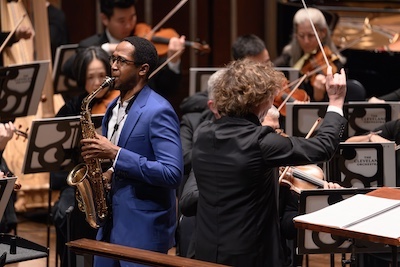
If so, the 41-year-old Finnish conductor Santtu-Matias Rouvali should be a strong contender. He was nothing but impressive on Thursday evening, when he led inspired, flawless performances of Billy Child’s saxophone concerto, “Diaspora,” with the brilliant Steven Banks on the horns, and of Richard Strauss’s mellifluous and possibly autobiographical tone poem, “Ein Heldenleben (A Hero’s Life).”
Banks is an extraordinarily talented musician. His technique is unwavering, and his musicality above reproach. Childs’ compelling concerto gives the soloist ample opportunities to demonstrate these qualities.
Developed by composer and soloist working together, Diaspora is based on three works by poets Nayyirah Waheed, Claude McKay and Maya Angelou. Motherland, the vibrant opening solo played on the soprano immediately seized and held your attention. Its flowing lines supported by clear, tight pizzicatti and its engaging technical passages supported above a busy orchestra.
Rouvali’s steady beat — he trained as a percussionist — kept the flow of interlocking lines in good order. Childs’ music segued into softer, gentler moments, followed by a thrilling cadenza that explored the saxophone’s color and Banks’ great dynamic range.
Banks switched to alto for If We Must Die, marked by haunting single beats in the bass drum and sound flourishes from the orchestra, as the soloist played a storm of scales crying out as Slave Ships departed on the Middle Passage journey.
For And Still I Rise, Banks moved to the back of the orchestra next to the piano, where he played a soulful gospel song.
Returning downstage, Banks returned to soprano — his high squeals and scale passages sailing up and down the extremes of the instrument, bringing a surge of emotion to the concerto’s conclusion. As one, the exhilarated audience rose to their feet.
Introducing his encore, Salleres Variations — his own composition — Banks said that he promised himself that he wouldn’t chicken out because the piece is as difficult to play as it sounds.
Indeed the fast-paced work left you wondering how it was possible to play so many notes so cleanly.
Richard Strauss’s eighth tone poem continues to divide critics, who either regard it as an unsavory essay in egotism or a repository of some of the composer’s most ravishing music (a large number of excerpts from Strauss’s earlier works are quoted in the score).
Rouvali allowed everything in this performance to unfold naturally, without effort. He brought musical magic to Strauss’s dramatic, and at times, extravagant score.
He set a stately tempo for the majestic opening, and found the humor in Strauss’s caricatures, like the music critics represented in the flutes.
Concertmaster Elizabeth Fayette contributed exquisite solo playing highlighting the playfulness of the music that portrays Strauss’s wife Pauline.
Offstage trumpets provided a regal fanfare, leading into the controlled chaos of the bold march. Rouvali paced the ending with sensitivity and Nathaniel Silberschlag’s valedictory horn solo rang handsomely in the hall. A hero’s life indeed.
Photos courtesy of Yevhen Gulenko
Published on ClevelandClassical.com November 5, 2026
Click here for a printable copy of this article
