

by Daniel Hathaway
 Though we were kept very busy this week, by Friday people were relaxing into their routines and there was time and opportunity to get to know one another a little better.
As coachings went on, I had some nice conversations with my fellow ensemble members, who brought a bit more experience to the Baroque Performance Institute than others, but reflected the expansive age range of participants (in our case from teens to 70s).
Luka Stefanović, the cellist, is 17, but already has an impressive track record on the modern cello (his father plays violin in the Baltimore Symphony). Florence Peacock, the soprano (from Chapel Hill, NC), has attended BPI for many years and has managed to overcome auditory problems with the help of high-tech hearing aids — she’s amazing.
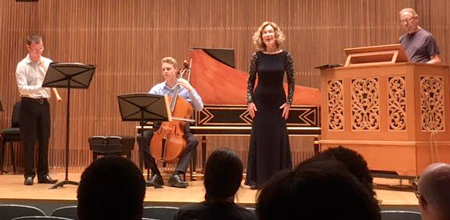 Bob Brooks, the bass, served for several decades in the Air Force, after which he took up church choir conducting and private voice teaching in Dallas. He’s attended BPI for thirteen years, as has his wife Patsy, who is singing Telemann in another ensemble. (Bob nipped into the archives and provided his own edition of an obscure Graupner recitative and aria for Saturday’s concert.)
Peter Maddigan, our Australian oboist, graduated from university with a double degree in modern and Baroque oboe, but gave those instruments up on the advice of his dentist when he began experiencing severe jaw pain. He went on to take a law degree and became a barrister. Ten years later, a new dentist advised him to have his wisdom teeth extracted, which took care of the problem. He’s making his second (long!) journey to Oberlin.
There are other stories to be shared. I happened to join Nicola Canzano, one of the official BPI accompanists, for lunch on Thursday, and asked him about his abrupt reversal of career I’d heard about from someone else. He set out to earn a doctorate in a thorny subfield of physics at Santa Cruz, but his obsession with Baroque music took hold and steered him in a new direction. He plays organ in an Episcopal church and writes what he calls “new” Baroque music — he handed me a stack of scores to peruse.
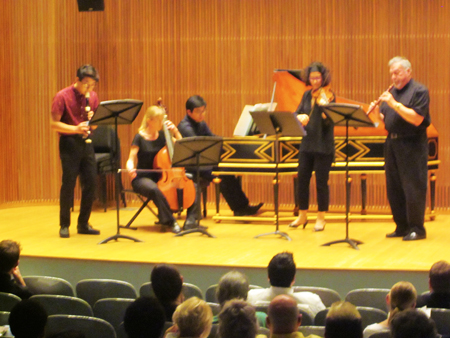 I can’t wait to have lunch on Tuesday with Peter Lim — an entering first-year student at Oberlin this fall, and his sister Kaya. A native of Korea, Peter apparently learned to play the recorder by watching YouTube videos, and Kaya is making her first foray into the transverse flute this summer.
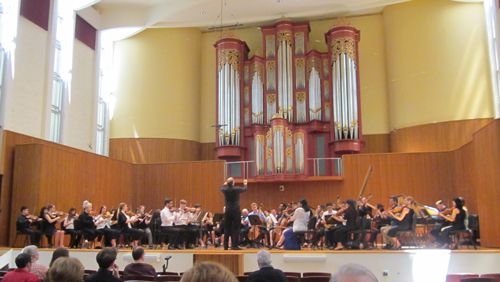
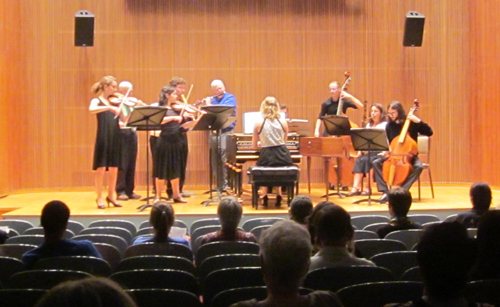
Saturday afternoon’s student ensembles concert was a progressive affair, beginning in Warner Concert Hall, where Joe Gascho led the Student Orchestra in a Sinfonia by Alessandro Scarlatti and a Concerto by Corelli (photo above). Impressive, energized performances from an ensemble that had only rehearsed for an hour and a half on each of three days during the week.
Then, 22 ensembles serially showed off their accomplishments in Kulas Hall. Catharina Meints explained how it would work: ensembles would meet to tune in an adjacent room two groups ahead of their own performance, then advance to the green room, then to the stage. The stage crew were ready with setup diagrams, and everything proceeded with admirable efficiency.
 The programs demonstrated the cleverness with which the faculty assembled groups and assigned repertoire during that hectic 90-minute session last Monday morning.
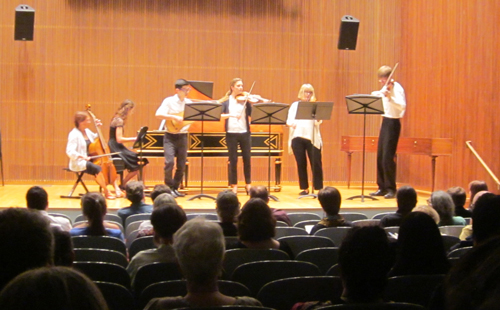
And some wonderfully bizzarre pieces popped up on this concert. Boismortier’s Quinque Sur Octave was the perfect teaching piece for a quartet of violins (and caused some chuckles as Meints ascended and descended within the octave scale that gives the piece its name).
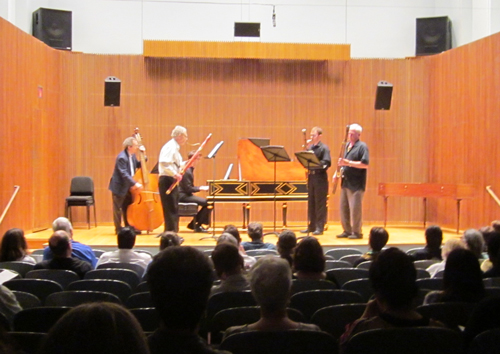
 Michel Corrette’s Concerto “Le Phenix” is a great vehicle for three bassoons and continuo — one of the parts supplied by faculty member Andrew Schwartz, and artistic director Kenneth Slowik providing gravitas on the violone.
 Having commitments in Cleveland, I had to leave after my own ensemble’s performance, though I did stay to hear an impressive reading of a Telemann concerto. But I would love to have heard the entire concert to get to know my fellow musicians better through their playing.
On to week two.
Published on ClevelandClassical.com June 24, 2017.
Click here for a printable copy of this article
