

by Samantha Spaccasi
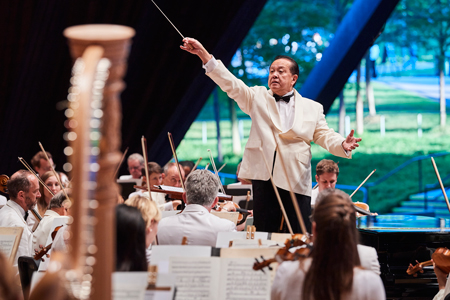 What could be better than an evening of sitting on the lawn of Blossom Music Center — summer home of The Cleveland Orchestra, wine in hand, enjoying a picnic dinner while waiting to hear the ensemble play with pianist Aaron Diehl? Not much. On July 2, Diehl and the Orchestra, conducted by Jahja Ling, performed an array of favorites.
The evening opened with a lively interpretation of Shostakovich’s short, fun Tahiti Trot, an arrangement of Vincent Youman’s “Tea for Two” from No, No, Nanette that the composer finished on a wager in less than an hour. Though the piece is upbeat and energetic, Ling kept the Orchestra at a measured pace throughout, allowing the audience to appreciate all the qualities of the music, from the charming, whimsical sounds of the celesta, played beautifully by Joela Jones, to the clear lines played boldly by the percussion section. The entire ensemble was exceptionally tight, thanks to the skilled work of Ling. Throughout the entire performance, he was a joy to watch — right at the climax of the more intense sections of the music, Ling would jump up vigorously.
Diehl, making his debut with the ensemble, joined Ling and the Orchestra for Gershwin’s Concerto in F. The pianist was perfect for the work, his excellent phrasing and jazz training shone throughout. Diehl is a technical player, shown by his mastery of the difficult, tumbling passages, but performed with a relaxed looseness that conveyed ease and enjoyment of the music. The artist conquered the many moods the Concerto requires, ranging from hopeful, to triumphant, to romantic. Even during the airier, lighter sections of the Concerto, Diehl commanded attention with his nuanced interpretation.
Robert Russell Bennett’s Porgy and Bess: A Symphonic Picture began majestically with wonderful mallet work by Marc Damoulakis. The delicate flutes balanced the rich sounds of the low strings during, creating a full, melodious contrast. Some especially solid performances came from the first violins, playing the melody of “Summertime” in an appropriately jazzy fashion that recalled the slow movement of a muddy river on a hot summer afternoon. Principal oboist Jeffrey Rathbun snaked the melody quietly through the rest of the music, giving a multifaceted interpretation of the part. Another standout performance came from concertmaster Peter Otto, who played his solo with a gentle tranquility and depth. Mark Dumm traded out his violin for a characteristic banjo solo in “I Got Plenty of Nothin’” and the splendid saxophones, headed by Howie Smith, added a perfect sonority.
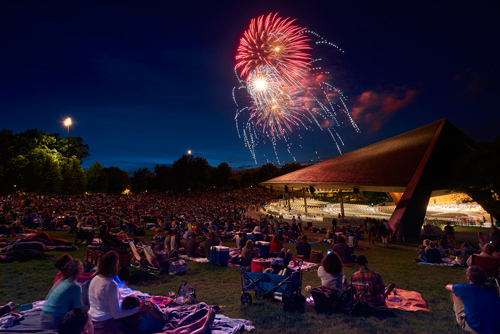 The final work, Tchaikovsky’s famously loud “1812” Overture, started out quiet with a well-blended sextet of four cellos and two violas creating an air of suspense. The trombones nailed the first motif softly. This was a good artistic decision on the part of Ling, as it created more anticipation for the coming volume. Robust low strings were quickly dulled by the booming cannons, which were so loud they caused many to jump out of their seats. The percussion section deserves appreciation for the ringing chimes accompanying those famous blasts.
Capped by a fireworks display, it was a delightful, moving evening that showed why The Cleveland Orchestra is one of the nation’s best.
Photos by Roger Mastroianni.
Published on ClevelandClassical.com July 5, 2017.
Click here for a printable copy of this article