



by Kevin McLaughlin
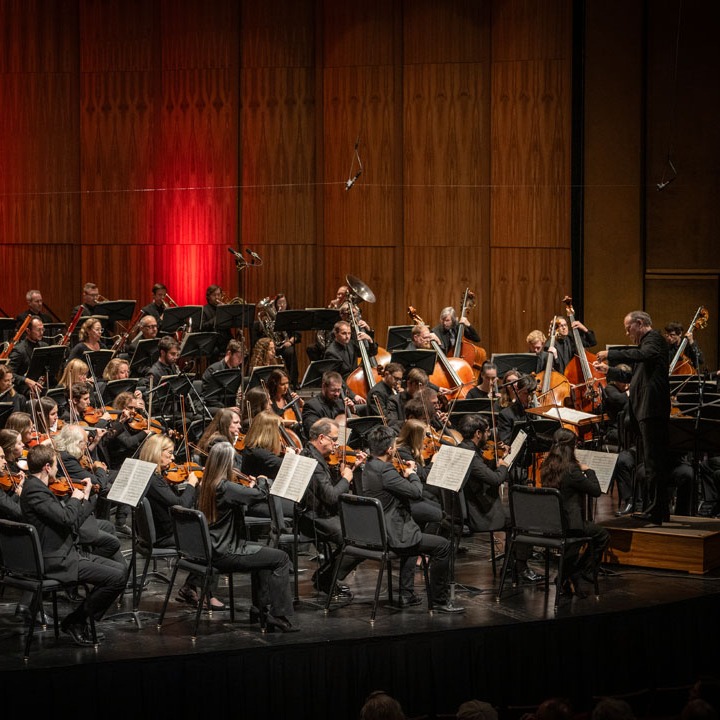 The Akron Symphony opened its season Saturday night, September 20 at E.J. Thomas Hall, with a program that combined geniality, youthful cheek, and grand ambition. Under the direction of Christopher Wilkins the orchestra sounded happy to be back and playing before an excited house.
Brahms’s Academic Festival Overture is a thank-you note written to honor a university that gave him an honorary degree. As Wilkins reminded us, Brahms never went to college, but here he donned the cap and gown like a puckish undergrad, weaving together student songs more often heard in beer halls than lecture halls. Under Wilkins, the piece carried both dignity and delight. The opening had the sincerity of ceremony, then the tunes tumbled in like students fresh from hijinks on the quad. The orchestra answered with warmth, rhythmic lift, and good humor. When the final tune arrived, it rose like an alma mater — or a sudsy cheer — echoing fondly across the years.
Angela Cheng, who serves on the faculty at Oberlin Conservatory, joined the ASO for Clara Schumann’s seldom-heard Piano Concerto. She wrote it at sixteen — an astonishing act of confidence for a teenager. The concerto begins with a short orchestral flourish, quickly answered by the piano. Cheng replied with her customary grace — the mark of a pianist’s pianist — and her delight in the music was unmistakable. As Wilkins had promised, her performance was not about display but clarity. It was Clara Schumann’s voice that mattered, not the pianist’s.
The slow movement is a dialogue between piano and cello while the orchestra puts its instruments down to listen. Cheng and principal cellist Eri Snowden-Rodriguez shaped it tenderly, like two old friends catching up. The cellist is a musician of uncommon eloquence, who played with a depth that gave the movement — if not the concert — its emotional center.
The finale swept in with a burst of energy that was full of youthful brilliance. The winds led with the clarinet adding brightness to the piano’s exuberance. Cheng met the challenges head-on, her playing precise and spirited, while Wilkins kept a keen ear on balance and pacing.
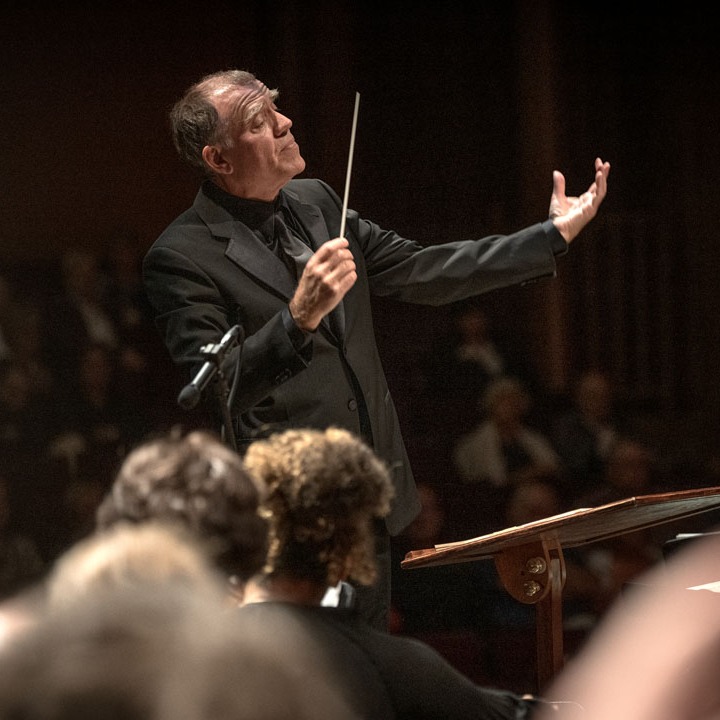 After intermission came Mahler’s Symphony No. 1, “Titan.” Few works cover so much ground in four movements.
The first begins in a mist of muted strings and distant fanfares, as if the earth were waking at dawn. Out of that hush rose a sunny tune — Mahler’s own “Ging heut’ morgen übers Feld” (“I Went This Morning Across the Field”) — that set the music on its way. Wilkins let the theme grow naturally, leaving room for cuckoo calls, rustic dances, and sudden brass outbursts, sharpened by the tightly unified trumpets.
The second movement is a heavy-footed but good-humored country dance. Wilkins’ tempo was perfectly gauged for maximum peasant groove. The strings stamped, the winds chattered, and the horns swaggered in like villagers from the pub.
In the third, Mahler turns uncanny: a funeral march spun from “Frère Jacques” in a minor key. Bassist Ann Gilbert shaded it with solemnity and mischief, while klezmer-like bursts from winds and trumpets grinned through the gloom.
The Finale broke like a summer storm. Brass, percussion, and timpani unleashed their force before yielding to passages of calm and sweetness. The Akron strings reminded us why they are among the orchestra’s glories, shaping their tutti aria with supple beauty and tenderness. Wilkins kept the pace taut throughout, culminating in a satisfying final chorale — less forced triumph than earned release. The ovation was instant and genuine.
Published on ClevelandClassical.com September 23, 2025
Click here for a printable copy of this artic
