

by Mike Telin
 Benjamin Britten’s War Requiem, first performed on 30 May 1962, was commissioned to mark the consecration of the new Coventry Cathedral, which was built after the original 14th-century structure was destroyed during a World War II bombing raid.
Britten, a pacifist and conscientious objector, chose to interleave the traditional Latin Mass for the Dead with poems by Wilfred Owen that were written during World War I.
On Thursday, April 23 at 7:30 pm in Mandel Concert Hall, Klaus Mäkelä will lead The Cleveland Orchestra, Chorus, Children’s Chorus, and soloists soprano Tamara Wilson, tenor Andrew Staples, and baritone Ludwig Mittelhammer in Britten’s monumental work. The program will be repeated on Saturday at 7:30 pm and Sunday at 3:00 pm. Tickets are available online.
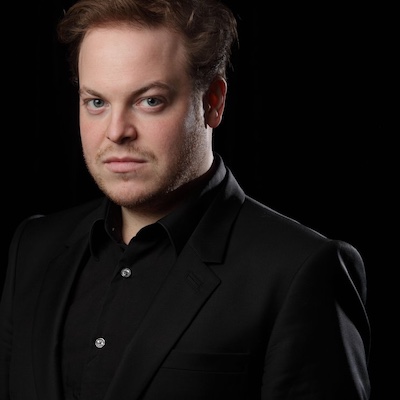
We caught up with Andrew Staples by phone and began our conversation by asking him to share his thoughts on the work.
Andrew Staples: What strikes me now about the War Requiem is how Britten manages to keep the war itself present the whole time. It’s on one level a kind of requiem, but on another, it’s an intimate feeling about what war is like, the pity of that, and the craziness of losing a generation of people. And he does that on one stage on a monumental scale. But then some of the most devastating parts are almost silent, intimate, little chamber moments that really speak to the heart. I think that’s the thing about it that I love.
Back when I was a kid — I was once in the offstage boys’ choir when I was a chorister, and even then I realized this was a huge, important piece.
As a British musician, I think this is a masterpiece and I feel honored to be able to perform it.
Mike Telin: What is it about Britten’s music that allows him to do things that he does in this piece?
AS: He can do two things singularly well. One is to talk about quite troubling things. A lot of his operas for instance have all sorts of horrible things happening in them and characters that you wouldn’t want to be identified with. But he can also express those things while showing you the kind of humanity within.
In the War Requiem, it’s his ability to go between those huge scales and in the face of something utterly devastating and horrific, find these moments of humanity and hope. And he’s able to give a kind of soundtrack to those things which is restrained enough that it draws people in.
It can be a very emotionally sort of manipulative experience. But it’s very hard. It’s not a simple piece, and that’s why it’s wonderful that we get to perform with such an incredible orchestra like Cleveland, with an incredible conductor, soloists and singers, because it requires technical mastery and an emotional ability and flexibility.
It has these multi-layered things — two orchestras, an offstage choir and soloists spread out — and then he destroys the normal structure of the requiem mass by inserting these bits of contemporary poetry, and creates a wonderful experience from this.
MT: It’s striking what the world is going through at the moment. It’s always a timely piece, but now it’s more timely than ever.
AS: I think that’s right. The pity of that situation is that it seems there’s always going to be some reason that makes it feel more relevant. But putting on a piece like this really does call into question many of the decisions that we have been making on a personal and a global level. So the interesting thing for an audience sitting through it, is to find a way to experience a kind of ritual or a meditation on these themes. And I hope that the outcome is both positive in the sense that it might give people hope for tomorrow and allow them to deal with any stresses and grief that they have, and bring context to the evening. And I think it’s another underlining of the importance of an artistic endeavor in the face of things that might seem hopeless.
MT: What do you enjoy about the piece?
AS: I think it’s satisfying. There are some moments where it’s technically challenging because you have to sing against a full orchestra — almost two orchestras. And you have to sing this energetic, almost live battle-type music.
And then it drops down to almost like a single spotlight, and you’re there expressing intimate, personal feelings about what happened yesterday on the battlefield. So it requires a range of expression. And if you’re in good voice and able to float the words “give us peace,” I think that’s the most thrilling moment in the piece.
MT: Have you performed in Cleveland before?
AS: No, this will be my first time, so I’m really looking forward to being there. As a younger musician you ask yourself which are the best orchestras? Which do I want to get the badge that I’ve been there? I’ve been very lucky to perform with all the others, but I’ve never done a concert with the Cleveland Orchestra, so this is a big one for me.
MT: Is there anything else you think people should know before they come to hear the War Requiem?
AS: I think if people have the time and want to do a bit of homework, they should read those Wilfred Owen poems. The poems that Britten chose are special gems.
MT: In addition to being an accomplished tenor, you’re also a photographer and filmmaker — how do you have the time to do it?
AS: That’s a good question. I was saying to someone this morning that on a concert day or an opera day, you don’t have to do anything until 7:00 in the evening. So you’ve got the rest of the day to do other stuff. So it’s sort of multi-multitasking.
MT: What do you have on your agenda at the moment?
AS: I’ve got a bunch of films that are in various stages — some are in edit, some are in pre-production, and some we’re still filming. I’ve got some documentaries as well. One is about a guy I met who’s a doctor who set up a girls’ school and orphanage in the Chocó region of Colombia near a town called Istmina.
But the thing that drew me to the story was that a lot of the funding for that project is through giving classical concerts in Germany. I’m always looking for stories about why music is good for humanity.
There’s another film about how exposure to music, playing it and listening to it, really is prophylaxis for neurodegenerative diseases. I think that as soon as the arts budget becomes part of the health drive we can further secure our future. Bits of the film are going to be shown in concerts in Germany this year.
There’s another thing that’s interesting: the day after I leave Cleveland I fly straight to Gothenburg, where I’m doing my first conducting/singing engagement. I’m singing Britten’s Serenade for Tenor, Horn and Strings, but also conducting some Bach with the orchestra and chorus. It’s going to be a crazy few days.
Photo by Richard Ecclestone
Published on ClevelandClassical.com April 20, 2026
Click here for a printable copy of this article
