

by Peter Feher
 The German composer Michael Praetorius never had a Christmas hit on the level of, say, O Tannenbaum — an early version of which, circa 1600, is attributed to his contemporary Melchior Franck.
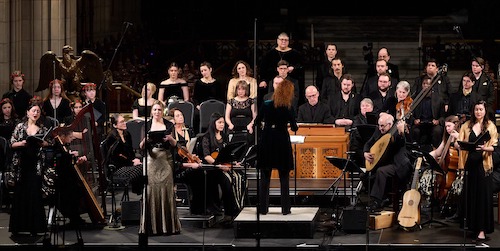
But in the 21st century, Praetorius has found seasonal success thanks to a team of savvy producers. Apollo’s Fire and artistic director Jeannette Sorrell have championed the composer for two decades now, fashioning his music into an enduring, historically informed holiday program. Christmas Vespers isn’t a single piece from the Praetorius catalog but rather a unique “best of” compilation that Cleveland’s Baroque orchestra unveiled in 2005 and last presented in 2015.
Who says a liturgical service can’t be popular? Apollo’s Fire once again drew sold-out crowds to church venues across Northeast Ohio with these concerts, including a packed Trinity Cathedral on Thursday evening, December 18. And for anyone who still can’t get enough Praetorius, the ensemble plans to release a video recording of the 2025 Trinity performances — not instead of, but in addition to, the group’s 2007 CD.
Although the program inspires a kind of devotion, Christmas Vespers isn’t exclusively for the faithful. Sorrell structured the evening in two parts that lean on dramatic principles as much as the Lutheran liturgy. The first half unfolds in the solemn season of Advent, with the days of December growing darker, before the second half erupts in the joyousness and light of Christmas Day and Jesus’ birth.
There couldn’t have been greater contrast between the concert’s opening chorale, Nun komm, der Heiden Heiland — chanted in an almost medieval manner by the a cappella men and women of Apollo’s Singers — and the musical festivities that followed. The performance would climax with the closing hymn of “In dulci jubilo” (Good Christian Friends, Rejoice,) the full forces of chorus and orchestra joining in an all-out celebration conducted by Sorrell.
Singing in German, Latin, and English is in the spirit (if not always the exact language) of Praetorius, who sought to synthesize the Renaissance and Baroque styles that his career historically straddled. That’s how his elaborate polyphonic setting of Wachet auf! — decorated with Italianate flourishes for the vocalists, violinists, and cornetto players — can share a program with his simple harmonization of the carol “Lo, how a Rose e’er blooming.”
The English translation of the latter is Sorrell’s nod to the Protestant preference for the vernacular. As every Apollo’s Fire fan knows, her productions will depart from strict reenactment when doing so better conveys the character of the composer.
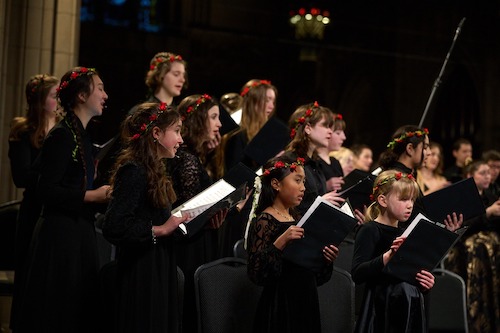 Nowhere in Christmas Vespers is this approach more effective than in the mix of adult and child soloists who take the stage, reflecting the fact that in his time Praetorius wrote for both professional musicians and laypeople.
The female voices contributed extra sparkle to several key scenes. Sopranos Rebecca Myers, Molly Netter, and Andréa Walker gracefully handled the intricate echo effects of Ach, mein Herre, the one selection so Latinate that it might have been mistaken for Monteverdi. Among the youth choristers of Apollo’s Musettes, Elora Kares shone especially brightly in the final rejoicing to uplift all assembled.
Published on ClevelandClassical.com January 2, 2026
Click here for a printable copy of this article