

by Mike Telin
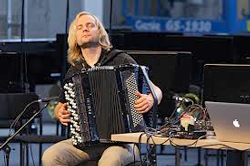 On Sunday, April 27 beginning at 7:30 pm, CMA Concerts at Transformer Station presents Norwegian virtuoso classical accordionist Frode Haltli. The program features music by Hans Abrahamsen, Magnar Åm, Arne Nordheim and Aldo Clementi. “Even though this program is classical contemporary music, I think it reflects my interests in different kinds of music,” Haltli said during a telephone conversation from his home in Norway. “It’s not your ordinary contemporary music, it [ventures] out into many different directions.”
If you’re wondering about the term “classical accordion” you’re not alone. The instrument has yet to be recognized in many parts of the world as one associated with classical music. So why is that different in Scandinavia? “It really is because of one person, Danish player Mogens Ellegaard. He was the first accordionist to introduce the instrument to real composers in Scandinavia. He really developed the accordion in a more classical way, although in my view it will never be a traditional “classical” instrument.”
Perhaps not, but if you take a quick glance at Haltli’s repertoire list on his website, you will find many recognizable contemporary composers such as Berio, Lindberg, Pintscher, Gubaidulina and Zorn, all of whom have composed for the instrument. [Read more…]
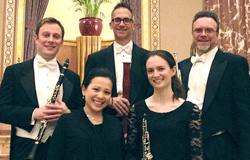 On Sunday, April 27 beginning at 3:00 pm in Pilgrim Congregational Church, Arts Renaissance Tremont presents a concert of chamber music for woodwinds and piano performed by Cleveland Orchestra members Mary Lynch, oboe, Robert Woolfrey, clarinet, Barrick Stees, bassoon and Richard King, horn, with Cicilia Yudha, piano.
 For thousands of years humans believed the earth was flat and if you traveled too far you would eventually fall off the edge. It was the third century Greek scholar Eratosthenes who first began to calculate the circumference of the Earth. In the twentieth century, Ohio and specifically Cleveland, has played an important role in furthering space research. Founded in 1941as the Aircraft Engine Research Laboratory by the National Advisory Committee for Aeronautics (NACA) NASA’s John H. Glenn Research Center actually predates NASA by 17 years and is named in honor of former senator John H. Glenn, an Ohioan who was the first American to orbit Earth.
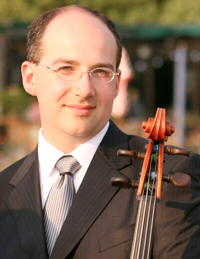 Last Thursday evening, April 17, The Cleveland Orchestra under guest conductor Herbert Blomstedt’s masterful hand performed a stunningly beautiful concert of romantic music. The program featured two wonderful Slavic works.
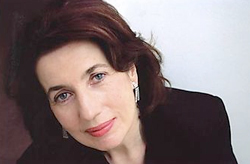 British pianist Imogen Cooper and British conductor Jane Glover will both be making their Severance Hall and Cleveland Orchestra debuts this weekend. I reached Imogen Cooper in London to talk about Beethoven’s first piano concerto, a piece that I tell her still gives me goose bumps and puts me in a good mood every time I hear it.
 Just a year ago, Boston-based soprano Amanda Forsythe dazzled Apollo’s Fire audiences with memorable performances in “Mozart and Papa Haydn”. Writing for this publication about arias she sang from the young Mozart’s Lucio Silla in Finney Chapel at Oberlin, Nicholas Jones said, “Ms. Forsythe gave us a rendition of pyrotechnics…that convinced us of its value, even as we recognized the immaturity of the composer. Staccato arpeggios, long legato lines, a mad scene with its requisite oddities — all were entirely enthralling.”
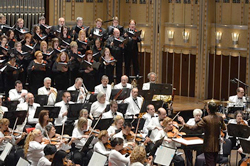 The Cleveland POPS Orchestra (Carl Topilow, conducting) and Chorus will present five Friday evening subscription concerts at Severance Hall next season, in addition to “The Magic of Christmas” at the Palace Theatre on November 30 at 2pm and its 19th annual New Year’s Eve Concert and Dance at Severance Hall on December 31 at 9 pm.
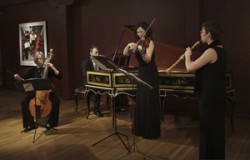 At its fifth anniversary benefit concert on April 12, Les Délices artistic director Debra Nagy announced that the ensemble, which specializes in French baroque music, would present four pairs of concerts next season with a bonus performance in September.
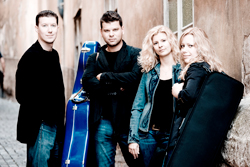 For their second appearance on the Cleveland Chamber Music Society series at Plymouth Church on April 8, the Pavel Haas Quartet scheduled two riveting twentieth-century works, Leos Janáček’s Quartet No. 1 and Benjamin Britten’s Quartet No. 2, followed by Beethoven’s “middle period” Quartet in e, op. 59, no. 2.
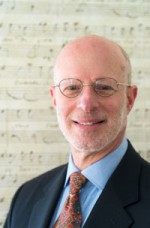 On March 13, Early Music America, the advocacy organization for performers, scholars, students and audiences, announced the selection of Donald Rosenberg as the next editor of Early Music America magazine. Founded in 1985 and now based in Pittsburgh, Early Music America (EMA) provides its membership with publications, advocacy, and technical support, in addition to publishing the quarterly magazine. (The term “Early music” includes Western music from the Medieval, Renaissance, Baroque, and Classical periods, performed on period instruments in historically-informed styles.