

by Kevin McLaughlin
 From midday Friday through Saturday night, the Baldwin Wallace Bach Festival presented a steady run of events in Gamble Auditorium — lectures, master classes, busking, and concerts. I heard the two evening anchors — “Concerto Countdown” and Mass in G Minor and Magnificat — which gave a fair picture of the whole.
Friday night, April 17, offered something to look at as well as hear: an array of harpsichords drawn together for Bach’s concertos for multiple keyboards. Festival director Dirk Garner led the count — four, then three, then two — as players rotated in and out, trading bright sprays of plectral fancy-fare.
The concerto for four harpsichords opened the proceedings in a bright rush. This is Bach borrowing from Vivaldi — a concerto for four violins turned into something more percussive (noticeable from the very first note) and more architectural. The four soloists, Jason Aquila, Qin Ying Tan, Logan Rees, and Dylan Sanzenbacher traded figures with crisp timing, their lines crossing and recrossing like well-regulated traffic. Entries spoke cleanly, and phrases had shape.
There is a danger, in a piece like this, of the keyboards sounding the same — the same attack, the same color — and some monotony did set in, but Bach and the players found ways to vary the texture. In the Largo, the instruments drew inward and overlapped, blending into a single, murmuring voice before the final Allegro set them off again at a livelier pace, the lines cleanly articulated.
Between the concertos came a reorientation, or “cleansing of the palette,” as Garner described it. The vocal ensemble Ampersand, led by Madeline Healey, offered motets from the collection at the Riemenschneider Bach Institute. The ensemble sang with a straight tone that suited the repertoire, yet there was warmth in the sound as well.
The three-harpsichord concerto is a denser piece — more argumentative, you might say. Aquila, Rees, and Sanzenbacher handled its quick turns and tight corners with assurance. Bach lets the orchestra speak more here, but Garner kept the balance clear, the strings stepping forward and yielding when needed. Near the end, Aquila, playing the first harpsichord part, shone in a brief solo turn, with a sense of line and fluency.
The evening closed with the concerto for two harpsichords in C minor with Aquila and Tan at the keyboards. This is the most familiar of the three works. The outer movements moved with purpose, the rhythms set cleanly and kept on a firm line. In the Adagio, the two soloists found a gentler conversation, passing the melody back and forth over a soft bed of strings. The effect was like two voices in agreement, finishing each other’s thoughts.
The sound of multiple harpsichords – especially as strategized and combined by Bach – was a rare treat. There was pleasure, too, in the physical business of the players rising and sitting, the quiet choreography and the sound of so many pins and mechanisms at work. Garner kept it all moving, with tempos that felt sensibly judged and a clear sense of where each piece was headed.
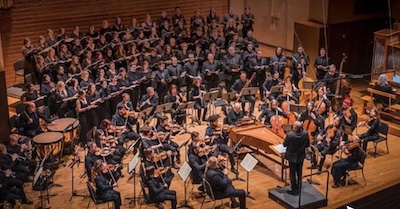
Saturday evening, April 18, closed the festival with a program that featured two of Bach’s large-scale sacred works. Dirk Garner again led the Bach Festival Orchestra and BW Motet Choir, with student soloists drawn from the choir as well as guest Ellie Sutherland, Haitham Haidar, and Andrew Padgett. The program paired the well-traveled Magnificat with the rarely heard Missa brevis in G minor.
This year’s BW Motet Choir, joined by BWV: Cleveland’s Bach Choir and a handful of select high school students, was a standout: an eager, tight-knit group that sang with urgency and purpose.
While Bach’s B Minor Mass, majestic and sprawling, is the Everest of choral music, the G Minor is nimble, tightly made, and largely neglected — this year marked its debut at the B W Bach Festival.
Written in the 1730s, it belongs to Bach’s Kyrie-Gloria Masses, four compact works that repurpose earlier German cantata movements. If this suggests Bach the Thrifty, it’s really Bach the Magpie, turning familiar material into something luminous.
Dirk Garner gave careful attention to his musicians. The Kyrie opens with an instrumental introduction in which the oboes lead, and Johanna Pennington opened the movement with an elegiac theme, before the altos took it up, rising in the eleison and shaping it with simple pathos. In the Gloria, the chorus kept the line moving even at a measured pace, and the tenors instilled a notable lightness.
The soloists brought supple lyricism to the arias and demonstrated the strength of Bach’s vocal writing. After hearing him the day before with Ampersand, bass Andrew Padgett, met heightened expectations in “Gratias agimus tibi,” setting his line upright like a candle, steady against the surrounding strings. Alto soloist Ellie Sutherland invested the aria “Domine Fili” with similar warmth.
In “Qui tollis,” tenor Haitham Haidar sounded relaxed and open, with cellist Jacqueline Kaminski and Pennington answering in kind.
A tight ensemble, alive with wit, color, and drama, the choir was a mix of current students, alumni, and pros that handled Bach’s intricate polyphony with assurance. In “Cum Sancto Spiritu,” Garner clarified each strand of the fugue, and the orchestra — especially the strings — offered a silken cushion that stopped just short of plush.
Written in 1723 for his first Christmas in Leipzig and later revised to its now-standard D Major, the Magnificat is a Baroque blockbuster — one of Bach’s earliest successful public statements.
The piece brims with invention, from joyful fanfares to tender solos and duets. Here, Bach is both architect and dramatist, transforming the sacred text into a pageant of human feeling.
The Festival Orchestra and combined Choirs delivered a Magnificat that balanced spectacle with spiritual depth. Trumpets, led by Larry Herman, added a nimbus of splendor to the big moments, especially the opening chorus and Gloria. Pennington shone in her solo oboe d’amore turns, while BW flute faculty members Sean Gabriel and Kaleb Chesnic gave “Esurientes implevit bonis” its light, pastoral lift.
The choir kept their momentum, navigating the rapid-fire text with agility and verve. The soloists, stepping out briefly to shine before disappearing again, made strong impressions: Charles Shaun Bohrer’s bass in “Quia fecit mihi magna qui potens est,” Virginia Grabovsky’s bright “Et exsultavit,” and John K. Russell’s incisive “Deposuit potentes.” Tessera Marie Rippentrop’s “Quia respexit” was finely shaped, the duet “Et misericordia” (Beth Satariano, alto, and Haitham Haidar, tenor) sparkled, and the women’s trio “Suscepit Israel” glowed with gentle warmth. The final chorus, “Gloria Patri,” was thrilling.
What stood out was the human scale within Bach’s intricacy. It spoke directly — even to listeners who may not have expected it to.
Published on ClevelandClassical.com April 22, 2026
Click here for a printable copy of this article
