



by Daniel Hathaway
 The complete Shostakovich cycle of quartets that the Jerusalem Quartet served up last May in five well-attended performances at the Cleveland Museum of Art to celebrate the 75th anniversary of the Cleveland Chamber Music Society was a hard act to follow.
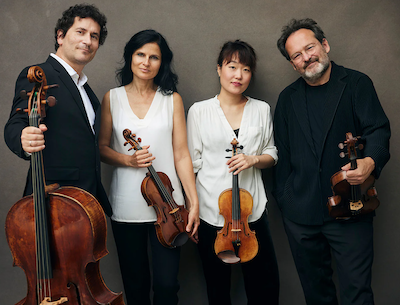
CCMS allowed its patrons some variety by opening its 76th season with a September concert for violin and piano, followed by a bracing program on October 21 from the Belcea Quartet that balanced extreme textures and dissonance with an abundance of sweetness and nuance, while also producing a rich blend and a vast array of articulations.
Those extreme textures were supplied at the outset by Anton Webern’s Five Movements for String Quartet. The first, Heftig bewegt, included legato scratching sounds, pluckings, ponticello — playing close to the bridge — and sudden, random bursts of energy, the second, Sehr langsam, a lyrical viola solo. The third was a heavily accented march that turned into a galop to the finish line, the fourth, Sehr langsam featured slow, sustained lines and a gorgeous first violin solo. The sixth, In zarter Bewegung, ended the suite with mysterious music that faded into nothingness.
Then the Belcea tried to trick the listener into believing that there was a sixth movement by segueing into the Adagio that begins Mozart’s K. 465 quartet and gives it its nickname, ‘Dissonant.’
After that brief introduction, consonance reigned. The opening allegro was nimble and lithe — pure C major. In the Andante Cantabile, the Quartet emphasized the singing qualities of Mozart’s lines, expertly passing off its musical motives over a lovely cello line.
The trio of the Menuetto clearly demonstrated the Belcea’s tendency to lavish attention on every nuance in the music — sometimes at the expense of broader gestures. The finale (Allegro molto) restored the lithe mood of the first movement, offset by heavily accented notes that produced almost fiddling lines. The coda made for a rousing conclusion.
Dissonance and drama returned after intermission with Benjamin Britten’s Quartet No. 2, nominally also in the key of C, but completely unlike the Mozart.
Mysterious music peppered with intense dissonances and quirky slides led to sharp attacks and deft violin playing in the high register. Borrowing a format from Britten’s 17th-century mentor, Henry Purcell, the third movement Chacony, introduced by strong unisons, is a continuous set of variations that lasts as long as the first two movements combined.
After all parties have had the opportunity to contribute at length and exchange material — including some crisp technical passages — Britten ends the Chacony with great, triumphant pillars of major chords decisively played by the Belcea Quartet.
Published on ClevelandClassical.com November 4, 2025.
Click here for a printable copy of this article
