

by Daniel Hathaway
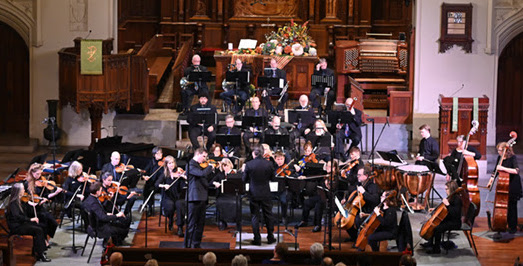 Let’s cut to the chase and simply say that it would be difficult to imagine a more perfect and moving performance of Beethoven’s Violin Concerto than the one David McCarroll gave with Daniel Meyer and BlueWater Chamber Orchestra on Sunday afternoon, November 23 at Rocky River Presbyterian Church. We’ll come back to that thought.
The straight-through performance preceded the Beethoven with works by Cleveland composer Margaret Brouwer and a youngish Aaron Copland.
Brouwer’s engaging and popular The Art of Sailing at Dawn evokes memories of growing up on the Great Lakes. A flute conjures sonic images of gulls, and subtle waves support a lovely oboe solo before the wind kicks up and dark clouds assemble. A storm erupts, but soon passes, leading to a quiet ending.
Meyer led an expansive performance where all the interlocking lines were smoothly passed from player to player and section to section.
Moving indoors, Aaron Copland wrote his Music for the Theatre in 1925, just after he returned from studies in France with Nadia Boulanger, and one year after the premiere of George Gershwin’s Rhapsody in Blue opened the doors of concert music to the influence of jazz.
Not written with a particular play or theatre in mind, the five-movement suite gets right down to business in “Prologue” with a snare drum roll and a trumpet fanfare that introduce a jazzy theme studded with percussion.
“Dance” features bluesy trumpet and clarinet solos and a memorable bassoon lick, while “Interlude” foreshadows the composer’s later work Quiet City with its pensive English horn solo, beautifully played by Martin Neubert.
Introduced by trumpet fanfares, “Burlesque” gave pianist Elizabeth DeMio tricky, jagged rhythms to toss off from the piano on the sidelines.
And in “Epilogue,” chord progressions we’ve come to identify as Americana thanks to Aaron Copland, accompanied fine solos by violist Laura Shuster, concertmaster James Thompson, and bassoonist Phillip Austin.
Conducting with easygoing precision, Meyer kept all of the thorny rhythms under control, allowing the special thematic material of each movement to come through.
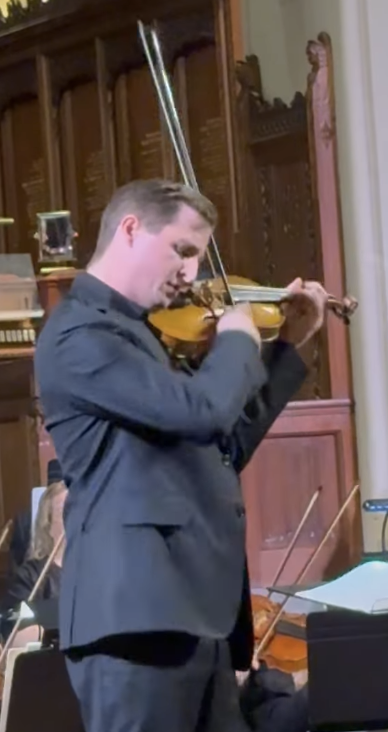 Having proven their mettle as area musicians who have played together for decades, the BlueWater ensemble turned another stylistic page to join Pittsburgh Symphony concertmaster David McCarroll in an epic performance of Beethoven’s Violin Concerto. A violinist of formidable musicianship, he produced a richly-hued tone that sang handsomely out into the sanctuary whether the dynamics were whisper-soft or grandly heroic.
After the striking opening notes by timpanist Hunter Wirt, beautifully balanced wind lines led to McCarroll’s grand entrance and bassoons supported his simple but gorgeous opening lines.
After the Concerto’s lackluster premiere, Beethoven re-arranged it for piano and orchestra and included his own cadenza. Here, McCarroll’s own transcription of that cadenza was heard, which includes a prominent timpani part thrillingly played by Hunter Wirt.
The slow movement featured McCarroll’s remarkable phrasing of long, lyrical lines and beautifully blended strings. The passage with pizzicato strings was heavenly, and after a sweet cadenza, the soloist’s transition into the third movement was thrilling.
McCarroll’s joyful performance of the Rondo was supported by wind calls from the horns, clarinets, and bassoon. A sparkling second theme was introduced in a wonderful duet with bassoonist Phillip Austin.
Under Meyer’s direction, the BWCO sounded superb, and combined with McCarroll’s masterful musicianship — I’ll say it again — it would be difficult to imagine a more perfect and moving performance.
Photos from the November 22 performance at Church of the Covenant.
Published on ClevelandClassical.com November 26, 2025
Click here for a printable copy of this article
