

by Daniel Hathaway
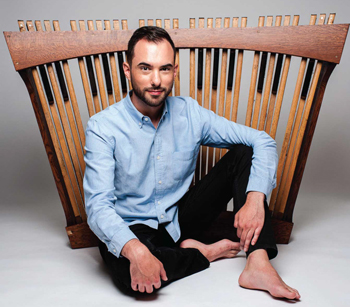
 Organist Christopher Houlihan’s two previous recordings were devoted to music by Maurice Duruflé, Jehan Alain and Louis Vierne — three go-to composers for demonstrating the talents of a young organ virtuoso. His most recent release on Cleveland’s Azica label takes on more dangerous interpretive material: some of the more monumental works of Johann Sebastian Bach, as well as Houlihan’s own arrangement of Bach’s Concerto in the Italian Style.
Performing on the Mather Chapel organ at Trinity College, Hartford, Houlihan manages to show both flair and good taste before he even plays a note of Bach. Adding a beautiful flourish of his own to the beginning of the Fantasia in g, he immediately seizes the listener’s attention. Though his playing is grand and often fiercely virtuosic in the rest of the piece, he never crosses the line into dazzle for dazzle’s sake. The fugue sparkles, then grows to a thunderous conclusion.
Those used to hearing big registrations for the Prelude and Fugue in b will be surprised by the somber approach on this disc. There’s some evidence that these pieces might have been played as prelude and postlude for the funeral of the Electress of Saxony in 1727, and the organist chooses soft registrations that would have fit that occasion. Swells and ebbs in dynamics enliven the prelude. The fugue also begins softly — with tremolo — but grows to a large, reedy plenum as Bach’s winding counterpoint increases in intensity.
The other big pieces are the Toccata, Adagio, and Fugue in C, and the Passacaglia and Fugue in c. He dashes off the Toccata brightly with contrasting registrations for its echoes both in manuals and pedal, adding a little personal flourish at the end. The Adagio is slow and staid, the bridge to the fugue played on an 8’ principal with tremulant and a pregnant decrescendo at the end. Houlihan’s open articulation makes the fugue especially festive, and his choice of the alternate ending (a long C Major chord rather than a dismissive one) brings the piece to a splendid conclusion.
 His registration of the Passacaglia is colorful and subtle. He sneaks the reeds in and out using the swell shades, and backs off from big registrations to let the last of the twenty variations gain in intensity. The fugue clicks right along, Houlihan teasing the theme out of inner voices with reed stops. A big rallentando sets up the Neapolitan chord near the end — a chord he sits on for a long time before adding a tiny cadenza and bringing the piece to an end on full organ.
The organist’s clever arrangement of the Italian Concerto turns this harpsichord piece into quite a different animal. It takes some getting used to, especially the plenum with its galumphing pedal line he chooses for the third movement. It might work better with lighter textures in a drier acoustic.
His performance of the Trio Sonata in G is delightful — clear and piquant with 8’ stops in the pedal for the first two movements. A trumpet stop in one hand and 16’ pedal registers thicken up the last movement, but Houlihan’s playing remains vivacious.
The 1971 Austin instrument in Mather Chapel has French stop names but an American Classical soul. Its variety of timbres provide the performer a lot to work with, and he uses its resources judiciously. Azica gives a fine sense of the sound of the instrument as well as capturing the ambiance of the chapel.
This recording presents a view of Christopher Houlihan’s artistry that should appeal to a broad spectrum of listeners — Bach purists included.
Christopher Houlihan will make two Northeast Ohio appearances this spring: on Sunday, March 19 at 5:00 pm at Christ Presbyterian Church in Canton, and on Sunday, April 23 at 4:00 pm at Stambaugh Auditorium in Youngstown.
Published on ClevelandClassical.com March 15, 2017.
Click here for a printable copy of this article
