

by Timothy Robson
 It was with a sense of relief and anticipation that I attended last Thursday’s third-to-last concert of ChamberFest Cleveland 2021, after a complete pandemic cancellation of its 2020 season. This musical star of Cleveland summers returned along with many performers from past seasons, plus talented younger musicians in CFC’s Rising Star program. As usual, the performances were top-notch.
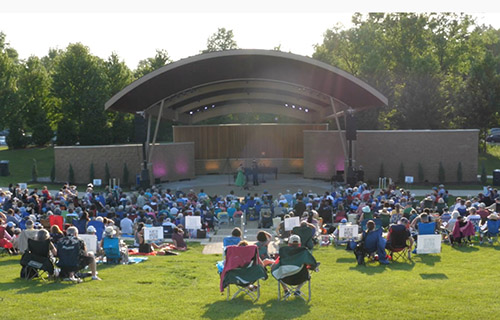
The venue was The Grove, an attractive small amphitheater in Mayfield Village, with the massive Progressive Insurance Company complex standing between the park and I-271. A sloped viewing area reminded one of a mini Blossom Music Center without the pavilion. A large number of birds also gathered in the roof above the stage, singing their sunset songs to accompany the music.
Sterling Elliott, cello, and Roman Rabinovich, piano, opened the concert with Ludwig van Beethoven’s 1801 Variations on “Bei Männern welche Liebe fühlen” from The Magic Flute. Making his CFC solo debut at this concert, Elliott is a student at the Juilliard School and one of this year’s ChamberFest Rising Stars. His biography already lists a significant number of important performances and collaborators. His is a career that should be followed.
Mozart’s melody appears at the beginning and then again close to the end of the work — in the intervening variations it is disguised in figurations and filigree in both cello and piano. The central slow variation is in E-flat minor, contrasting with the jollity of the other virtuosic major-key variations. Rabinovich was an excellent partner for Elliott — their phrasing and coordination were elegant.
Bedřich Smetana’s Piano Trio in g, Op. 15 was given a powerful reading by three CFC stalwarts: violinist Yura Lee, cellist Julie Albers, and the hard-working Rabinovich. The three movements were often dominated by Lee’s highly dramatic playing, although that may have been the result of amplification. Others may have had a different sonic experience. The cello seemed to carry the more lyrical music. The second movement alternated between sinister music and passages in a sunny major. The finale was a fierce, virtuosic tarantella, again alternating with beautifully lyrical passages.
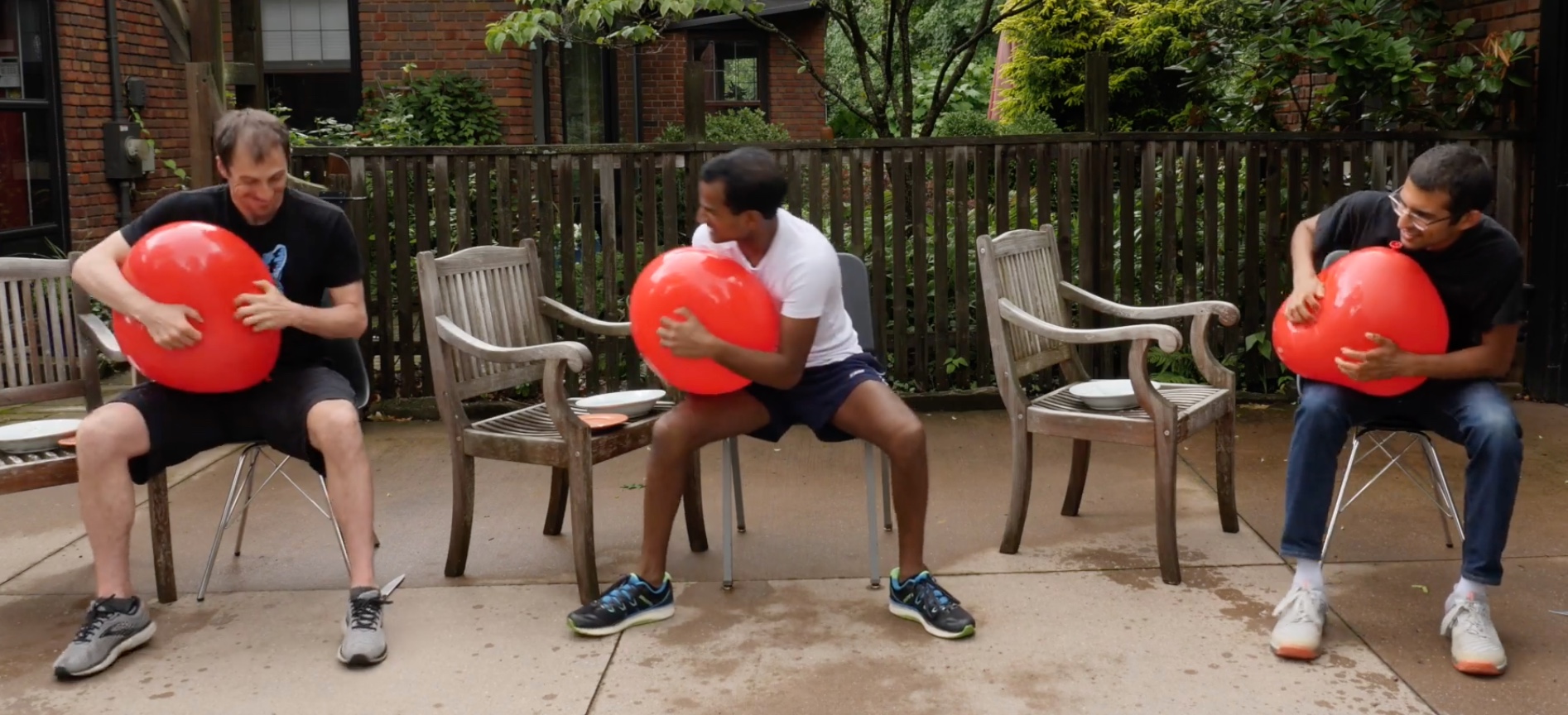 Rolf Wallin’s Scratch for three amplified balloons, lasting about five minutes, was a delightful change of pace. Alexander Cohen, Jeremy Sreejayan, and Zubin Hathi were identified as percussionists — calling them balloonists might have confused the issue. Each player, seated, had a very large inflated red balloon and a saucer of water on a small table beside them. Wallin’s work has no score — the performance instructions are passed along by oral history. The action and “music” are highly choreographed, with the performers assuming unusual poses during pauses in the performance.
Each performer sprinkled and splashed water, baptism-like, on his balloon to make scratches, squeaks, and other unexpected sounds while massaging what might have been the pregnant belly of a mom-to-be. Toward the end, each player revealed a very large carving knife, and slowly, in unison, they brought the knives closer and closer to their still-inflated balloons. Just before the dramatic denouement, the three players froze in place, and the piece ended to uproarious laughter and applause from the audience.
Felix Mendelssohn’s String Quintet No. 2 in B-flat, Op. 87 closed the program. Rising Star violinist Nathan Meltzer joined Diana Cohen, violists Yura Lee and Ayana Kozusa, and cellist Sterling Elliott. The four movements were standard Mendelssohn. The first was an Allegro romp, followed by an “Andante scherzando” that mixed light, often pizzicato passages with the charm of a minuet. The “Adagio e lento” was dramatic, especially the significant first violin solo over accompanying tremolo passages. The devil-may-care fourth movement featured a maximum variety of texture in the five instruments.
And yet in the end I felt disappointed. The two-hour program of heavy-duty 19th-century European music (plus a short new work by Norwegian Rolf Wallin added to the program at the last minute) seemed dissonant with the sultry outdoor location. It was the musical equivalent of being served a cassoulet for dinner on a hot day, when a salad would have been preferable. The amplification did not serve the musical detail well enough, creating musical balances that were askew.
Published on ClevelandClassical.com June 30, 2021.
Click here for a printable copy of this article
