



by Daniel Hathaway
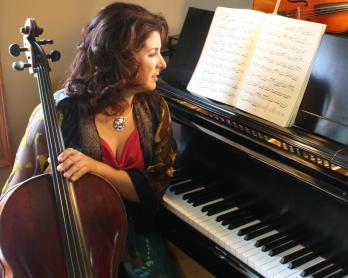 On the eve of Holocaust Remembrance Day, CIM faculty cellist Melissa Kraut joined her sister, clarinetist Rena Kraut, in Mixon Hall to share a family album of photos, remembrances, and music chronicling the journey of their forebears from Rzeszów in Nazi-occupied Poland to Palestine and Israel, and finally to the United States. Assisted by faculty pianist Anita Pontremoli, the Kraut sisters presented a moving timeline titled “From the Shtetl to the Concert Stage: The Thread that Sustained Music through the Holocaust” (Shtetl is Yiddish for “village.”)
The Holocaust is so massive and difficult to imagine that it can seem like an abstraction to those who were not directly touched by the atrocities of the Nazis. Programs like this one bring the experience onto a personal level that nearly everyone can relate to, and touching details gain special significance. For example, the Krauts’ presentation also coincided with the 73rd anniversary of the liberation of Auschwitz, but how many of us knew that unlike the suddenly freed prisoners at other camps, once the gates were unshackled the Auschwitz inmates were simply left to find their own way home?
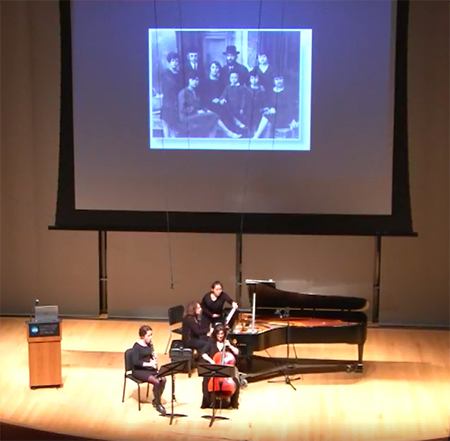
Most of the music the Krauts chose to accompany their family history was folk-based. Arrangements and medleys of traditional Hebrew tunes — Mabel Tov, Shalom Alecheim, Rosinkes mit Mandalach — reflected life in small Polish villages, many of which simply vanished with their Jewish population. It was also a world of amateur musicians. At one point, Melissa Kraut recalled asking her mother about her violinist grandfather. “He wasn’t a violinist,” she replied, “he was a fiddler — like on the roof!”
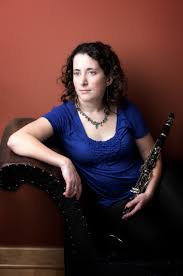 Klezmer music figured importantly in the family history, a subject Rena Kraut noted that she had to investigate in order to play several selections on Friday in which the clarinet takes a prima donna role, including Joachim Stutchewsky’s The Hassadic Trio.
Rena was supposed to become a violinist, but Melissa said that when the family had finally settled in a Chicago suburb, her sister had grown tired of the instrument and only practiced in the back seat of the car on the way to music lessons. “Then we threw her a clarinet and things went better.” Better indeed. Rena Kraut now teaches clarinet at Gustavus Adolphus College and at the St. Paul Conservatory in the Twin Cities.
Toward the end of Friday’s program, Melissa Kraut invited three of her cello students onstage. Hannah Moses, Eliza Fath, and Joseph Teeter joined her for a sonorous performance of Bach’s “Little’ G-minor Fugue. The trio ended the short program ended with Ofer Ben Amots’ evocative Ancient Dances.
Watch CIM’s video of the concert here.
Published on ClevelandClassical.com February 14, 2018.
Click here for a printable copy of this article
