



by Kevin McLaughlin
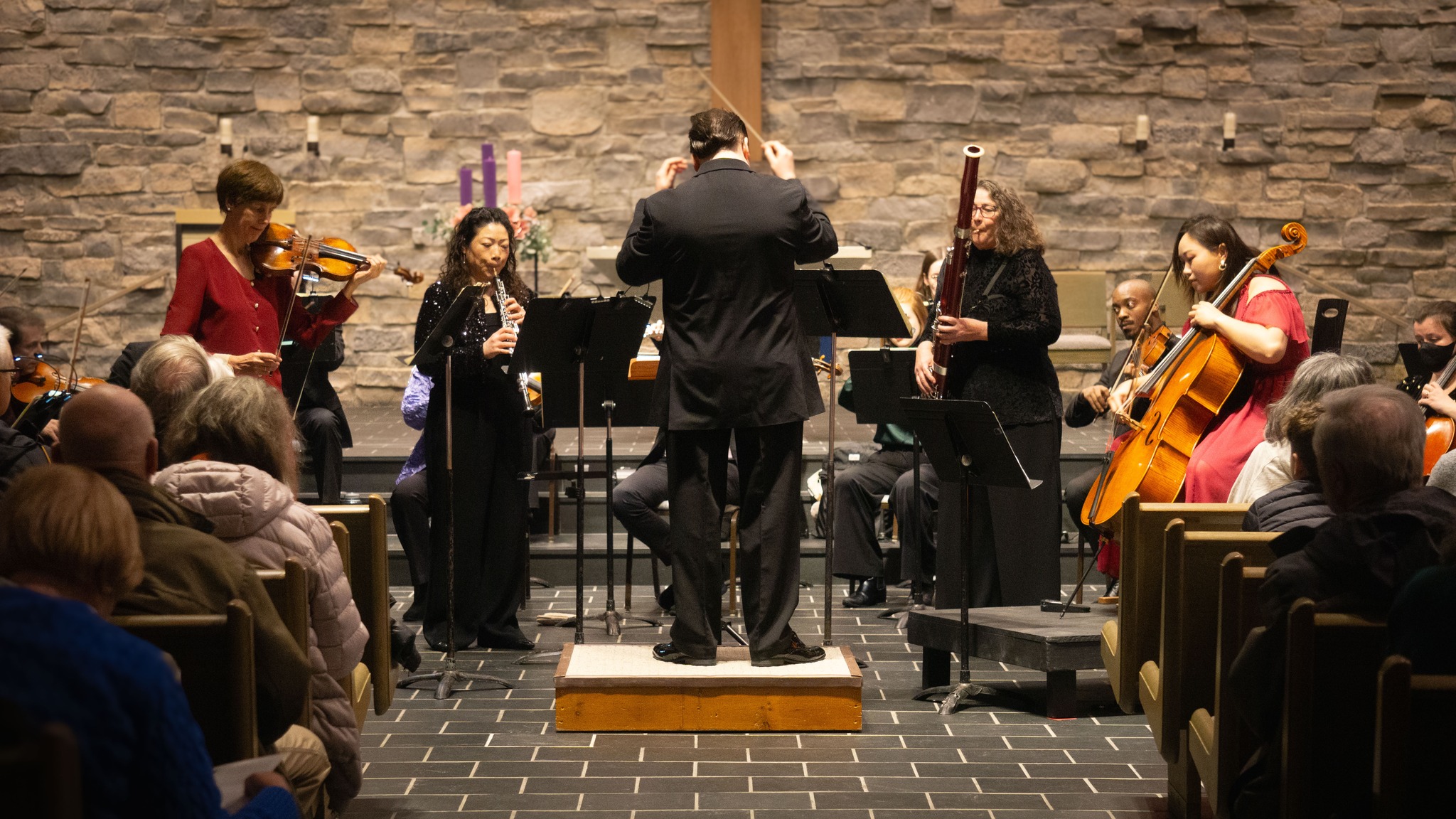 “We love coming here!” CityMusic Cleveland’s managing director Henry Peyrebrune said in his opening remarks on Friday at St. Noel Catholic Church. Open and modern and warmly lit, St. Noel proved a welcoming setting for December 5th’s well-attended concert. Many pews had been claimed early, and finding a seat required a bit of roaming. As always with CityMusic, admission was free, with only a suggested ticket price and friendly greeters at the door.
The program, titled Three Eras, One Conversation (although I only counted two) traced a through-line from Mozart to Haydn to Stravinsky, with conductor James Feddeck clarifying the connections across style and time.
Mozart’s Symphony No. 29 is familiar, tuneful, and clever — qualities that Feddeck and the players brought into comfortable focus. The pert falling octave that opens the “Allegro moderato” and recurs as a motivic anchor of the movement, set the tone for a reading that was both directional and elegantly proportioned. Only a couple of errant horn notes broke the surface — forgivable given Mozart’s sudden high writing and the period-style honesty of the ensemble.
The “Andante” was shapely and quietly radiant, in the way Mozart so often is. The “Menuetto” had lift and courtly poise, its Trio offering a well-contrasted release. And the “Finale,” taken at a lively pace, was efficient, cleanly articulated, and impressively balanced. The program notes reminded us that Mozart was a violist, and the inner lines indeed carried special life throughout. Feddeck’s leadership here was notable for its clarity and pacing — everything was well shaped.
The centerpiece was Haydn’s Sinfonia Concertante in B-flat, a work that blends the rhetoric of the symphony and the concerto while spotlighting a quartet of soloists: violinist Laura Hamilton, cellist Mingyao Zhao, oboist Virginia Kao, and bassoonist Sue Barber. Their interplay was generous and collegial.
Hamilton and Zhao engaged in what felt like a friendly competition during the group cadenzas — they made showing-off a virtue, then yielded to each other with graceful reciprocity. Zhao is an eloquent cellist who deserves many more solo opportunities at these concerts. Kao brought a lovely oboe tone and unfailing taste, while Barber handled one tricky turn after another with disarming ease. Feddeck kept the ensemble responsive and light on its feet, shaping a performance that was both elegant and sociable.
Stravinsky’s Concerto in E-flat, “Dumbarton Oaks” (1938), marked a decisive stylistic turn. Modeled on Bach’s Brandenburg Concerto No. 3, yet unmistakably Stravinskian, the piece is all motion: rhythmic feints, darting lines, and a language that can resemble a windup toy scooting around a tabletop — fascinating to follow, until it simply stops.
Feddeck led a patient, witty, and unforced performance, allowing the work’s intricate counterpoint to register without heaviness. Daniel McKelway, clarinet, and Laura Gilbert, flute, sparred and parried like an old married couple, with Stravinskian snap. The ensemble handled the concerto’s perpetual-motion surfaces with nimble clarity and lean, bright textures. In the process, they seemed to transform into a lithe baroque-folk band. Aha, a third era, giving off faint whiffs of mahogany and catgut.
The audience was as pleased as could be. A standing ovation followed, and the narthex buzzed with animated conversation as listeners filed out. CityMusic’s commitment to free, community-centered concerts continues to draw large, engaged audiences throughout the city, and Friday’s performance showed why: strong repertoire choices, thoughtful leadership, and polished playing that suits any era.
Published on ClevelandClassical.com on December 10, 2025
Click here for a printable copy of this article
