


by Mike Telin
 The creation of new opera is a passion of Scott Skiba, Cleveland Opera Theater’s executive artistic director. And earlier this month Skiba and his company brought that passion to life during the third annual {New Opera Works Festival}, which was held at Baldwin Wallace Conservatory from February 4 through February 9. From the beginning, {NOW} has included partnerships with area music institutions — this year’s the Festival involved collaborations with Baldwin Wallace, Bowling Green State University, the Cleveland Composers Guild, Hiram College, and Oberlin.
New to the festival was the incorporation of an American Futures Residency, which brought composers Jake Heggie and Griffin Candey, and soprano Ann Moss to the BW campus to work and collaborate with conservatory students. All Festival activities were free and open to the public.
While the 2019 edition brought the most expansive agenda of workshops, performances, and talk-back sessions to date, at its heart, {NOW} was about the development and ultimately the premiere of new opera by way of Griffin Candey’s The House of Bernarda Alba with libretto by Obie Award-winner Caridad Svich.
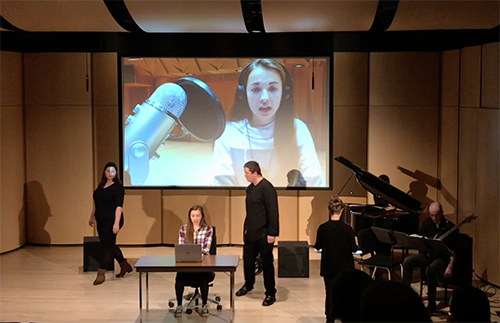 During the Festival’s inaugural year there was a public reading of Spanish dramatist Federico García Lorca’s final play. The second year centered around a reading of Svich’s libretto, and this year brought a workshop reading of scenes with piano accompaniment from Acts I and II. The 2020 Festival will include the opera’s premiere. The work is a co-commission between Cleveland Opera Theater and the BW Conservatory.
In an interview with ClevelandClassical.com Candey said that having four years to develop the opera is “really luxurious.” He added that he appreciates Cleveland Opera Theater’s focus on the development of the libretto. He pointed out that “one of the issues with new opera is not that the music is bad, but that the librettos have a lot of clunky moments where things don’t flow or gel in the story. It’s nice having the extra time to read the source materials and ask people what characters they connect with.”
 The plot of Lorca’s tragic play is centered on the Alba family. After the death of their mining-mogul father, the five daughters have been called home by their mother to begin an eight-year mourning period, during which time the daughters are prohibited from engaging in any relationship, causing tensions to rise.
What I heard on Friday, February 8 in Gamble Auditorium was riveting. Candey is a natural at composing for the voice — the libretto is both in English and Spanish. The opening chorus, a Requiem, was beautiful. In Act II Scene I, the conversation between the four daughters was truly touching. Candey’s music for the title character makes her a force to be reckoned with, and mezzo-soprano Nancy Maultsby played her to the hilt.
It’s always difficult to imagine what the music will sound like once orchestrated, but Candey told the audience during a talk-back-session that he’s planning on writing for a Britten chamber ensemble à la The Turn of the Screw.
In addition to Maultsby, the all-female cast included Joanne Uniatowski (LaPoncia), Anissa Clay (Adela), Sabina Balsamo (Angiustas), Sarah Antell (Martirio), Olivia Beal (Amelia), Ciara Newman (Magdalena), Nanette Canfield (María Josefa) and Kailyn Martino (Kitchen Maid).
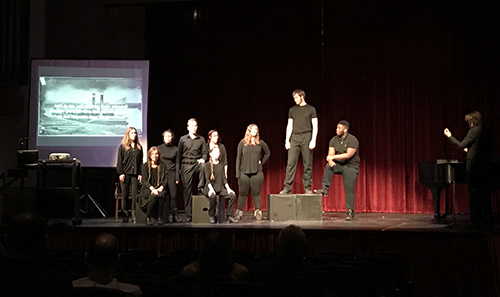 This year {NOW} introduced a second opera in development, Dawn Sonntag’s Coal Creek, based on the crossroads of cultures in a remote town in Alaska. On February 10, also in Gamble Auditorium, there was a staged workshop performance of scenes from Acts I and III with chamber ensemble, and what I heard was stunning. I was completely taken with Sonntag’s opera Verlorene Heimat (“Lost Homeland”), which was presented during the 2018 {NOW}, and Coal Creek promises to be its artistic equal. Already her music — which wonderfully evokes the Pacific Northwest — serves the libretto wonderfully, enhancing each character’s personality. And those characters are well on their way to being fully developed.
The opera is inspired by Sonntag’s personal experience as a three-time participant in the Alaska Geographic field course, where she joined eight other composers in Denali National Park.
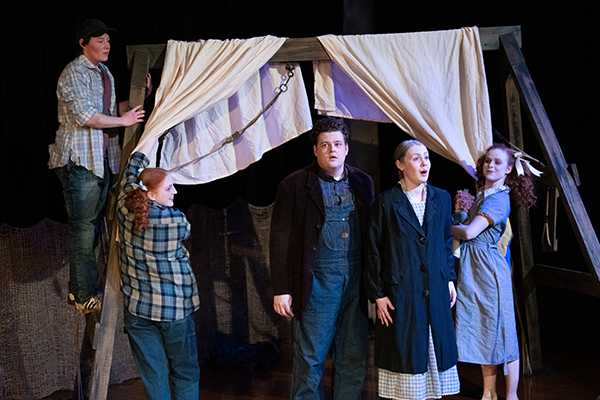 {NOW}’19 kicked off on February 4 in Wilder Main Lounge on the Oberlin College campus with an Oberlin Winter Term Opera performance of Missy Mazzoli’s Proving Up. Directed by Christopher Mirto, the opera tells a haunting tale of a family’s pursuit of the American Dream in the shadow of Civil War Nebraska. Cleveland Opera Theater hosted a post-performance talkback and reception with Mazzoli and librettist Royce Vavrek. Read a review here.
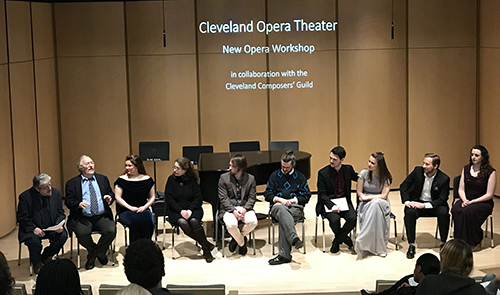 The Festival continued its partnership with the Cleveland Composers Guild on February 9 with performances that featured excerpts from Margi Griebling-Haigh’s The White Trout, Ryan Charles Ramer’s The Divorce Box, Jeffrey Quick’s Little White Hen, and Robert Rollin’s The Only Jealousy of Emer.
A first-time collaborator was Bowling Green State University’s MicroOpera program. Composed, directed, performed and produced by BGSU students, the February 10 performances included Jon-Luke Martin’s The Bizarre but True Story of the Rusty Hammer Donut, excerpts from Adam Har-zvi’s The Wanderer, the Guide, and the Beasts of the Mind, Jesse Diener’s Bennett’s Need, and Nadine Foley’s Stream of Consciousness.
The inclusion of an American Futures Residency provided audiences with the terrific opportunity to hear some spectacular performances of Art Song. Although Jake Heggie is widely known for his operas such as Dead Man Walking and Moby-Dick, he is equally skillful at composing for that more intimate artform. And the terrific soprano Ann Moss proved herself to be an insightful interpreter of his music.
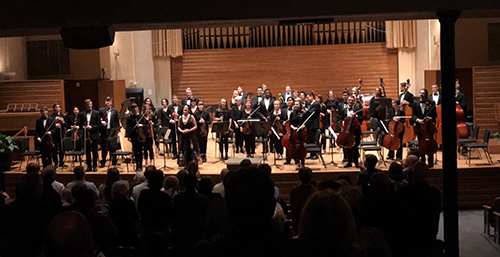 On February 6 in Gamble Auditorium, conductor Soo Han led the BW Symphony Orchestra in the U.S. orchestral premiere of Heggie’s Newer Every Day: Songs for Kiri on poetry by Emily Dickinson. Commissioned by the Ravinia Festival in celebration of Dame Kiri Te Kanawa’s 70th birthday, the work began its life as a song cycle for soprano and piano.
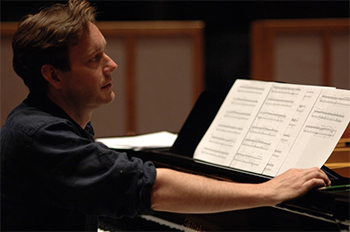 The poems of Dickinson have been a source of inspiration for Heggie’s songs dating back to his teenage years, and it was clear that he has a profound understanding of her poetry — his music vividly captures the words. It is theatrical, but here, in the orchestrated version, was wonderfully full but never overpowering. He creates openings in pillowy clouds for the vocal lines to shine through.
Ann Moss dramatically evoked the serenity of “Silence,” and the playfulness of “I’m nobody! Who are You?” She appropriately laughed in “Fame,” and found melancholy in “That I did always love.” “Goodnight” brought the lovely premiere to a close. Throughout Han and his players were impressive collaborates.
Prior to the concert, Cleveland Opera Theater launched its LGBTQ affinity group with a reception sponsored by PRIZM magazine.
The following evening’s activities began with a memorable recital by Moss with Heggie at the piano.
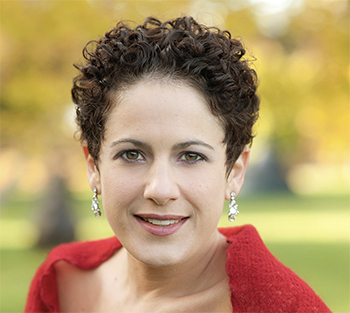 The recital also gave audiences insight into the exceptional songwriting skills of Griffin Candey. Moss began with the world premiere of two excerpts from his Fox Songs (2018) — “Three Foxes by the Edge of the Field at Twilight,” set to poetry by Jane Hirshfield, and “Fox” with poetry by Carl Wilkinson. Moss brilliantly captured the narratives of each of these ethereal works, while Heggie nimbly guided Candey’s music, moving in and out of the vocal lines.
Candey’s reflective side was revealed during two excerpts from Hard Stones, set to the words of Boston-based poet Lisa DeSiro. Written to commemorate the 5th anniversary of the Boston Marathon bombings, “Lockdown” and “Boston Strong,” provide a range of emotions, which Moss delivered with dramatic pathos.
It not often that we get to hear vocalists perform unaccompanied works, but doing so is one of Moss’s new adventures. Singing with a full palette of colors, dynamics, and sounds, her performance of Vartan Aghababian’s An Amethyst Remembrance (2003), set to the poetry of Dickinson, was stunning.
Moss brought a full range of emotions to the world premiere of David Howell’s …What’s happening (2018) for unaccompanied coloratura soprano. Moss described the work as an aural depiction of anxiety, and she brilliantly produced a series of sounds from haunting to screeching to a panic attack from the point of view of a person with autism, until the work’s final words ‘Am I OK,’ bring the journey to conclusion.
Heggie’s From “The Book of Nightmares” (2013) for voice, cello, and piano, brought the hour-long recital to a close. Set to texts by U.S. poet laureate Galway Kinnell, Heggie’s music brings each of the four poems to life. Once again, Moss and Heggie performed with aplomb as did cellist Faith Rohde, who made easy work of her often thorny lines.
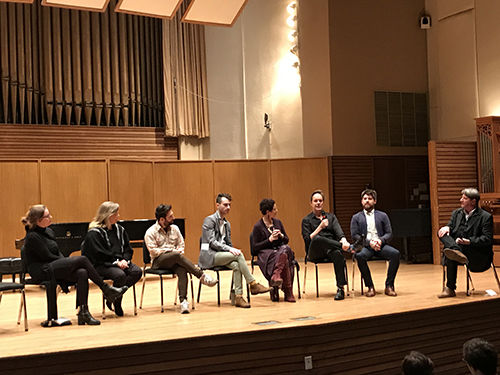 Following a short break, I had the privilege of moderating the New Opera Forum, which included panelists Griffin Candy, Jake Heggie, Ann Moss, Christopher Mirto, Sean Ellis Hussey, Dawn Sonntag, and Ellen Jackson. Conversations addressed the ups and downs of working in opera and the music business.
It takes time for a festival like {NOW}, which focuses as much on the process of creating opera as it does on performances, to find its footing. This year marked a major step forward.
Published on ClevelandClassical.com February 26, 2019.
Click here for a printable copy of this article
