



by Nicholas Stevens
 For all its diversity, Russian music often seems to boil down to a few key figures when it comes to concert programming. Statistics confirm this: in the 2016-2017 season, most of the music written between 1850 and 1969 that American orchestras played was Russian in origin. When Vasily Petrenko appeared with The Cleveland Orchestra last weekend at Blossom, the iconic works on the program by Rachmaninoff and Prokofiev fit that pattern. The power and freshness of the August 11 concert came from its rarity of an opener, its sparkling solo performance, eloquent encore, and shattering symphonic moments.
The program began with a tone poem the length of a pop song, Anatoly Liadov’s Baba-Yaga. Born four years after Tchaikovsky, Liadov completed few large-scale works. Baba-Yaga, named after an evil spirit from Russian folklore, bubbles along with irrepressible energy, sounding a bit like a Russian take on The Sorcerer’s Apprentice, and offering many delights. The flute section excelled at its clever ending.
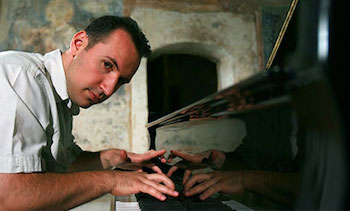
Simon Trpčeski set a solid precedent for the rest of his performance in Rachmaninoff’s Rhapsody on a Theme of Paganini with his very first chord, a bass-heavy roar. As fun to watch as he was to hear, Trpčeski sat nearer the right end of the keyboard than the left, having to twist and lean to reach many of the piece’s tolling bass notes. The soloist maintained a dreamy sense of time and phrasing in slower sections, and conspired with Petrenko to made an inexorably expanding wedge out of the famous 18th variation. As he played the piece’s impish final notes, Trpčeski abruptly stood — a fun and welcome bit of theatre. After an enthusiastic ovation, he gave the crowd Mendelssohn’s Song Without Words, Op. 30, No. 6. Rendered in simple, elegant, and transparent fashion, it felt like the perfect palate-cleanser between the heavier fare on either side.
The serene opening of Prokofiev’s Symphony No. 5 unfolded against a sonic backdrop of insects’ chirps, but given Petrenko’s penchant for sudden turns toward high-volume peaks, the mood of tranquility was bound to break before long. Prokofiev’s fifth has many moments of darkness, but Petrenko and the Clevelanders colored the first movement with especially somber hues. Prominent rumblings in the low register, courtesy of pianist Joela Jones and contrabassoonist Jonathan Sherwin, registered as warnings. Petrenko approached the end of the movement as though pushing a massive, heavy door closed.
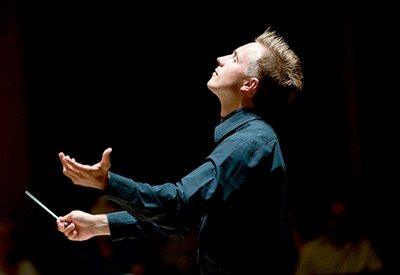 The trumpets allowed their tone to fray and fracture during a low passage in the second movement, a brave and compelling choice. In the third, Petrenko kept a lid on even the most expressive melodic moments, leaving space for the finale to bring catharsis. The violins handled a major tune with a soft but powerful touch. From the understated first few bars to the thrill ride of the conclusion — high-octane yet high-definition — the Orchestra’s performance of the fourth movement surged toward the inevitable. For Prokofiev, living in the Soviet Union in 1944, that was a vexed concept that nonetheless contained a kernel of hope.
Published on ClevelandClassical.com August 20, 2018.
Click here for a printable copy of this article
