



by Daniel Hathaway
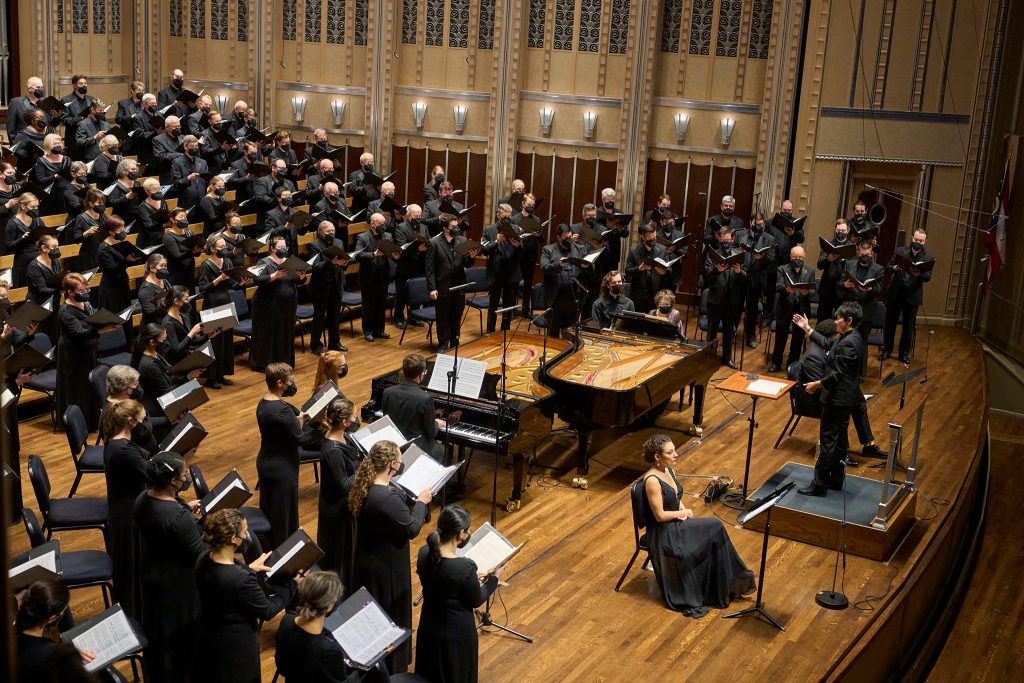 Like the exiles in The Book of Isaiah who returned rejoicing to Zion, the Cleveland Orchestra Chorus jubilantly revisited Severance Music Center, the scene of many past triumphs, on Thursday evening, October 28. Chorus director Lisa Wong was on the podium, Johannes Brahms’ Ein Deutsches Requiem was in singers’ hands and on their lips, a pair of Steinways manned by Carolyn Warner and Daniel Overly sat dovetailed at center-stage, and a near-capacity audience witnessed the homecoming.
Had the Chorus been missed during its many months of silence? You bet it had. A thunderous welcome greeted the 120-some singers as they smartly filed onstage, to be matched at the other end of the evening by a warm and lengthy ovation for a job well done.
Unlike the famous Requiems by Mozart, Verdi, and Fauré, this non-liturgical and non-operatic work by Brahms is more of a humanistic cantata, bringing scriptural messages of comfort and consolation to those who mourn, while fully acknowledging the transitory nature of existence.
All flesh is as grass, and all the glory of man as the flower of grass.
The grass withers, and the flower thereof fadeth away.
Wong shaped a sensitive, yet powerful performance with impressive dynamic contrasts. While the Chorus’ opening words were barely audible but exquisitely supported (Selig sind, die da Leid tragen), the fugue subject that announces the return of the redeemed (Die Erlöseten des Herrn) was strong and confident. Drawing lovely, blended, and vibratoless tone from her singers, Wong made you forget that face masks might be making it difficult to enunciate and project.
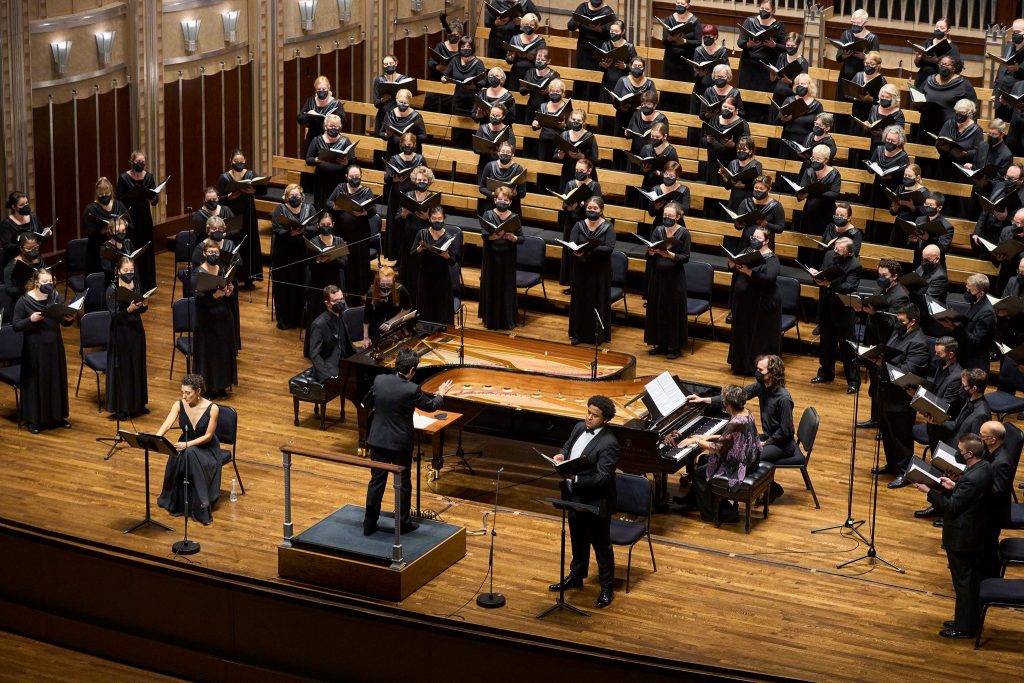 The two soloists performed unmasked. Singing with richly-hued timbre, baritone Chris Kenney rivetingly declaimed his two arias. Soprano Andrea Carroll delivered her special message of comfort (Ich will euch trösten wie einen seine Mutter tröstet) in a bright and commanding voice.
Warner and Overly gave the singers warm, colorful support, playing the two-piano version that Brahms himself created — not just for rehearsal purposes, but for use in a concert performance. The wind section or Harmonie that gives much of Brahms’ orchestral music its special character went missing in Thursday evening’s performance (most noticeably in Wie lieblich sind deine Wohnungen), but the piano textures also allowed choral nuances to come across more clearly.
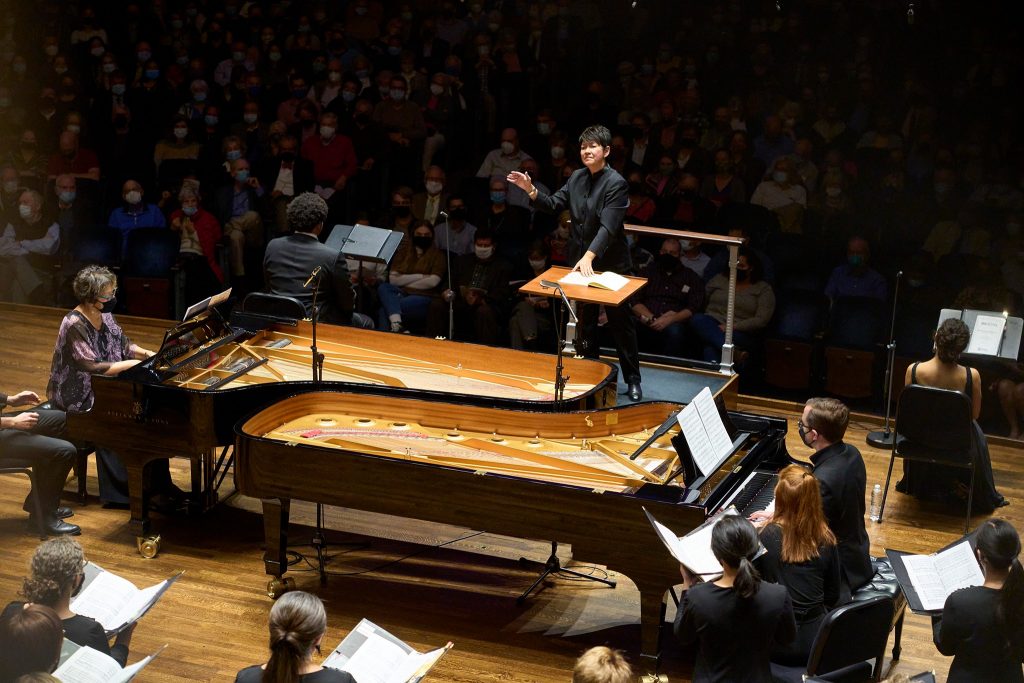 And for once, social distancing actually worked in favor of the music. Spreading the Chorus out over the whole expanse of the Mandel Hall stage let extra air into the performance, giving Brahms more psychological space to make his splendid choral effect.
Photos by Roger Mastroianni courtesy of The Cleveland Orchestra.
Published on ClevelandClassical.com November 10, 2021.
Click here for a printable copy of this article
