

by Kevin McLaughlin
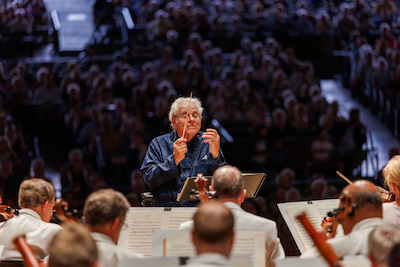 This article was originally published on Cleveland.com
CLEVELAND, Ohio — A standing ovation greeted violinist and conductor Itzhak Perlman as he entered the Blossom Music Center Stage stage in a motorized wheelchair, the first of three accolades he would receive on Thursday evening, July 9. Wearing his familiar smile, he went not to the podium but to a position beside concertmaster Joel Link, where he would both play and conduct the first two works in this all-Beethoven program.
The Cleveland Orchestra has presented eminent soloists in multiple roles before — but Perlman’s appearance, in his 80th year, made Thursday’s concert especially charged.
Conducting is no sideline for Perlman. He has led major orchestras in the United States, Europe, and Israel, and has held formal posts with the Detroit, St. Louis, and Houston symphonies.
Beethoven’s two Romances, written around the turn of the 19th century, belong to composer’s early style. They are compact works — closer to concerto slow movements than showpieces. The G-major Romance opens with the violin alone in slow double stops, and from Perlman’s place on the wide Blossom stage, these first sounds of the night arrived as if the violinist were merely warming up.
No. 1 is the more intimate of the two, but Perlman also gave it quiet radiance. His tone still has unmistakable warmth — rounded, direct, and singing — and each return of the melody came with disarming charm. The F-major Romance, No. 2, offers more emotional depth in its minor-key episodes, although Perlman’s intonation and some passagework occasionally lost focus. The audience answered with a second standing ovation.
After a brief pause, a ramp was brought out, allowing Perlman to motor his way up to the podium (without violin) for the Egmont Overture. He led with economical gestures, and The Cleveland Orchestra mostly understood them, although Beethoven’s slow opening left the drama oddly slack before his final burst of victory music.
The Seventh Symphony, completed in 1812, belongs to one of Beethoven’s most difficult periods, marked by his deepening deafness and the famous letter to the “Immortal Beloved.” Perlman’s reading was taut and ultimately thrilling.
The long introduction to the first movement had breadth, before yielding to a Vivace that owed its brightness and panache to the brass and woodwinds. The Allegretto moved steadily, although sometimes sinking into solemnity. The Scherzo was crisp and buoyant, and the Finale pressed ahead with controlled abandon, building to a frenzy that brought the Blossom crowd to its feet for the third time.
The evening’s pleasure lay in hearing Perlman draw on a lifetime of musical authority, first expressed through the violin, then from the podium, to give Beethoven his due — and the audience one more Itzhak Perlman encounter to remember.
Photo by Kevin Libal
Published on ClevelandClassical.com July 20, 2026
Click here for a printable copy of this article
